
Tech Domains 2026 What Founders and Investors Need to Know

Introduction: Navigating the Expanding Universe of Technology Domains
Twenty years ago, you could say "tech" and everyone knew what you meant. Computers, software, maybe the internet. Today, that simple word covers dozens of specialized worlds. AI, cloud, cybersecurity, biotech, fintech, clean energy tech. Each one has its own language, its own investors, and its own rules.
We call these tech domains. A tech domain is a focused area of innovation that has grown big enough to stand on its own. Think of it as more than just a synonym for technology. It is a complete ecosystem with its own trends, leaders, and funding cycles.
The history of technology stretches back thousands of years, but the pace of change has never been faster. We have gone from the first computers to AI systems that can write code in just a few decades. Looking at technology over the long run helps us see how new domains emerge and why.
For startup founders, picking the right tech domain can define your company’s future. For investors, knowing which domains are gaining traction and which are fading helps you avoid costly mistakes.

This article gives you a practical, data-driven overview of the major tech domains in 2026.
We will cover where each domain stands today, what is driving growth, and how different domains are beginning to converge. Understanding what a tech domain actually means starts with a clear base. You can define technology with this practical framework designed for founders and investors.
If you want to stay ahead of the curve on AI and technology, subscribing to The AI Newsletter Worth Reading delivers clear daily updates straight to your inbox.

In the next sections, we will break down each major tech domain and what it means for your strategy in 2026.
The Foundations of Tech Domain Evolution: From General-Purpose Computing to Specialized Sectors
Before we break down each tech domain individually, it helps to understand how we got here. The first computers were general-purpose machines. They could run any program you gave them, but they were rare, expensive, and mostly used by governments and large universities.
Then something changed. The internet connected everything. Mobile devices put computers in every pocket. And data started exploding in volume. These shifts forced technology to get more specific. One size no longer fit all.
Three main forces drove this specialization.
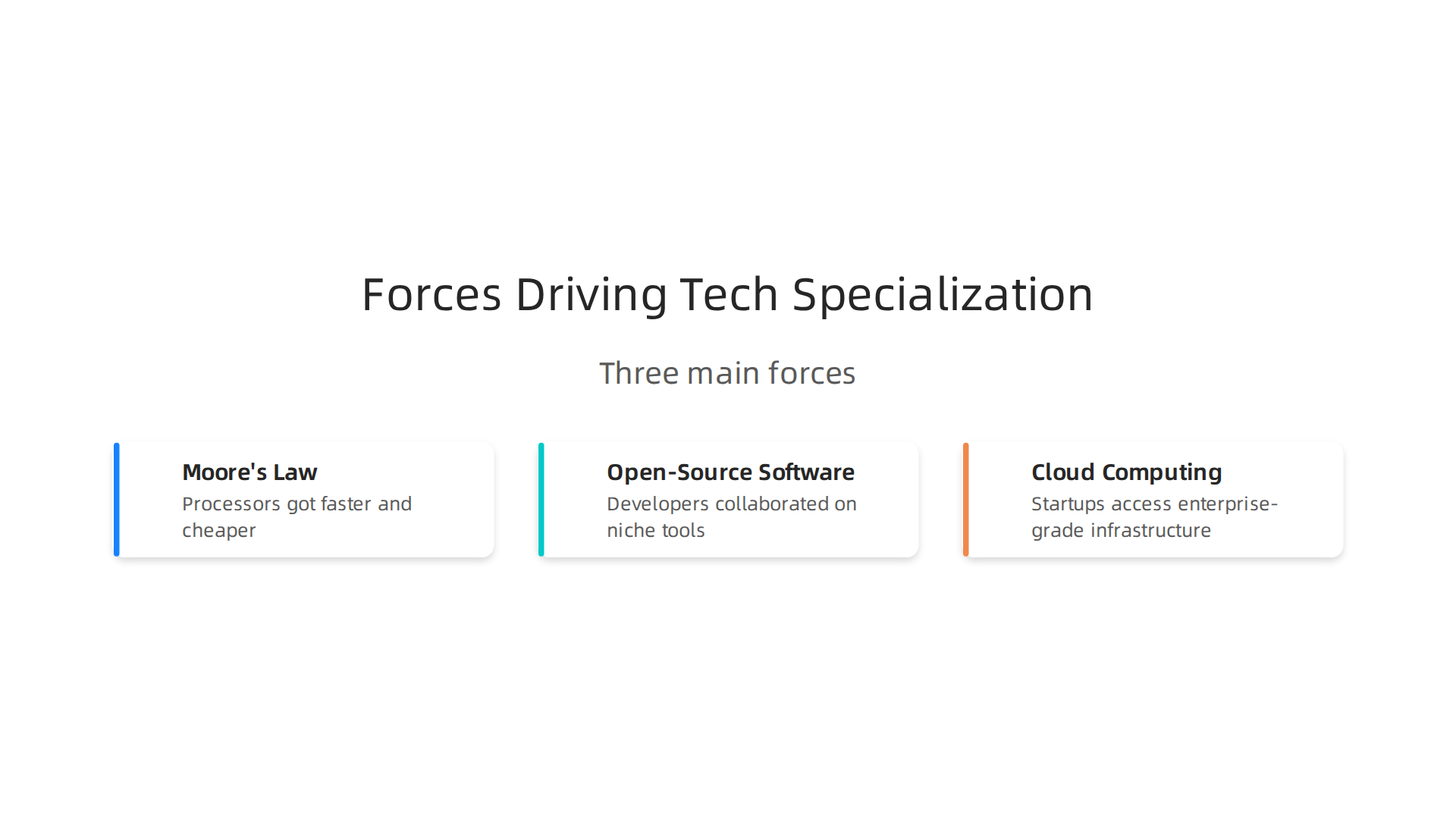
First, Moore’s Law meant processors got faster and cheaper every couple of years. That made it possible to build specialized hardware for specific tasks. Second, open-source software let developers around the world collaborate on niche tools without starting from scratch. Third, cloud computing gave startups access to enterprise-grade infrastructure without needing their own data centers.
Venture capital cycles also played a huge role. Money flowed into promising niches, which attracted more talent, which created better products, which drew even more investment. The artificial intelligence market shows this pattern clearly. Valued at over $600 billion in 2026, AI has grown from a research curiosity into one of the most important tech domains in the world. The Artificial Intelligence (AI) Market Report 2026-2033 projects it could reach $3.6 trillion by 2033.
Understanding these foundations matters for a simple reason. The same forces that created today’s tech domains are still at work. If you can recognize the pattern, you can spot the next domain before it goes mainstream. The history of AI offers a perfect case study of how a general-purpose concept became one of today’s most specialized and valuable sectors.
Domain Deep Dive: Artificial Intelligence & Machine Learning
Let’s start our deep dive with the tech domain that has seen the most explosive growth over the past few years: artificial intelligence and machine learning. AI has moved from a promising niche into the core of how businesses operate, products are built, and decisions are made.
What’s driving this growth in 2026? Three things stand out.
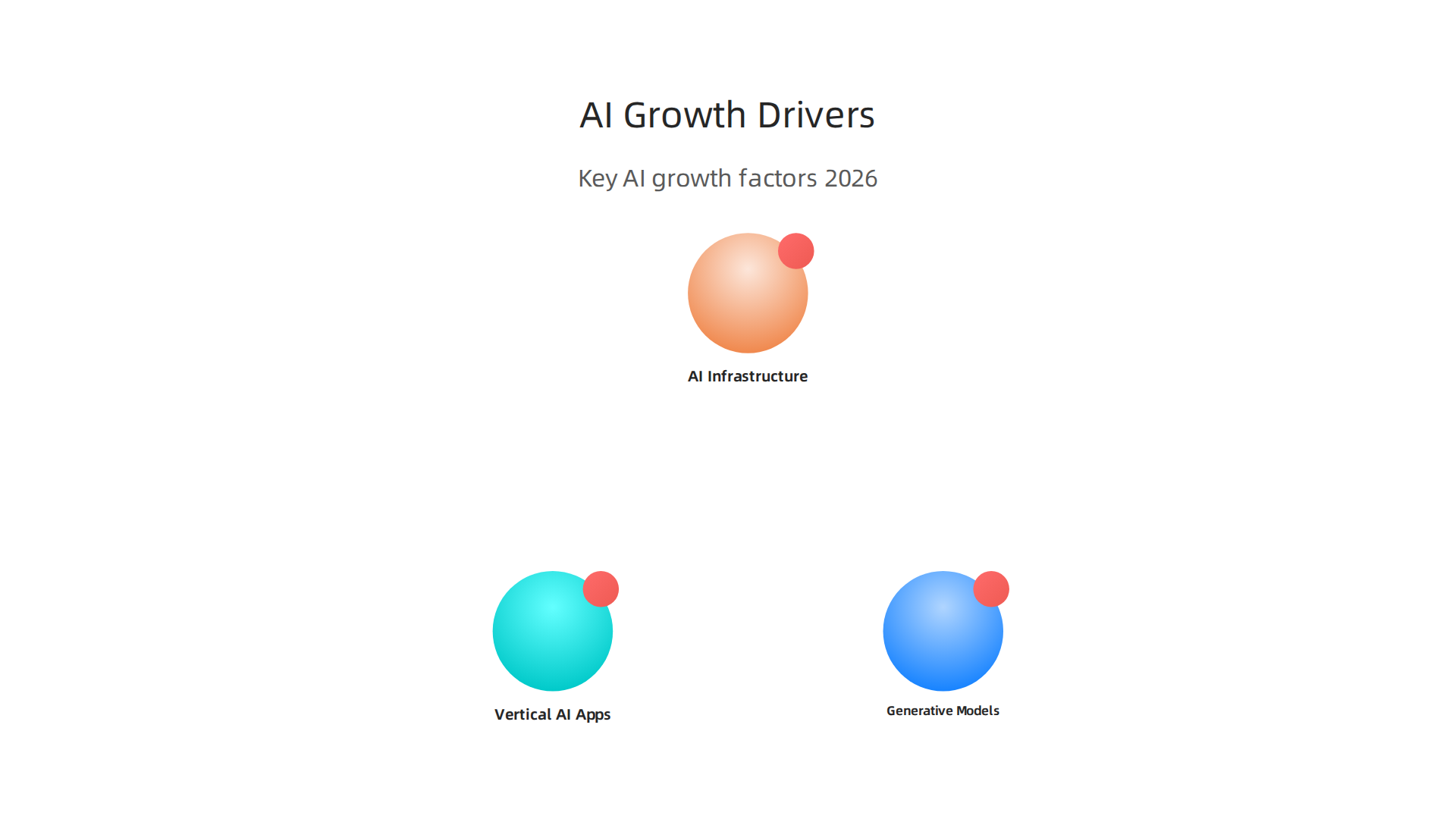
First, generative models and large language models (LLMs) have become mainstream tools. Companies use them to write code, create marketing copy, and even handle customer support. Second, vertical AI applications are popping up everywhere. Instead of one general AI product, we now have AI built specifically for healthcare, legal, finance, and dozens of other industries. Third, AI infrastructure has become a massive business on its own, with cloud providers offering specialized chips and services designed specifically for machine learning workloads.
The numbers back this up. The global artificial intelligence market is projected to grow from over $375 billion in 2026 to nearly $2.5 trillion by 2034, according to the Artificial Intelligence (AI) Market | Global Report 2034. Investment in AI startups hit record levels in 2025 and 2026, with venture capitalists pouring money into everything from foundation models to AI-powered drug discovery. To see how different AI platforms stack up for real business use, check out this AI platforms comparison for startups and enterprises.
Within this tech domain, several key subdomains are worth watching. Natural language processing (NLP) powers chatbots and translation tools. Computer vision helps self-driving cars and medical imaging systems. AI agents are emerging as autonomous helpers that can complete multi-step tasks on their own. And AI infrastructure companies provide the hardware and software that make everything else possible.
For founders and investors trying to navigate this fast-moving space, it helps to have a trusted source of daily updates. If you want to stay ahead of the curve, consider subscribing to The AI Newsletter Worth Reading. It delivers clear, actionable AI news every day without the hype.
We’ll explore the other major tech domains next and see how they compare.
AI Subdomains and Emerging Trends
When you look more closely at the AI landscape in 2026, it’s clear that a few subdomains are quietly stealing the spotlight. Sure, generative AI still grabs the biggest headlines. But two other trends are gaining serious momentum: AI agents and edge AI.
AI agents are autonomous programs that can plan and complete multi-step tasks without constant human help. Think of them as digital assistants that don’t just answer questions but actually take action, like booking flights, managing supply chains, or writing and deploying code. Edge AI, on the other hand, moves AI processing from the cloud onto local devices, like smartphones, cameras, and factory sensors. This makes AI faster, more private, and usable even without an internet connection.
These shifts are happening inside a larger tech domain where major cloud providers are spending on AI capabilities. AWS, Microsoft, and Google are battling for dominance in the Cloud Market Share Q1 2026, and that competition fuels further innovation in AI subdomains.
Regulation is also shaping this evolution. The EU AI Act is the most prominent framework so far, requiring companies to label AI-generated content, assess high-risk systems, and ensure transparency. This creates both hurdles and opportunities for startups, especially those building compliance tools or explainable AI.
Meanwhile, money is flowing toward startups focused on AI safety and model efficiency. Making AI models cheaper to run, harder to misuse, and easier to audit is becoming a priority. For founders and investors wanting to understand the difference between these subdomains, it helps to read about Agentic AI vs Generative AI and how each fits into the larger tech domain.
Domain Deep Dive: Cloud Computing & Edge Infrastructure
While AI is the most exciting tech domain right now, the cloud infrastructure underneath it is where the real action happens. In 2026, cloud computing has grown into a mature and complex tech domain. Companies rarely pick just one provider. Instead, they build hybrid and multi-cloud environments that mix public clouds, private servers, and edge locations. This is creating new challenges for startups deciding where to run their workloads.

It is also driving demand for experts who can manage these scattered systems. You can see how the largest cloud providers compete to serve this new landscape.
At the same time, edge computing has become a critical synonym for technology that needs to react instantly. Instead of sending every bit of data to a central cloud, edge AI processes information right where it is collected, on a factory sensor, a self-driving car, or a security camera. This makes real-time applications like autonomous systems and IoT networks faster and more private. A great example is how startups use edge AI and real world applications to build better mobile security and surveillance.
The money flowing into this space proves it is more than a trend. The cloud computing market is projected to grow from $905 billion in 2026 toward $2.9 trillion by 2034, according to the latest Cloud Computing Market Size report. That is double-digit growth driven entirely by the need for faster, smarter, and more distributed computing.
Get clear daily AI updates from The Deep View Newsletter. Their team cuts through the noise to deliver the AI and infrastructure news that actually matters for your business. If you want to stay ahead in this fast-moving tech domain, The AI Newsletter Worth Reading is a smart starting point.
Key Developments in Cloud and Edge: Hybrid Architectures and Real-Time Computing
The biggest shift happening in this tech domain right now is how companies choose to run their systems. Instead of putting everything with one provider, more enterprises are building hybrid and multi-cloud setups. This means they mix public cloud services with private servers and sometimes edge locations too. Why? Two big reasons: avoiding vendor lock-in and building better resilience. If one provider has an outage, your whole business does not go down with it.
Edge computing is where a lot of the real innovation is happening. Think about a self-driving car. It cannot wait for data to travel to a cloud server and back. It needs to make decisions in milliseconds. That is exactly what edge computing does. It processes data right where it is collected, on a factory sensor, a security camera, or a delivery drone. More companies are using edge for AI inference, running trained models directly on devices instead of in a remote data center. This makes applications faster, more private, and more reliable. You can see how one startup uses edge AI to build better mobile security in the LiveView Technologies funding story.
This trend is pulling in serious investor money. Venture capital firms are pouring funding into edge-native startups that build hardware, software, and networking tools for distributed computing. The security challenges in these scattered environments are also creating demand for stronger protection. The Google Cybersecurity Forecast highlights how threat actors are using AI to speed up attacks, which makes securing hybrid cloud and edge setups even more urgent for companies that depend on real-time data processing.
Domain Deep Dive: Cybersecurity & Trust Architecture
If the hybrid cloud and edge worlds are expanding fast, so are the doors for attackers. That is why cybersecurity has turned into one of the most critical tech domain priorities of 2026. Companies are not just adding security as an afterthought anymore. They are rebuilding their entire approach to trust.
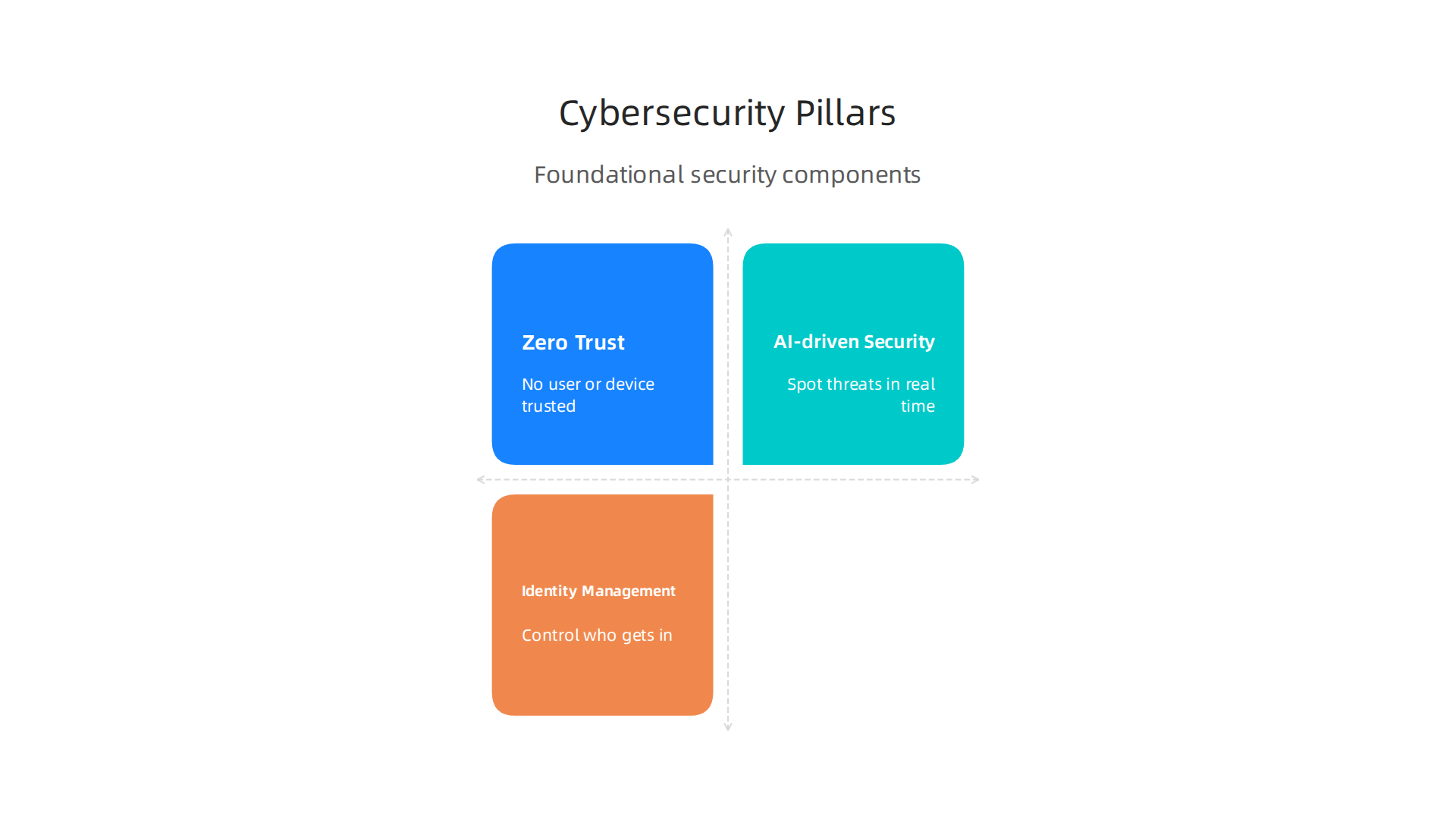
The old model of a secure perimeter is dead. Today, the standard is Zero Trust architecture. This means no user or device is trusted by default, even if they are already inside the network. Every access request gets verified. Every connection gets checked. Alongside Zero Trust, two other areas are growing fast: AI-driven security tools that spot threats in real time and modern identity management systems that control who gets in and what they can do.
The numbers back up the urgency. Global cybersecurity spending is on track to hit well over $250 billion in 2026. Reports show the market could climb past $306 billion this year alone, with projections for continued double-digit growth through the next decade. You can dig into the latest data in the Official 2026 Cybersecurity Market Report.
Attackers are getting faster using AI, which means defenders have to get faster too.
For anyone building a startup or investing in one, this tech domain is impossible to ignore. Understanding the synonym for technology that fits here is about recognizing that security is not a feature. It is the foundation. If you want to stay sharp on how AI is reshaping security and the broader tech landscape, The AI Newsletter Worth Reading delivers clear daily updates straight to your inbox. And if you are curious about how tech authority has evolved around security concepts, check out this piece on how AI understands synonym for technology beyond simple keywords.
Emerging Threats and Solutions in Cybersecurity
While Zero Trust and AI security tools build a stronger foundation, the threats themselves keep evolving too. Ransomware is still one of the biggest dangers companies face in 2026. Attackers are not just locking up files anymore. They steal data first and then demand payment to keep it private. Supply chain attacks are also common. Bad actors find one weak vendor and use that opening to reach bigger targets across the whole network.
Here is the thing that surprises most people. AI-generated phishing has become incredibly hard to spot. These emails use perfect language and personal details pulled from real sources. They look exactly like messages from a boss or a trusted partner. That is why the tech domain of cybersecurity has to keep reinventing itself faster than the attackers can adapt. Even regulated industries like digital healthcare, where patient data is extremely sensitive according to recent digital healthcare industry trends, face growing threats.
The good news is that solutions are keeping pace. AI-driven threat detection tools can catch unusual behavior in seconds before damage spreads. Zero Trust Network Access, or ZTNA, makes sure users only see the systems they really need and nothing more. And quantum-safe cryptography is being built now to protect sensitive data against future attacks from powerful quantum computers. Startups building in these areas are catching serious attention from venture capitalists. One real example of innovation is edge AI mobile security solutions, which show how security is moving closer to where the data lives.
For founders and investors, paying attention to this synonym for technology shift matters. The startups that solve these hard security problems today will be the ones leading the market tomorrow. If you want to follow how AI is changing security and every other area of tech, The AI Newsletter Worth Reading brings you clear daily updates straight to your inbox.

Domain Deep Dive: Biotechnology & Health Tech
Another tech domain where AI and data science are making a huge impact is biotechnology and health tech. In 2026, these fields are merging faster than ever, creating entirely new subdomains that were science fiction just a few years ago.
Think about what is happening right now. Digital therapeutics are becoming real treatments that doctors actually prescribe. These are software programs that help manage conditions like anxiety, chronic pain, and even type 2 diabetes. AI-driven drug discovery is cutting the time it takes to find new medicines from years down to months. And personalized medicine is moving from a buzzword to a reality. Your genetic makeup, your lifestyle, and your environment all get factored into treatments designed just for you.
The numbers tell the same story. The global digital health market is on a strong growth path. One recent analysis puts the digital health market size forecast at over 1.1 trillion dollars by 2035. That kind of growth does not happen without deep investor confidence.
What makes this tech authority so attractive to founders and investors? A few things stand out:
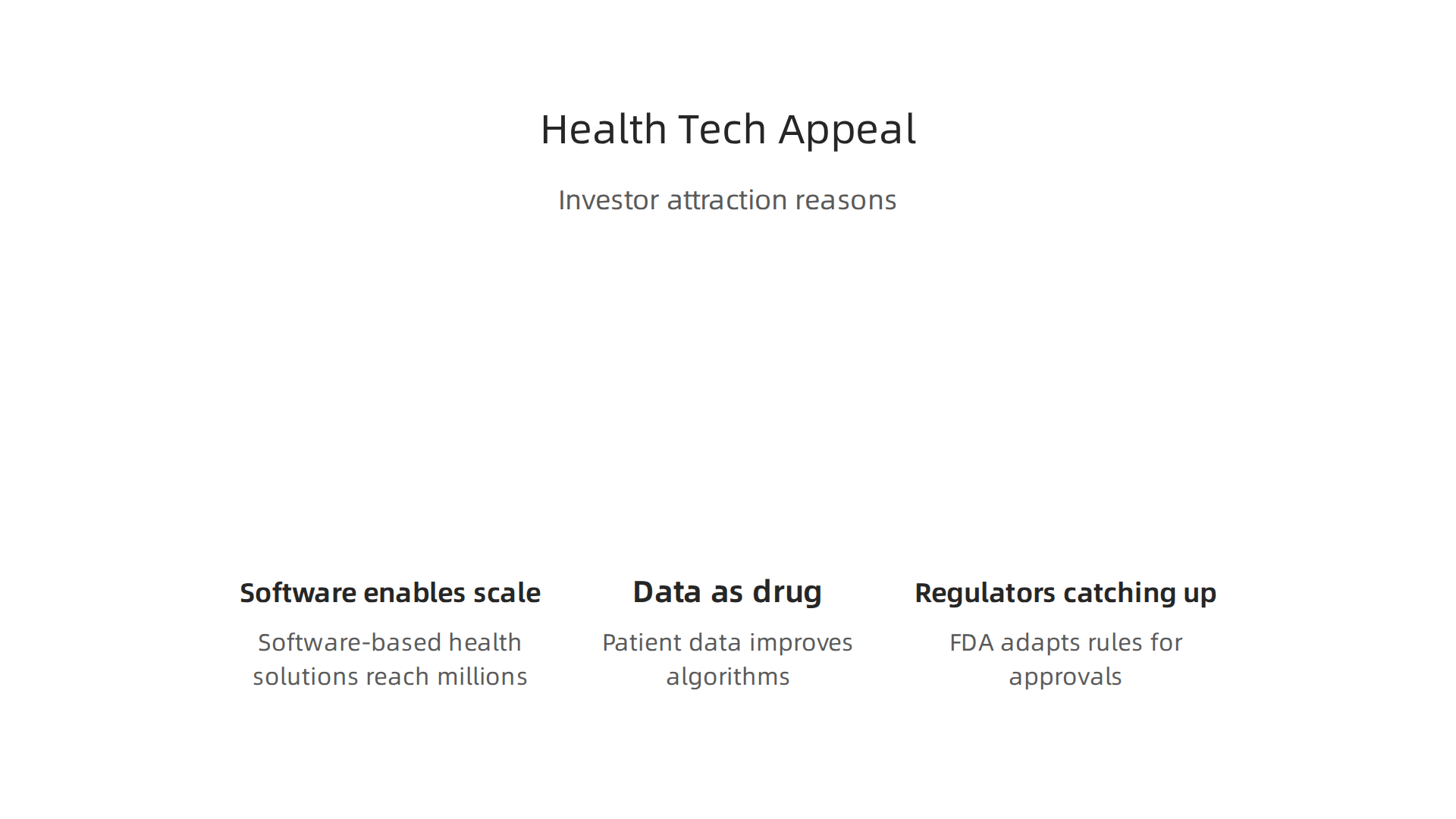
- Software enables scale. Unlike traditional biotech that relies on expensive labs and long trials, software-based health solutions can reach millions of users quickly.
- Data is the new drug. The more patient data these platforms collect, the better their algorithms become. This creates a powerful moat over time.
- Regulators are catching up. The FDA and other agencies are adapting their rules to approve digital treatments faster.
For anyone trying to understand where the next big opportunities in the synonym for technology space will appear, health tech is impossible to ignore. The startups building software-first solutions for real medical problems are getting serious attention from venture capital. If you want to see how innovation spreads across different industries, reading about disruptive innovation in 2026 can show you patterns that apply across biotech and beyond.
Innovations to Watch in Biotech and Health Tech
So what specific innovations in this tech domain are worth tracking in 2026? A few stand out because they are already changing how medicine works today.
First, AI models are speeding up drug discovery in a big way. What used to take years in a lab can now happen in months.

Machine learning algorithms analyze millions of chemical compounds, predict which ones will work safely, and even suggest new molecules that human researchers might never have considered. The result is faster, cheaper drug development that gets treatments to patients sooner.
Second, wearables and remote monitoring devices are becoming essential tools for clinical trials. Instead of bringing patients into a clinic for every checkup, researchers collect real world data from smartwatches, continuous glucose monitors, and smart rings. This data is more natural and often more accurate than readings taken in a sterile hospital room. It also makes trials more accessible to diverse populations who cannot easily travel to research centers.
Third, regulatory pathways are finally evolving. The FDA and other agencies have created faster approval routes for digital health products. This matters because it gives startups a clearer path to market with less uncertainty. Companies no longer have to guess whether their software based treatment will get approved.
These trends all connect through technology convergence. As the World Economic Forum has noted, technology convergence is redefining competitive advantage across industries, and health tech is a perfect example. When AI, wearables, and smart regulation come together, the result is better medicine delivered faster.
If you want to track how AI is reshaping biotech and other industries, staying informed on the latest developments is essential. You can explore how top AI companies in 2026 are driving these changes to see where the next breakthroughs will come from.
For daily updates on these fast moving fields, The AI Newsletter Worth Reading delivers clear insights straight to your inbox. Get clear daily AI updates from The Deep View Newsletter to stay ahead of what is coming next.
Domain Convergence: Where AI, Cloud, Cybersecurity, and Biotech Intersect
The real magic in today’s tech landscape happens when different fields start working together. You might focus on one tech domain like biotech or cloud computing, but the most exciting breakthroughs come from their overlap. Think about AI powered security tools that learn from attack patterns in real time. Or cloud native biotech platforms that run clinical trial simulations at a fraction of the cost. None of these would exist if each field stayed in its own lane.
This convergence is not a small trend. It is reshaping how investors think about opportunity. Traditional funds that only look at one sector often miss the big plays that sit at the intersection of two or more domains. For example, a startup that combines AI with cybersecurity and edge computing is harder to categorize but often more valuable than a company doing just one thing well. Understanding these intersections helps you predict the next wave of platform shifts before they become obvious.
The World Economic Forum has dug deep into this idea. Their recent WEF 2026 Insight Report on Technology Convergence explains how combining powerful domains creates new competitive advantages that single domain strategies cannot match.
For founders and investors, this means changing how you search for opportunity. Instead of asking "Which tech domain is hot right now?" ask "Where do two domains collide in a way that creates something new?" That is where the biggest returns live.
One clear example is programmable biology meeting cloud computing. This combination lets researchers design organisms digitally before growing them in a lab. It saves years of trial and error. Another example is spatial intelligence merging with robotics to create autonomous systems that understand the physical world in real time.
These convergences are also creating entirely new market categories. Ten years ago, nobody talked about AI native cybersecurity or cloud native biotech. Now they are standard terms. The categories that will define the next decade are probably being formed right now at the edges of multiple tech domains.
If you want to understand how these shifts create investment opportunities, check out our guide to disruptive innovation in 2026. It covers real world examples of how convergence drives market change.
Summary
This article maps the major tech domains shaping 2026—what a tech domain is, why domains specialized from general‑purpose computing, and which areas matter most today. It offers data‑backed deep dives into artificial intelligence, cloud and edge infrastructure, cybersecurity, and biotechnology, explaining the drivers behind each domain’s growth and the key subdomains to watch. The piece also highlights how cloud and edge enable real‑time AI, why Zero Trust and AI‑driven security are now table stakes, and how digital therapeutics and AI‑assisted drug discovery are transforming health care. Readers learn practical signals investors and founders use to spot opportunities, common convergences that spawn new categories, and concrete strategic choices for building or funding startups in 2026. The goal is to give founders and investors a clear framework to evaluate domains, spot emerging intersections, and choose where to focus resources.