
AI Platforms 2026 Compared for Startups and Enterprises

Introduction
The world of AI tools in 2026 is bigger and busier than ever. Every week, a new platform launches promising to change the way you build, train, or deploy AI models. For startup founders, investors, and tech professionals, this explosion of options creates real opportunity. But it also creates a headache.

How do you know which tools are worth your time and money?
That is where this article comes in. We cut through the noise to highlight the most impactful AI platforms available right now. Our goal is simple: help you decide where to focus your energy and budget. If you need a deeper framework for making these choices, check out our guide on evaluating AI platforms for your startup.
One platform that has earned serious attention is Lightning AI.
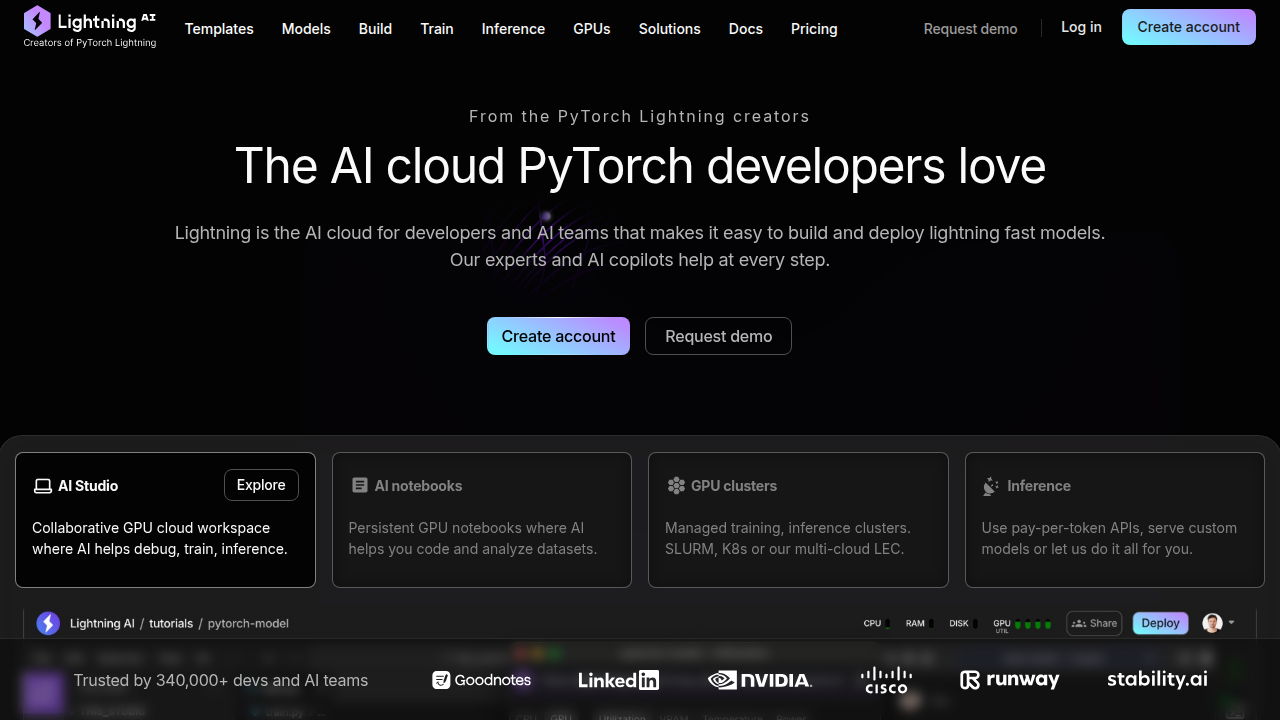
Built by the team behind PyTorch Lightning, this company has raised over $100 million in funding, including a recent $50 million investment from Cisco, J.P. Morgan, and NVIDIA. As reported in their funding announcement, the platform has already attracted more than 240,000 users across 2,000 organizations. That kind of traction says a lot about its value for teams building AI products.
But Lightning AI is not the only game in town. New entrants like Augment AI and OtherHalf AI are also pushing boundaries, while conversations about AI ethics grow louder every day. Whether you are evaluating a full development suite or looking for a specialized tool, knowing the landscape is half the battle.
In this guide, we compare the top AI platforms for 2026. We look at features, pricing, performance, and real-world use cases. If you are a startup founder or investor trying to make smart decisions, you will find practical insights here.
For daily updates on the fast-moving world of AI, consider subscribing to The AI Newsletter Worth Reading. It delivers clear, curated news so you never miss a beat.
But first, let us dive into what makes an AI platform truly stand out in 2026.
Lightning AI: The All-in-One Platform for AI Development
If the introduction piqued your interest, let us take a closer look at what makes Lightning AI such a standout choice in 2026.
The biggest headache for most AI teams is the endless switching between tools. You train in one place, deploy in another, and scale using a completely different setup. Lightning AI fixes this by bringing everything into one environment. That unified approach saves time and reduces mistakes. As one report noted, a Fortune 100 company cut its AI infrastructure setup time from 30 days to just two using this platform. You can read more about how Lightning AI raises $50M to eliminate AI development headaches and why enterprises are paying attention.
At its core, the platform is built on the wildly popular PyTorch Lightning framework. If your team already works with PyTorch, switching over feels natural. The code stays clean, and the framework handles the tricky engineering parts like parallelizing across GPUs. You can explore the open-source foundation on GitHub – Lightning-AI/pytorch-lightning. The platform keeps getting better with regular updates. In 2026, the team has rolled out new collaboration features that let multiple developers work on the same AI app in real time. A thorough Lightning Ai Review 2026 – Updated Features, Pricing & Verdict highlights how these additions make teamwork smoother than ever.
What do these updates mean for your startup? Less time wrestling with cloud configurations and more time actually building AI products. The pay-as-you-go pricing model helps too. You get a free tier with 22 GPU hours per month, which is generous for getting started. When you are ready to scale, costs stay predictable. The official Lightning AI | Idea to AI product, ⚡️ fast. page shows how teams move from prototype to production without the usual friction. This focus on speed and simplicity explains why more than 240,000 users across 2,000 organizations have already adopted the platform.
While new players like Augment AI and OtherHalf AI are generating buzz, and conversations around AI ethics continue to evolve, Lightning AI remains a top contender for teams that want a reliable, all-in-one solution. It is especially useful for startups that want to move fast without hiring a huge DevOps team. For a broader look at the ecosystem and how other tools stack up, check out our breakdown of the best AI platforms for business in 2026 compared and rated.
Specialized AI Tools: From Data Labeling to Model Deployment
Lightning AI gives you an all-in-one setup. But sometimes, your startup needs a tool that does one thing really well. A whole wave of specialized AI tools has popped up to solve specific pain points across the AI lifecycle.
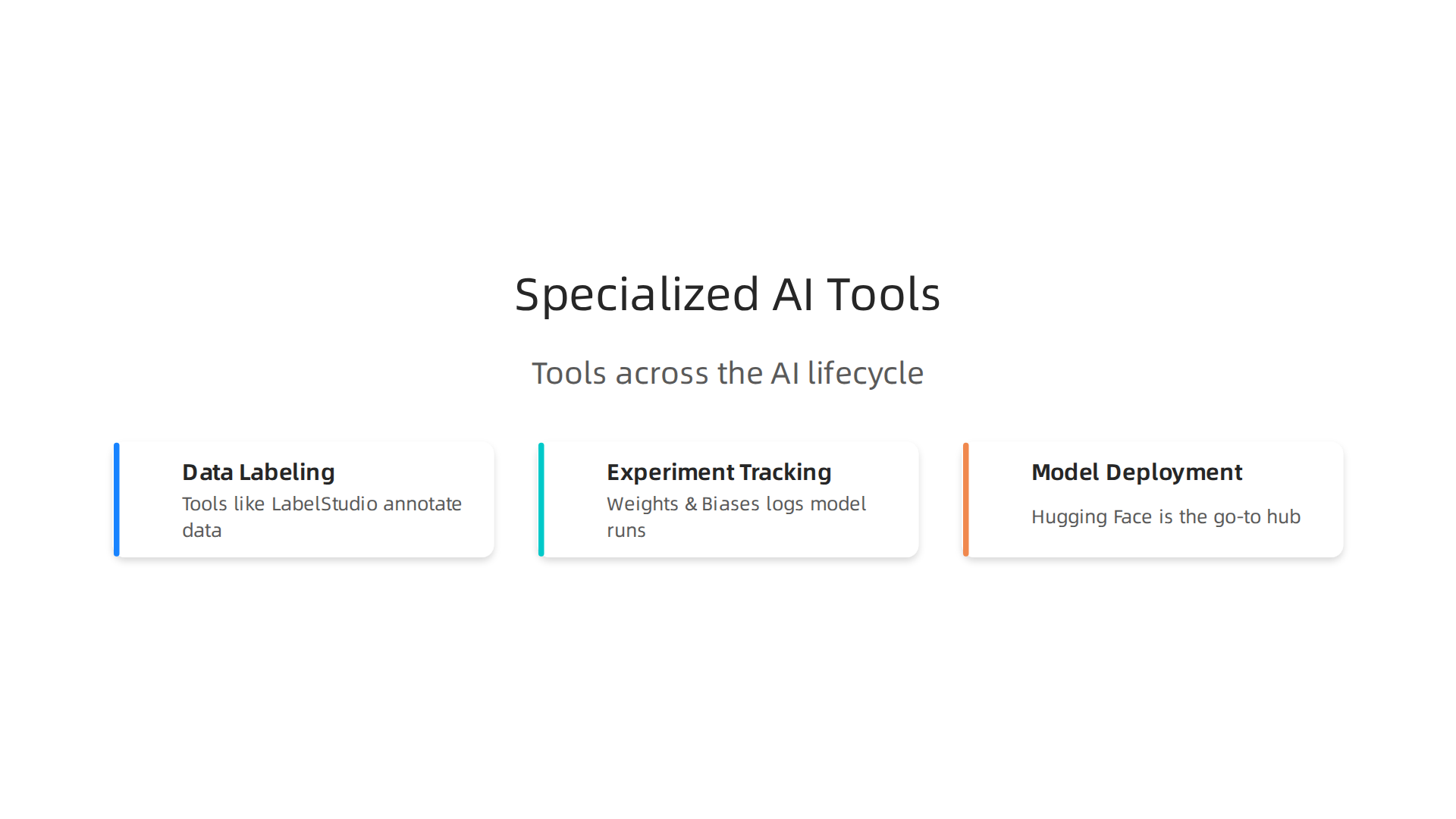
Whether you are labeling raw data, tracking experiments, or monitoring a model in production, there is likely a platform built just for that job.
For example, when you need to prepare training data, tools like LabelStudio help you annotate images, text, and audio quickly. It is open source and flexible, so your team can customize it for your specific project. For tracking experiments, many teams turn to Weights & Biases.

It logs every model run, compares results, and helps you figure out which hyperparameters work best. And for sharing and deploying pre-trained models, Hugging Face has become the go-to hub. You can find thousands of models and datasets there, all ready to use.
These specialized platforms are powerful on their own. But here is the catch: if you use too many different tools, your stack gets messy. You might end up jumping between five different dashboards just to move a single project forward. That is why choosing the right set of tools matters. The best approach in 2026 is to start simple and add specialized tools only when you really need them. For a deeper look at how to make those choices, check out our guide on how to evaluate AI platforms for your startup in 2026.
Another option is to lean on platforms that already integrate with the most popular specialized tools. That way you get the best of both worlds. For a broader view of what is out there, the top 10 AI tools for Q2 2026 list includes many of these niche players alongside the big names. It gives you a sense of the full landscape.
The AI tool ecosystem is growing fast. New platforms show up every month. Staying on top of them all can feel like a full-time job. That is why a steady stream of curated updates helps. For clear, daily AI updates, you can subscribe to The AI Newsletter Worth Reading. It cuts through the noise and brings you the headlines that actually matter for your startup.
In the end, specialized tools are great, but they work best when you know exactly what problem you are solving. Choose wisely, test before committing, and keep your stack as lean as possible.
The Rise of No-Code and Low-Code AI Platforms
What if you have a great idea for an AI product but do not know how to code? That used to be a dead end. Not anymore. No-code AI platforms are changing everything. They let people with zero programming background build, train, and deploy machine learning models using drag-and-drop interfaces.

You just upload your data, pick a model type, and the platform handles the rest. This shift is opening up AI to whole new groups of people.
Think about a small business owner who wants to predict customer churn. A few years ago, they would have needed to hire a data scientist or pay a consultant. Today, they can use a no-code platform like Bubble or Softr to create a simple prediction tool in a few hours. That is the kind of democratization that is reshaping the startup world. It is not just for tech companies anymore. Any business with a dataset can start experimenting with AI.
For startups that do have technical talent, low-code options offer a middle ground. These platforms give data scientists a faster way to prototype without losing the flexibility to customize. Instead of writing hundreds of lines of code from scratch, they can use visual workflows and pre-built components. Tools like n8n, which are included in the list of no-code AI workflow automation tools, let teams connect different services and build automated pipelines quickly. The result is faster iteration and less time spent on repetitive setup work.
Investors have noticed this trend. Funding is flowing into companies that lower the barrier to AI adoption, especially for small and medium businesses. When non-technical founders can build AI features themselves, the total addressable market for AI expands dramatically. That is why platforms like Lightning AI, which offer both coding and low-code options, are becoming popular. They let you start simple and add complexity only when you need it. Similarly, newer entrants like Augment AI and Otherhalf AI are focusing on making AI accessible without sacrificing power.
Of course, with great access comes great responsibility. As more people build AI models, questions about AI ethics become even more important. A no-code tool might make it easy to create a model, but it does not automatically make that model fair or unbiased. Founders need to think about data quality, bias, and transparency from day one.
If you are considering a no-code or low-code platform for your startup, start with a clear problem. Then pick a platform that matches your team’s skill level. For a side-by-side comparison of the main options, read our guide on best AI platforms for business in 2026. It breaks down the strengths and weaknesses of each approach so you can make a smart choice.
No-code and low-code are not just trends. They are the tools that are putting AI into the hands of people who need it most. And that is good news for everyone.
AI for Enterprise: Platforms Scaling Internal Innovation
But what happens when you need to scale AI across a company with thousands of employees, strict compliance rules, and years of legacy systems?

That is where enterprise-grade AI platforms come in. They are built to standardize development, enforce governance, and let teams collaborate without breaking security rules.
Large organizations are moving fast. Enterprise AI spending reached an estimated $247 billion globally in 2026, growing 64% year over year, and 78% of Global 2000 companies now have at least one AI workload in production (Enterprise AI adoption statistics 2026). But spending alone does not guarantee success. Many companies still struggle. In fact, 79% of organizations now face significant challenges when adopting AI, and more than half of executives admit AI is tearing their company apart (enterprise AI adoption challenges in 2026). The problem is often the same: too many scattered tools, no single source of truth, and weak governance.
That is why platforms like Dataiku, H2O.ai, and Domino Data Lab are growing so fast.
They offer one place where data scientists, engineers, and business leaders can build, test, and deploy models together. These platforms also handle the boring but important stuff. They track who changed what, flag biased data, and make it easy to explain how a model works to auditors. For companies in healthcare, finance, or insurance, that kind of control is not optional. It is required.
Even the more flexible platforms we talked about earlier, like Lightning AI, now offer enterprise editions with stronger security and compliance features. So a startup can start small and grow into the enterprise tier as it scales. That path makes it easier for founders to dream big without outgrowing their tools. Newer platforms like Augment AI and Otherhalf AI are also building for enterprise from day one, with a focus on easy integration and strong security.
For startups that want to sell into this market, the bar is high. You need SOC 2 certifications, SSO integration, and a clear story about data privacy. But the opportunity is just as large. The median enterprise now reports a 2.4x return on its AI investments, and top performers see more than 5x. Finding a way to help them get there is a golden chance.
No matter which platform you choose, building responsibly matters. As models become more powerful, enterprise buyers are paying close attention to fairness and transparency. That is why we put together a guide on ethical AI principles and real-world impact to help you think through these questions before you scale.
If you are building or investing in the AI space, staying informed is key. The landscape shifts every week. Get clear daily AI updates from The AI Newsletter Worth Reading to keep your finger on the pulse.
Open-Source AI Toolkits vs. Commercial Platforms: Pros and Cons
So you are ready to build with AI. But which path do you take? Open-source toolkits or commercial platforms? Each one has real trade-offs, and the right choice depends on your team, budget, and goals.
Open-source toolkits like PyTorch, TensorFlow, and Hugging Face give you full control. You can modify the code, fine-tune models on your own data, and keep everything on your own servers. That is huge for companies that handle sensitive information or need to meet strict compliance rules like HIPAA or GDPR. The cost can also be lower at scale. Once you have the infrastructure, you are not paying per token or per user. But there is a catch. You need a skilled team. Deploying open-source models requires DevOps work, GPU management, and ongoing tuning. That can add up to 0.5 to 1.0 full-time employee just for operations (Open-Source vs Commercial LLMs: The Complete Guide (2026)).
Commercial platforms like AWS SageMaker, Google Vertex AI, or newer entrants like Augment AI and Otherhalf AI handle the heavy lifting. They offer managed infrastructure, automatic scaling, and built-in security features. You can get a prototype running in days instead of months. The trade-off is cost. As your usage grows, token-based pricing can spiral. Still, for startups moving fast, the speed advantage is often worth it.
Then there is a middle path. Platforms like Lightning AI let you start with a flexible, open-source core and upgrade to a commercial enterprise tier later. For many teams, this hybrid approach gives the best of both worlds.
Whatever you choose, keep ethics in mind. Open-source models let you inspect and audit the training data and algorithms, which helps you catch bias early. That is a key part of responsible AI development.
If you want to dig deeper into what to look for, check out our guide on how to evaluate AI platforms for your startup. It walks through the exact questions to ask before committing to a tool.
Comparison of Leading Open-Source Frameworks
If you go the open-source route, you need to pick a framework.
Three names dominate in 2026.
PyTorch is the favorite in research. It is flexible and easy to debug. That makes it great for testing new ideas.
TensorFlow leads in production. It has strong deployment tools and works well on mobile and web. Many large systems depend on it.
Hugging Face is the go-to hub for pre-trained models. Instead of training from scratch, you download a model ready for your task. That saves time and GPU costs.
A newer option is JAX. It is built for high-performance computing. Researchers use it to train models extremely fast. For a deeper look at these tools, check the Best Python AI Frameworks in 2026 guide from JetBrains.
All these frameworks are open-source. That means you can inspect the code and catch bias early. It is a key part of AI ethics in practice.
If you build on top of these frameworks, platforms like Lightning AI can help you scale faster. But start with the right framework for your model.
For more on picking AI tools, see our guide on best AI platforms for business in 2026.
And if you want daily AI news to stay ahead, subscribe to The AI Newsletter Worth Reading for clear, daily updates.
Future Trends in AI Platform Ecosystems for 2026 and Beyond
We just talked about picking the right open-source framework. But here is the thing: the market is moving fast toward all-in-one platforms.
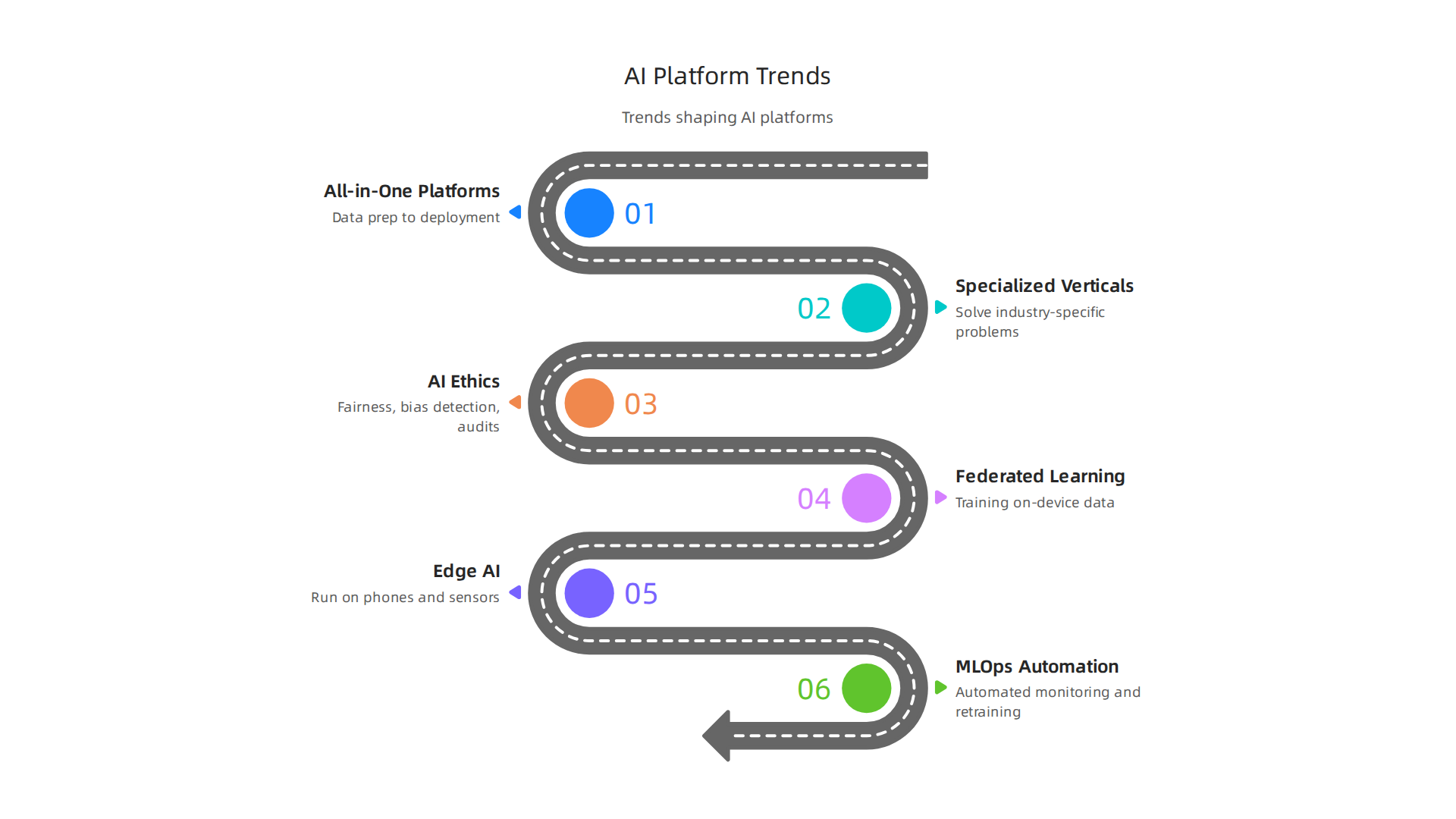
The AI Platform Market forecast for 2026 to 2036 shows the market growing to over 200 billion dollars by 2036. A big chunk of that growth comes from end-to-end platforms that handle everything from data prep to deployment.
Platforms like Lightning AI are a perfect example. They build on top of frameworks like PyTorch and give you managed infrastructure, model optimization, and easy scaling. Instead of stitching together separate tools, you get one place to work. That saves time and cuts costs.
But not every business needs the same thing. Specialized verticals keep popping up. OtherHalf AI focuses on healthcare and life sciences, making sure models meet strict compliance rules. Augment AI targets software developers, helping them build smarter apps faster. So while general platforms keep growing, niche platforms solve unique industry problems.
Venture capital firms are paying close attention. In 2026, they are backing platforms that solve two big challenges: scaling and governance. You can have the best model in the world, but if you cannot run it reliably or if it breaks ethical rules, it is useless. That is where AI ethics comes in. Modern platforms now include fairness checks, bias detection, and audit logs. They make it easier to build responsible AI from day one.
Another big shift is toward federated learning. Instead of sending sensitive data to a central server, the model gets trained on data that stays on devices. That protects privacy and still produces good results. Edge AI also keeps growing. Models run directly on phones, sensors, or factory machines instead of in the cloud. That gives faster responses and lower costs.
MLOps automation rounds out the list. Automated monitoring, retraining, and version control are becoming standard. Platforms now watch your model in production and alert you when performance drops.
If you want to stay ahead, start thinking about which trends matter most for your business. For more on how AI is reshaping the startup world, check out our guide on disruptive innovation in 2026.
How to Evaluate and Choose the Right AI Toolset for Your Startup or Investment
So you have a sense of where the AI platform market is heading. The real question is: how do you pick the right toolset for your specific needs? Whether you are a founder building a product or an investor backing the next big thing, having a clear evaluation framework saves time, money, and headaches.
For founders, the first thing to consider is your technical maturity and growth stage. If you are still testing ideas and building an MVP, you need something flexible and easy to use. Platforms like Lightning AI give you a single environment where you can experiment, train models, and deploy without worrying about infrastructure. As your startup scales, you will need stronger governance features, better monitoring, and built-in AI ethics checks to stay compliant. That is why platforms that include fairness detection and audit logs are becoming non‑negotiable.
For investors, the focus shifts to scalability and defensibility. You want platforms that show strong adoption metrics, active communities, and clear revenue growth. The 2026 AI Index Report from Stanford shows that the value of generative AI tools to U.S. consumers alone hit over $170 billion annually in 2026. That kind of market signal tells you that platforms with real traction are worth a closer look. Also, look for platforms that solve specific vertical problems. Remember OtherHalf AI in healthcare and Augment AI for developers? Niche focus often means deeper moats and higher switching costs.
Here is a simple framework to reduce the noise and make a confident decision:
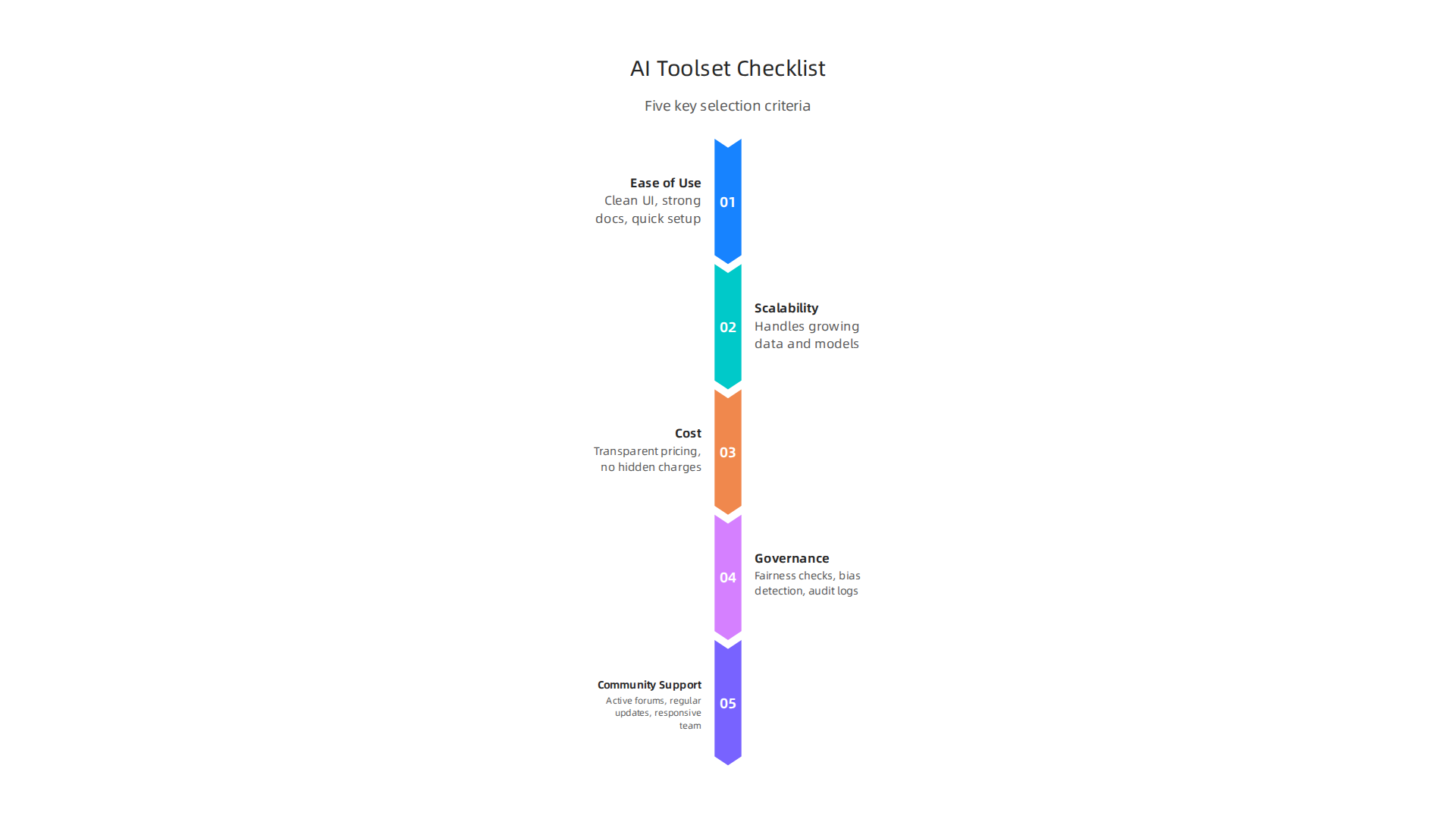
| Criterion | What to Look For |
|---|---|
| Ease of use | Clean interface, good documentation, quick setup |
| Scalability | Can handle growing data and model size without major rework |
| Cost | Transparent pricing, no hidden compute charges |
| Governance | Built‑in fairness checks, bias detection, audit logs |
| Community & support | Active forums, regular updates, responsive team |
Walk through each point with the platforms you are considering. If a tool fails on two or more criteria, it is probably not the right fit.
If you want a deeper comparison of the top options out there, check out our guide on the best AI platforms for business in 2026 compared and rated. It covers the strengths and weaknesses of each major player so you can match them to your goals.
And to stay ahead of every new platform, tool, and trend, get clear daily AI updates from The AI Newsletter Worth Reading. It is the easiest way to keep your finger on the pulse without drowning in noise.
Summary
This article maps the AI platform landscape in 2026 to help founders, investors, and tech teams pick the right tools. It explains why unified platforms like Lightning AI are gaining traction, how specialized and no‑code/low‑code tools fit into a lean startup stack, and what enterprise buyers need for governance and compliance. The piece compares open‑source toolkits and commercial platforms, highlighting trade‑offs in cost, control, and operational effort, and it outlines emerging trends such as federated learning, edge AI, and automated MLOps. Practical evaluation criteria and real‑world use cases show when to start simple, when to add specialized tools, and how to scale responsibly. After reading, you’ll know which platform types match different team stages, what governance and cost signals to watch, and a simple checklist to evaluate vendors before committing.