
Disruptive Innovation in 2026 Key Drivers and Real World Examples

Introduction
Digital transformation is no longer something you plan for. It is happening right now, all around you. In 2026, businesses do not ask if they should change. They ask how fast they can keep up. The force driving this change is something called disruptive innovation.
Disruptive innovation sounds like a big term, but the idea is simple. It happens when a new idea or technology starts small, often serving people that bigger companies ignore. Then it gets better over time. Eventually, it shakes up entire industries. Think about how streaming changed TV or how smartphones changed communication. That is disruptive innovation in action.
Right now, we are seeing six emerging technologies that are reshaping the business world. Artificial intelligence, quantum computing, and next-gen automation are just a few examples. These tools are not experiments anymore. They are real and they are changing how companies work every day.
So why should you care about disruptive innovation? If you are a founder, an investor, or a business leader, understanding this idea helps you make smarter choices. You can spot opportunities before everyone else.

You can also avoid getting caught off guard when a new competitor shows up with a cheaper, simpler solution. Knowing what to look for gives you an edge.
This article gives you a complete, data-backed look at disruptive innovation in 2026. We will cover what it really means, how to spot it, and how it is changing the startup world. Whether you want to understand what an innovation center is and why it matters for startups or just stay ahead of the curve, you are in the right place.
Let us start with a clear definition of disruptive innovation and what makes it different from regular improvements. Then we will look at real examples and strategies you can use today.
If you want to stay updated on the latest tech shifts, consider subscribing to The Deep View Newsletter for clear daily AI insights.
Defining Disruptive Innovation in the Digital Age
To really understand disruptive innovation, you need to go back to the original framework. Harvard Business School professor Clayton Christensen introduced the term in the 1990s. He wanted to explain why big companies often fail when smaller newcomers show up. His theory is more specific than most people realize.
Christensen made a clear distinction between two types of innovation: sustaining and disruptive. Sustaining innovation means making existing products better for existing customers. A faster processor in a laptop is a sustaining innovation. It serves the same people with an upgraded version. Most large companies excel at this.
Disruptive innovation works differently. It starts by serving customers that incumbents overlook or ignore. These are often people who cannot afford or do not need the full-featured, expensive product. The disruptive offering is simpler, cheaper, or more convenient. It may even perform worse on the features that matter most to mainstream customers. But it improves over time. Eventually, it becomes good enough for the mainstream, and the incumbent gets displaced. The disruptive innovation Wikipedia page explains this process in detail, including the two main types: low-end disruption and new-market disruption.
In the digital age, this concept has expanded. Digital disruption refers to technology-driven changes that reshape entire business models. It is not just about a better smartphone. It is about how online marketplaces, cloud software, and AI platforms create new ways of delivering value. For example, streaming services did not just improve DVDs. They changed how people access and pay for entertainment. That is a business model shift enabled by technology.
A common misconception is to call any new technology disruptive. Many people use the term loosely for any flashy startup or innovative gadget. But that is not what Christensen meant. A truly disruptive innovation must follow the specific pattern: start in a niche or underserved market, then move upmarket. An innovation that simply improves an existing product for existing customers is sustaining, not disruptive. Even a breakthrough invention may not be disruptive if it targets the same customers with a better offering. Understanding this nuance helps you avoid hype and focus on real opportunities.
For startups and investors, grasping this framework is essential. It helps you identify which new companies have true disruptive potential and which are just incremental improvements. You can also think about where your own business fits. Are you creating a solution for overlooked customers? Or are you competing head-to-head with incumbents on their home turf? The answer shapes your strategy.
If you want to explore how dedicated spaces foster innovation, check out this overview of what is an innovation center and why it matters for startups in 2026. It shows how structured environments can accelerate the kind of thinking that leads to disruption.
Key Drivers of Disruptive Innovation in 2026
So what makes disruptive innovation actually happen? In 2026, three big forces are creating the right conditions for it. Understanding these drivers helps you spot where the next disruption might come from.
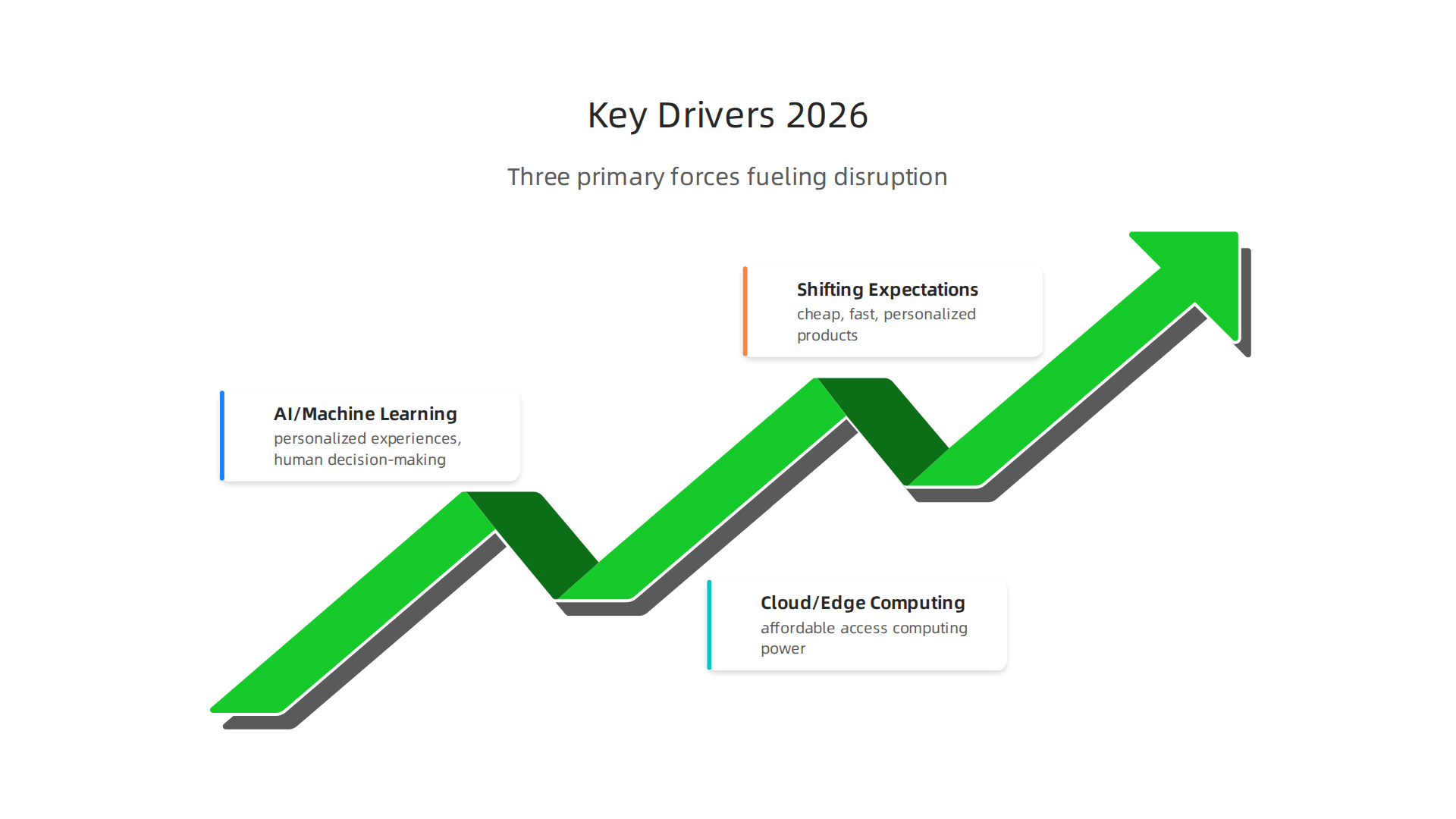
Artificial intelligence and machine learning. This is probably the biggest driver right now. AI lets companies deliver personalized experiences to thousands or millions of users at once. It also handles tasks that used to need human decision-making. That is a huge advantage for a small startup. A team of ten people can build an AI-powered tool that serves a niche audience better than a giant corporation can. As the AI learns from users, the product improves. And that is exactly the pattern Christensen described. The tool starts in an overlooked market and then moves upmarket. The latest Key Tech Trends & Disruptions in 2026 report shows that autonomous systems powered by AI are already reshaping finance, customer service, and operations across industries.
Cloud and edge computing. This driver is all about access. Ten years ago, building a serious tech product meant spending a fortune on servers, data centers, and IT staff. Not anymore. Cloud services let anyone rent world-class computing power for a small monthly fee. Edge computing pushes that power even closer to where data gets created, which matters for real-time applications in manufacturing, healthcare, and logistics. This levels the playing field completely. A two-person startup in a garage has access to the same infrastructure as a Fortune 500 company. That is exactly the kind of environment where disruptive ideas can grow.
Shifting consumer expectations. This one might surprise you, but it is just as important. People in 2026 expect things to be cheap, fast, and personalized. They do not have patience for complicated products with features they never use. They are happy to try a simpler alternative from a brand they have never heard of, as long as it solves their problem. That willingness gives disruptors a window. When a big company ignores a group of users who just want something simple and affordable, a new player can step in.
These three drivers feed into each other. AI gives you the ability to build smart tools. Cloud infrastructure gives you affordable access to computing power. And consumers are ready to embrace something new and simple.
If you want to see how this plays out in real startups, check out this breakdown of how generative AI assistants are reshaping startup innovation and funding in 2026. It shows exactly how AI is creating new opportunities for disruption right now.
And if staying on top of AI changes is important to you, The AI Newsletter Worth Reading delivers clear daily updates that help you make sense of what matters.
Case Studies: Real-World Disruptive Innovation
The drivers we just covered create the perfect conditions for disruption. But what does this actually look like in the real world? Let’s look at three industries where disruptive innovation is changing everything right now.
AI-driven drug discovery. Pharmaceutical research has always been painfully slow and expensive. A new drug can take over a decade and cost billions to develop. But AI is changing that. Startups in this space use machine learning to scan millions of chemical compounds in days instead of years. They find promising drug candidates faster and cheaper than big pharma can. This follows the classic disruptive pattern. The AI tools start by tackling small, ignored problems in drug research. Then they get better and move into bigger areas. It is the exact same story as the disruptive innovation examples you see from Uber and Airbnb, but in a completely different field. These companies are proving that AI can transform even the most complex scientific work.
Fintech startups and blockchain. Banking and payments have been dominated by the same big names for decades. But fintech companies using blockchain technology are changing that. They offer lower fees, faster transfers, and easier access to lending for people that traditional banks overlook. Think about a small business owner who cannot get a loan from a big bank. A blockchain-based lending platform can give them one in minutes. The service is simpler and cheaper. It does not need all the fancy features of a traditional bank. That is exactly how disruptive innovation works. The new player starts with a basic offering for an underserved group. Then it improves over time and starts pulling in customers from the big players.
Supply chain innovation with IoT and big data. Supply chains used to be a black box. Companies had no idea where their products were or what was happening during shipping. That is changing fast. Startups now use IoT sensors and big data analytics to create complete transparency. You can track a shipment from the factory floor to the customer’s door in real time. You can see temperature changes, delays, and even humidity levels. This kind of visibility was only possible for giant corporations with huge budgets just a few years ago. Now any business can afford it. That is the power of disruptive innovation in action.
These three examples show that disruption is not just a tech buzzword. It is happening right now in industries that affect our daily lives.

If you want to understand the places where these innovations grow, learning about what an innovation center is and why it matters for startups in 2026 can help you spot the next big opportunity before everyone else does.
How Startups Can Harness Disruptive Innovation
Now that you have seen how disruption plays out across industries, the next step is learning how to use it yourself. Here are three practical strategies for startups that want to harness disruptive innovation in 2026.
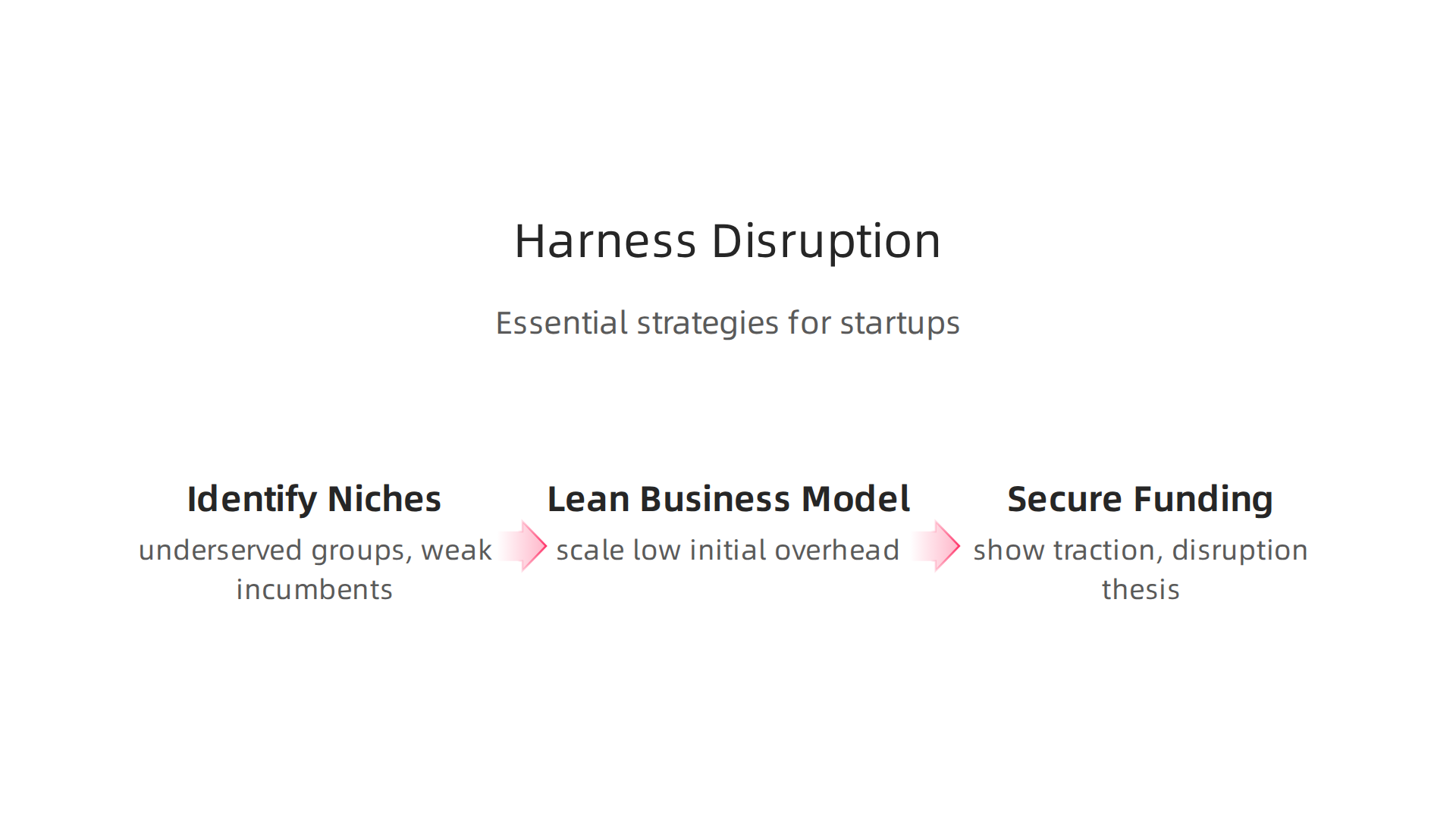
Identify underserved niches where incumbents have weak positions. Big companies often ignore small customer groups or focus on adding fancy features that most people do not need. That leaves a gap. Find a group of users who are overserved by expensive, complicated products or completely left out of the market. Start with a simpler, cheaper solution just for them. This is exactly how Airbnb and Canva got their start. For more examples of how to spot these opportunities, check out these disruptive innovation case studies that break down market gaps in detail.
Build a lean business model that scales with low initial overhead. You do not need a huge office or a big team to begin. Use cloud tools, AI, and automation to keep costs low while you test your idea. Start with a basic version of your product and improve it as you get feedback. This keeps you flexible and allows you to grow without burning through cash. Many successful disruptors began with a side project or a small team working remotely. The key is to focus on what matters most to your early customers and leave the extras for later.
Secure funding by showing traction and a clear disruption thesis. Investors in 2026 want to see that you are not just building another me-too app. They want proof that you are attacking a real market gap with a model that can scale. Show them early user growth, revenue from your first customers, or even a successful pilot program. You do not need a huge amount of data. A small but loyal customer base that loves your product is powerful evidence. If you are looking for more guidance on this step, this guide to finding startup investors walks you through the process step by step.
Disruptive innovation is not a magic trick. It is a repeatable playbook. Find the gap, keep your costs low, and prove your value before asking for big money. That is how you win.
If you want to stay ahead of the fast moving world of AI and tech disruption, sign up for The AI Newsletter Worth Reading. It delivers clear daily updates so you never miss a breakthrough.
The Investor Perspective: Funding Disruptive Innovation
Venture capital is pouring into disruptive innovation at record levels. In 2026, AI, biotech, and climate tech are attracting the biggest checks.

According to the World Economic Forum, nearly $3.5 trillion in assets are now under venture capital management, with AI alone accounting for more than half of global deal value. That means deep-pocketed investors are actively hunting for the next game changer.
But getting funded is not easy. Investors look at three things above all else: the team, the timing, and the defensibility of the idea. They want founders who understand their market inside out. They want a product that sits at the right point on the adoption S-curve. And they want a moat something that protects the business when bigger players try to copy it. If you are working on a truly disruptive innovation, you need to show all three.
Here is the hard truth: most disruptive startups never make it to scale. The majority of companies chasing genuinely disruptive approaches will fail. That is why the best investors focus on risk management as much as return potential. They look for founders with long term thinking, insider ownership, and capital discipline. They also watch for signs that the company is not just hype. A flashy idea without a clear path to revenue is a red flag.
If you are on the other side as an investor, you need a systematic way to separate real disruption from noise. Look for a 10x improvement on something customers actually care about. Position your bets according to where the technology sits on its growth curve. And remember that early stage opportunities offer huge upside but require smaller positions. For a deeper dive into how one major fund evaluates these factors, check out this ARK Venture Fund performance and risks analysis.
The opportunities in disruptive innovation are massive. The risks are just as real. The investors who win in 2026 will be the ones who combine bold vision with disciplined strategy.
Measuring the Impact of Disruptive Innovation
But how do you know if a disruptive innovation is actually working? The buzz is real. You see the headlines. You hear the pitch. Yet real impact needs hard numbers you can trust.
Most teams start with three common metrics. First is market share change. Are you taking customers from incumbents or creating new buyers? Second is revenue growth. Is the product generating enough money to keep going? Third is adoption rate. How fast are users jumping in? These numbers matter. They tell a story over time.
But here is the catch. These metrics are often lagging indicators. By the time you see them, the market may have already shifted. Attribution is tricky too. Did the innovation cause growth, or was it something else like a lucky partnership? And some of the biggest impacts are hard to measure. Things like customer loyalty, ecosystem changes, or shifts in how people think about a problem. These are qualitative factors that numbers alone cannot capture.
That is why experts look beyond basic metrics. According to the Interaction Design Foundation, monitoring user metrics for disruptive innovations like ease of onboarding, error rates, and satisfaction is critical. These signals show early traction before revenue catches up. They help you see if the product is sticky.
Some organizations use a composite framework called the Innovation Impact Score. It combines quantitative data with qualitative signals. Market share growth gets weighted alongside customer feedback and ecosystem influence. This gives a fuller picture than any single number.
If you run a startup or invest in one, measuring impact helps you decide where to double down. It is also why many founders build an innovation center and why it matters to track progress from the start. A structured approach separates true disruption from temporary hype.
To keep learning about the technologies shaping tomorrow, consider subscribing to The AI Newsletter Worth Reading. It delivers clear daily AI updates straight to your inbox, so you never miss a shift in the innovation landscape.
Navigating the Risks and Challenges
So you have your metrics and your clear picture of what disruptive innovation looks like. That is good. But the road is not smooth. The truth is that most attempts at disruption fail. And the reasons are often predictable.

The biggest challenge is simple math. Most disruptive startups never get big enough to matter. According to the 2026 disruptive technology investing guide from TraderHQ, the majority of companies chasing real disruption will fail. They cannot cross the gap from a great idea to a real business. That gap eats up cash, focus, and time. It is one of the hardest obstacles to survive.
Then comes the human side of the problem. Even when the technology is ready, the organization may not be. People resist change. Teams inside a company or a whole industry often push back against anything that threatens the old way of doing things. This cultural inertia can kill a promising innovation before it ever gets traction. The best technology strategy board in the world cannot help if the people running the company are not willing to shift.
Yet the risks go beyond money and culture. Ethical and regulatory questions are growing fast in 2026. Data privacy is a huge concern. Many disruptive technologies collect massive amounts of user data, and governments are still figuring out how to regulate that. On top of that, automation and AI are displacing jobs across industries. The public is watching. Regulators are moving. A startup that ignores these issues can face sudden shutdowns or fines.
Where do you start if you are building or investing in something truly new? A good first step is to study how other founders and investors think about risk. Learning how to evaluate AI platforms for your startup gives you a head start on assessing which technologies are worth the gamble.
The path to real disruption is narrow. But understanding the risks gives you a better shot at making it through.
The Future of Disruptive Innovation
So where is all this headed? The next wave of disruptive innovation is already forming on the horizon. And it looks nothing like the past.
Emerging technologies like quantum computing and biotech will open up entirely new frontiers. These fields are not just improving existing products. They are creating markets that did not exist five years ago. According to the Key Tech Trends & Disruptions in 2026 analysis from Ecosystm, autonomous systems and specialized AI models are moving beyond pilots into real operations. This shift will reshape customer service, finance, and even how governments run their infrastructure. The compute race is on, and countries are investing heavily in local data centers and sovereign AI stacks.
But technology alone is not enough. Global shifts in regulation, sustainability, and demographics will redefine what disruption means in 2026 and beyond. For example, the rise of low speed electric vehicles in China shows how environmental rules and affordability can create a perfect opening for new competitors. The driving disruption case study from the Christensen Institute explains how these vehicles compete on simplicity and cost, not speed or range. That is the kind of market reshaping that catches incumbents off guard.
What does this mean for you? Whether you are a founder, an investor, or a business leader, the key is adaptability. Continuous learning is no longer optional. The organizations that survive will be the ones that treat change as a constant. They will build cultures that question old rules and experiment quickly. The tips for driving disruptive innovation from HypeInnovation suggest you should encourage failure, ask everyone for new ideas, and run open campaigns with customers and suppliers. That kind of flexibility is what turns a good idea into a real market shift.
Staying ahead means feeding your mind with the right signals every day. That is why reading an innovation hub or following a trusted source of tech news matters. You cannot predict the future, but you can prepare for it.
If you want to keep up with how AI and technology are reshaping industries in real time, consider subscribing to The AI Newsletter Worth Reading. It delivers clear daily updates so you never miss a shift.
And if you are thinking about building your own innovation hub, check out this guide on what is an innovation center and why it matters for startups in 2026.
Summary
This article explains disruptive innovation in the digital age and shows why it matters for founders, investors, and business leaders in 2026. It defines the Christensen framework and distinguishes disruptive moves from ordinary sustaining improvements, then maps the three main current drivers—AI, cloud/edge computing, and shifting consumer expectations—that create fertile ground for new entrants. Through case studies in drug discovery, fintech, and supply chains, the piece shows how small, focused solutions can scale into market-changing businesses. Practical guidance covers how startups identify underserved niches, build lean scalable models, and prove traction to investors, while the investor view explains what funds look for and how they manage risk. The article also covers metrics and composite frameworks for measuring real impact, common failure modes like cultural resistance and regulation, and what to watch next (quantum, biotech, sovereign AI). After reading, you’ll be able to spot genuine disruptive opportunities, choose practical startup strategies, and evaluate both the upside and risks of pursuing disruption.