
AI Companies in 2026 What Founders and Investors Need to Know

Introduction
If you feel like the AI world changes every single week, you are not wrong. In 2026, artificial intelligence remains the most dynamic sector in all of technology. Record levels of investment are flowing into the space, and new AI companies seem to launch almost daily.
The numbers back this up. The global AI market is projected to grow from $375.93 billion in 2026 to nearly $2.5 trillion by 2034, according to the latest AI market size projections for 2026. That kind of growth creates massive opportunities but also serious challenges.
For founders, investors, and business leaders, tracking this landscape is no longer optional. It is critical.

Without a clear picture of who the key players are, where funding is flowing, and what risks exist, it is easy to make costly mistakes. Whether you are looking to invest in the next breakout startup or trying to position your own company for growth, you need reliable data.
At the same time, disruptive innovation trends in 2026 show that AI is reshaping entire industries faster than many expected. Understanding the landscape helps you spot opportunities and avoid the pitfalls that trip up others.
This article provides a comprehensive, data-driven overview of AI companies in 2026. We will cover the top players by valuation and revenue, the biggest funding trends, the key drivers of innovation, and practical due diligence strategies. Think of it as your map to the AI landscape this year.
If you want to stay on top of these fast-moving developments every single day, consider subscribing to The AI Newsletter Worth Reading. It delivers clear daily updates so you never miss a shift in the market.
Let us dive into the numbers and see what the AI company landscape really looks like in 2026.
Mapping the AI Company Landscape: From Foundation Models to Vertical Applications
The AI industry is not one big blob. It has clear layers, and each layer works differently.
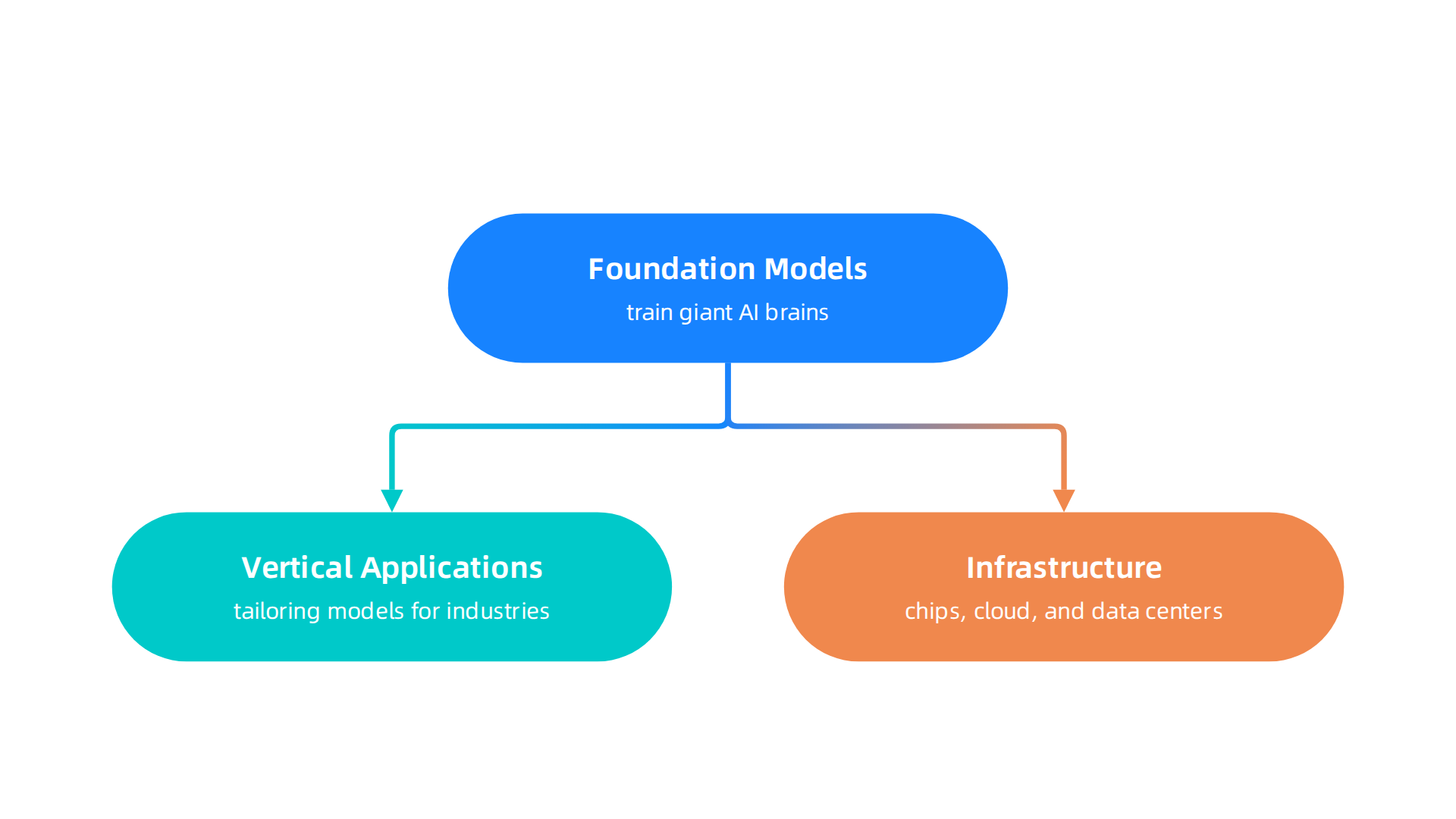
If you want to study AI companies or make smart moves as an investor or founder, you need to understand these layers.
The first layer is the foundation model builders. These are the companies that train the giant AI brains behind products like ChatGPT, Claude, and Gemini. A very small group dominates this space. According to the latest AI Company Rankings 2026, OpenAI leads with a valuation around $850 billion, followed by Anthropic at $380 billion. Then comes xAI at over $50 billion, and Mistral AI at $10 billion plus. The gap between the top two and the rest is huge. These companies spend billions on computing power and data to train models that everyone else builds on top of.
The second layer is the vertical application layer. Thousands of startups are taking those foundation models and tailoring them for specific industries. For example, companies build AI tools just for healthcare, legal research, customer support, or financial analysis. They do not need to train a model from scratch. Instead, they plug into existing APIs and add their own data and expertise. This is where most of the new AI companies are forming. If you want to evaluate AI platforms for your startup, it helps to know which layer each platform sits in.
The third layer is infrastructure. These are the companies that provide the chips, cloud services, data centers, and data engineering tools that make everything else possible. NVIDIA is the biggest here with a market cap over $5 trillion. But companies like Broadcom, TSMC, and CoreWeave also play critical roles. Without them, the foundation models cannot run and the applications cannot scale.
Here is the thing: the competitive dynamics are very different in each layer. Foundation model companies need deep pockets and massive technical talent. Vertical app companies need deep industry knowledge and the ability to move fast. Infrastructure companies need to nail hardware and reliability at massive scale.
For anyone looking at AI companies in 2026, understanding this landscape is step one. Which layer interests you most? That will shape your entire strategy for investment, partnership, or building your own business.
Funding Trends in AI: Where Is the Money Going in 2026?
Understanding the AI landscape is step one. Step two is following the money. And in 2026, that money is flowing like never before.
The first quarter of 2026 was the largest venture capital quarter in history. According to Crunchbase data, global venture funding hit roughly $300 billion across about 6,000 startups. That is up more than 150% compared to the same quarter last year. And the vast majority of that capital went to one sector: AI.
Here is the headline number. AI companies captured about $242 billion in Q1 2026 alone. That is 80% of all global venture funding.
For context, AI took about 55% of global VC dollars in Q1 2025. The jump is stunning.
But here is the catch. Most of that money did not spread evenly. It went to a very small group of players. Four frontier labs — OpenAI, Anthropic, xAI, and Waymo — raised a combined $188 billion in Q1 2026. That is 65% of every venture dollar invested worldwide in that quarter. These were the four largest venture rounds ever recorded, all closing inside three months. You can see the full breakdown of these record-breaking funding numbers in the massive AI funding rounds in Q1 2026 report.
What About Everyone Else?
If 65% of the money went to four companies, what happened to the other 5,996 startups that raised money? The answer is that early stage investing is still very active, but investors are much pickier now.
Seed funding totaled $12 billion in Q1 2026, up 31% year over year. But deal counts actually fell 30% to 3,800 deals. That means the average seed round got bigger, but fewer startups got funded at all. Investors want to see real traction and revenue before they write a check.
Early stage funding (Series A and B) reached $41.3 billion across 1,800 deals. That is up 41% year over year, but again, most of the growth came from larger rounds, not more rounds.
The message is clear. If you want to raise money for your AI company in 2026, you need to show you can execute. The days of raising a seed round on just an idea are fading fast. For a practical guide on what investors are looking for, check out this step by step guide on how to find investors for your startup in 2026.
Where Is the Money Going Geographically?
The geographic picture is just as concentrated as the company picture. The United States dominates AI funding by a massive margin. Private AI investment in the US reached about $109.1 billion, nearly 12 times China’s $9.3 billion and 24 times the United Kingdom’s $4.5 billion. The San Francisco Bay Area alone raised $122 billion in AI funding, more than three quarters of the total.
But other regions are growing fast. Indian AI startup funding more than doubled in Q1 2026 to $679.8 million, the best quarter on record for the country. Emerging ecosystems in the Middle East and Southeast Asia are also attracting attention from global investors.
If you want to stay ahead of these fast moving trends, it helps to have a daily source you can trust. That is why many founders and investors rely on The AI Newsletter Worth Reading for clear, daily AI updates that cut through the noise.
So where does this leave you? If you are studying AI companies, follow the concentration of capital. The winners are pulling away fast,

but the opportunity at the seed and Series A level is still real if you have the right traction and story.
Key Innovation Drivers: What’s Making AI Companies Succeed?
So the money is flowing to a small group of AI companies. But what actually makes those winners pull ahead? Knowing where the cash goes is useful, but the deeper question is what separates the breakout successes from the thousands that fade away.
The answer comes down to a few key drivers. And they are surprisingly consistent across the most successful AI companies in 2026.
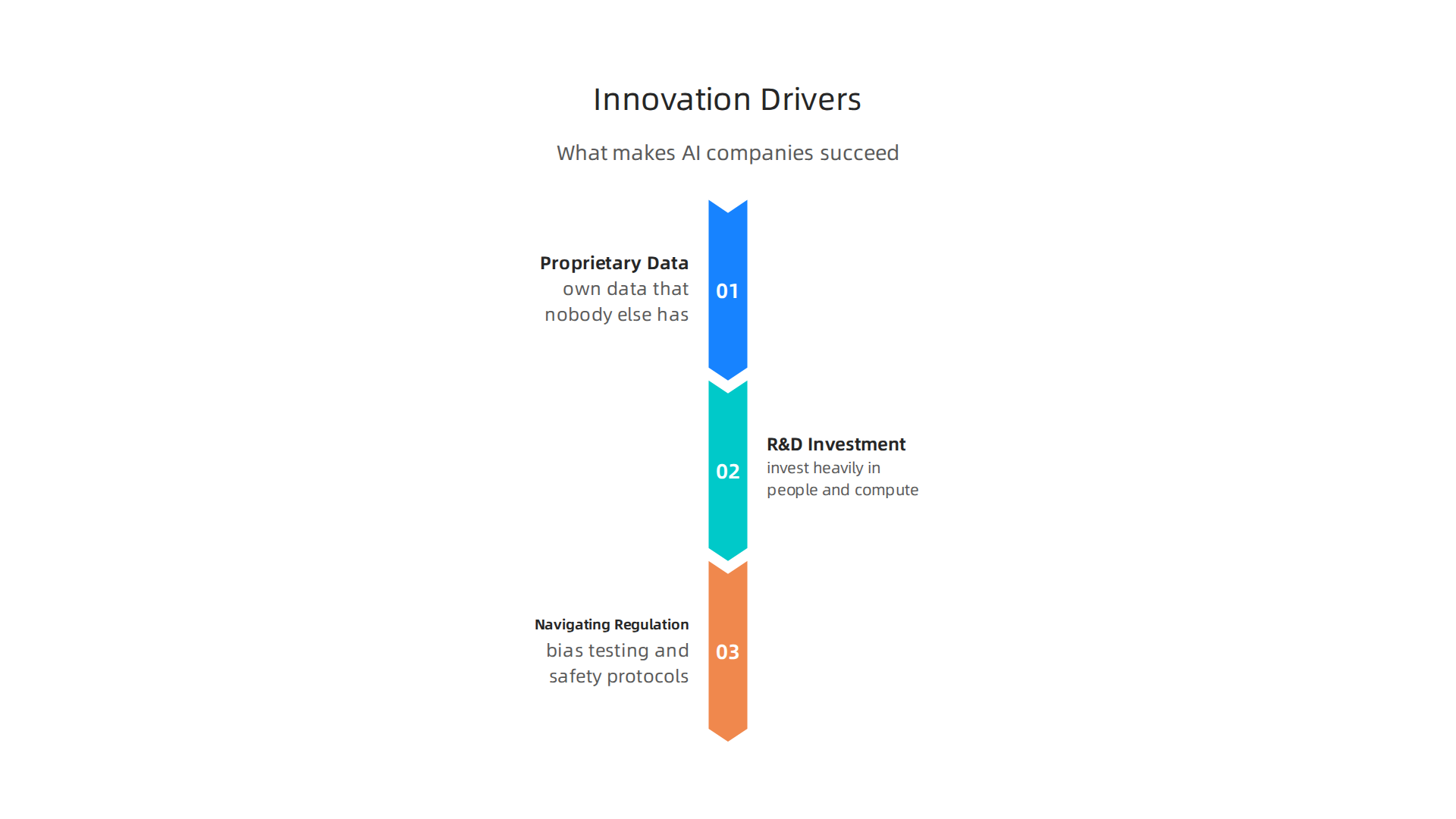
Proprietary Data Is the Real Moat
Here is the thing about AI models. The underlying technology is becoming more accessible every month. Open source models, cloud computing, and off the shelf tools mean anyone can build a basic AI application now.
What you cannot copy is a unique dataset.
The companies that win in 2026 own data that nobody else has. Maybe it is years of customer behavior data. Maybe it is proprietary engineering logs or medical imaging archives. Whatever it is, that data becomes a defensible barrier. Competitors cannot replicate it overnight.
When you study AI companies that have maintained their lead, almost all of them started with a data advantage.

The McKinsey research on AI high performers confirms that data readiness and unique data assets are central to capturing real value from AI. Companies that treat data as a strategic asset, not just a byproduct, consistently outperform their peers.
If you are building or investing in an AI startup, ask yourself one question first. What data do you have that nobody else can get? That is your moat.
R&D Investment in Talent and Infrastructure
The second driver is straightforward but expensive. The best AI companies invest heavily in two things: people and compute power.
According to the 2026 AI Impact Survey from Grant Thornton, organizations that built strong AI governance and invested in their workforce before chasing ROI are outperforming their peers across every measure. That means hiring top AI researchers, data engineers, and applied scientists. It also means buying the computing infrastructure to train and run models at scale.
You cannot cut corners here. The companies spending more than 20% of their digital budgets on AI capabilities are the ones seeing 5% or more EBIT impact from AI. The investment gap between leaders and laggards is growing fast.
When you look at how to evaluate AI platforms for your startup in 2026, the first thing to check is whether the company has invested in real talent and real infrastructure or just wrapped an API and called it innovation.
Navigating Regulation and AI Safety
The third driver is the one many founders overlook. And it is becoming a dealbreaker for investors.
AI governance is no longer optional. By 2026, treating responsible AI with the same seriousness as financial auditing or cybersecurity has become a market differentiator. Companies that proactively build bias testing, transparency reporting, and safety protocols into their products are winning trust from customers and regulators alike.
The Grant Thornton survey data makes this clear. Governance and compliance failures are now a leading cause of AI underperformance. Brands that stumble on ethics or safety face immediate backlash and legal consequences. The ones that get it right build loyalty that competitors cannot easily match.
Long term, the AI companies that survive and thrive will be the ones that treat safety as a feature, not an afterthought.
Bringing It All Together
So what should you look for when you study AI companies? Three things: a proprietary data advantage, real investment in talent and infrastructure, and a serious approach to governance and safety. Companies that check all three boxes are the ones most likely to lead the next wave.
Competitive Intelligence: How to Monitor AI Company Movements
You want to know which AI companies are about to break out. Or maybe you are an investor trying to spot the next big round before everyone else. Or a founder watching your competitors. The problem is there are thousands of AI companies out there. How do you track what really matters?
The trick is to watch for early signals. Big moves do not happen in secret. They show up in three places first: funding announcements, hiring patterns, and partnership news.
Watch the Money Flowing In
When an AI company raises a large funding round, it tells you a lot. It means smart investors believe in the team and the technology. So tracking funding announcements is your first move.
You can use platforms like Crunchbase, CB Insights, and PitchBook to see who raised money, how much, and from whom. But there is an even faster way to stay on top of things. The Forbes 2026 AI 50 list highlights the most promising AI businesses each year. It is a great shortcut to see which companies are getting traction and attention from serious investors.

Look at Who They Hire
Hiring patterns are another loud signal. When an AI company suddenly posts jobs for senior researchers, data engineers, or applied scientists, something is brewing. They are building something new.
You can spot these patterns by watching LinkedIn job boards and company career pages. If a small startup that usually has 10 employees hires five machine learning engineers in one month, pay attention. They are probably preparing to launch a major product.
Follow the Patents and Research Papers
This one takes a bit of digging, but it pays off. AI companies often file patents or publish research papers months before a product launch. By monitoring patent filings through the US Patent and Trademark Office or following preprint servers like arXiv, you can catch product directions early.
For example, a company that suddenly files patents around a new kind of data analysis engine is likely building something in that space. You get a head start on understanding their strategy before the rest of the market notices.
Bring It All Together with the Right Tools and Habits
Staying on top of all this takes effort. But you can make it easier by setting up alerts, scanning a few key sources each week, and subscribing to a trusted newsletter that curates the biggest AI news for you.
If you want a fast, daily way to track AI company movements, check out The AI Newsletter Worth Reading. It delivers clear updates on funding, breakthroughs, and company moves straight to your inbox. No noise, just the signals that matter.
And for a deeper look at how to separate real AI innovation from hype, read our guide on how to evaluate AI platforms for your startup in 2026. It will help you apply the same competitive intelligence lens to the tools you might use or invest in.
AI Company Valuation and Performance Metrics in 2026
Once you know which AI companies to watch, you need a way to size up their real value. Not every AI business with a flashy demo is worth a high price tag. In 2026, investors and founders rely on a handful of metrics to separate strong performers from the noise.
Revenue Multiples Tell the Story
The first number everyone looks at is the revenue multiple. This is the company’s valuation divided by its annual revenue. For AI companies in 2026, the range is wild.
According to the latest data, the median AI startup valuation multiples span from 10x to 50x revenue. The exact number depends on growth rate, market size, and how defensible the technology is. AI-native companies that have strong intellectual property and proprietary data consistently trade at the top of that range. Late-stage AI startups with completed IP audits command median multiples around 25.8x, while those without structured IP portfolios average only 18.2x. That difference of nearly 40% shows how much investors value genuine technology moats.
ARR Benchmarks Set the Stage
Annual Recurring Revenue, or ARR, is the single most watched metric for subscription-based AI companies. It sets your stage and your valuation floor.
In 2026, AI companies consistently command 2 to 3 times higher valuation multiples than traditional SaaS companies at the same ARR. For example, a $2M ARR AI startup might raise at $80M to $100M, while a traditional SaaS company at that revenue level raises at $20M to $40M. The premium is real, but it only holds for companies that can prove their customers will stick around and expand.
If you study AI company performance closely, you will see that top-tier AI businesses hit net dollar retention rates of 140% to 170%. That means existing customers spend 40% to 70% more each year as they discover new use cases. That kind of expansion is a green flag for investors.
Efficiency Metrics Matter More Than Ever
In the past, investors cared mostly about growth at any cost. That has changed. In 2026, metrics like burn multiple and gross margin are front and center.
Burn multiple compares net cash burned to net new ARR added. A lower number means the company is spending efficiently to grow. Investors now expect early-stage AI startups to show a clear path to a burn multiple below 2.0x within a few quarters.
Gross margin is another critical gauge. AI companies that build their own models often have higher compute costs, which can drag margins down. But the best AI companies find ways to keep gross margins above 70% by optimizing their data engineering and infrastructure. Investors pay close attention to whether a company can sustain healthy margins once compute costs are fully accounted for.
Putting It All Together
Understanding these metrics helps you spot which AI companies are truly building something durable and which ones are riding a wave of hype. To stay on top of the latest valuation trends and funding data, The AI Newsletter Worth Reading delivers clear daily updates straight to your inbox. It cuts through the noise so you can focus on the numbers that matter.
And if you want to dig deeper into how different AI technologies compare, check out our guide on agentic AI vs generative AI and what each means for valuation.
Navigating the Hype: Due Diligence Tips for AI Investments
You have the metrics down. You know what revenue multiples and ARR benchmarks look like. But here is the hard truth. Not every AI company with impressive numbers is a good investment. In 2026, hype runs deep. Smart due diligence helps you avoid costly mistakes.
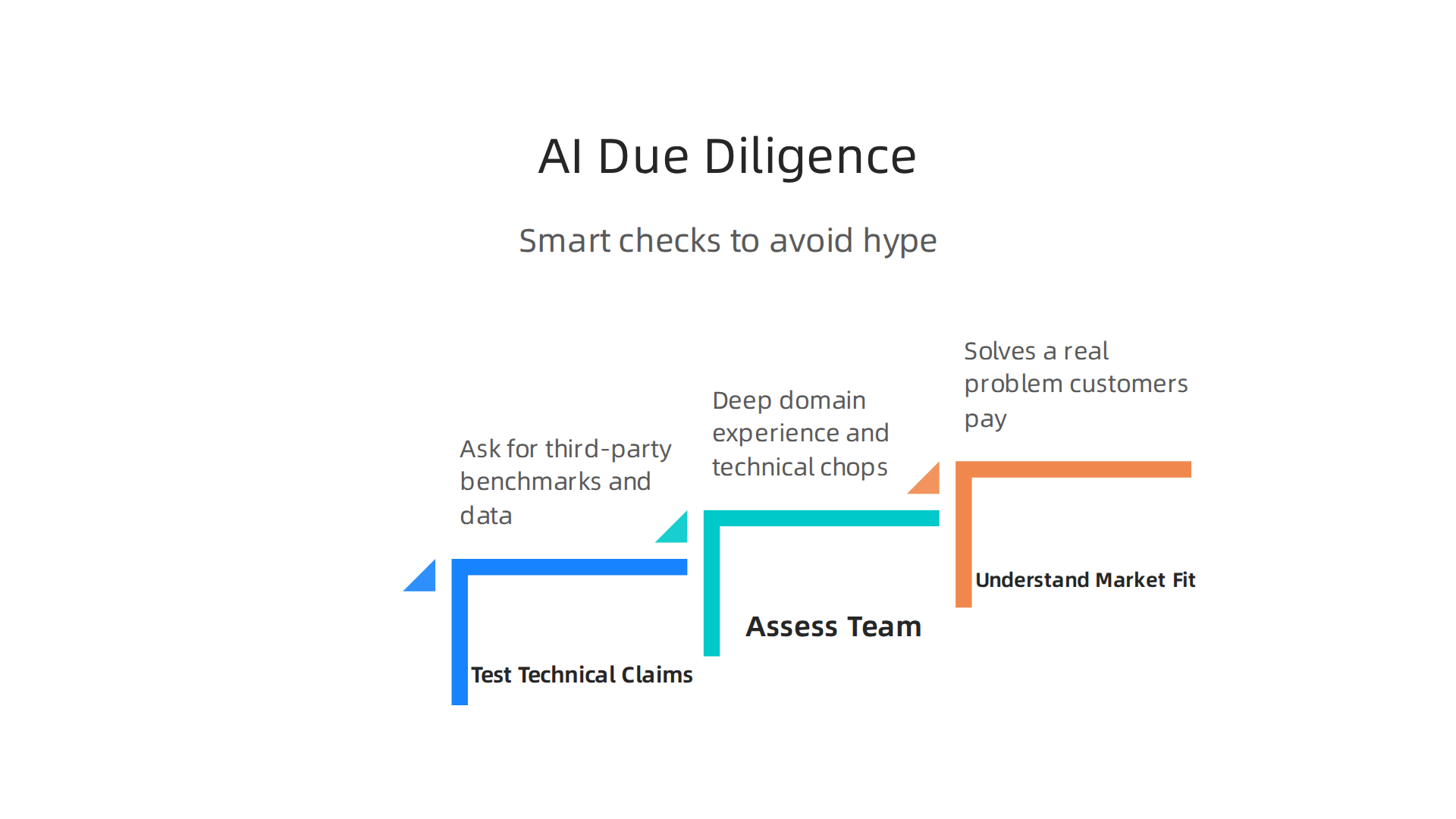
Start by Testing Technical Claims
Many AI startups make bold claims about what their technology can do. Words like "autonomous" and "self-learning" get thrown around a lot. Your job is to verify.
Ask for third-party benchmarks. Look for results from independent tests like those in the Stanford HAI report. If a company claims near-perfect performance on a coding benchmark, ask to see the data. Real AI companies share their test results willingly. Ones that hide behind marketing speak usually have something to hide.
Pay special attention to claims about autonomous AI. Most systems in 2026 still need human oversight in critical situations. The 2026 AI Business Predictions from PwC show that focused, responsible innovation matters more than flashy promises. Use that insight to guide your questioning.
Look at the Team Behind the Technology
The people building the company matter as much as the product itself. Strong teams have deep domain experience and real technical chops. The best indicator of future success is a founder who has done it before or has advisors with proven track records.
When you study AI companies closely, check who sits on the advisory board. Respected names in the field add credibility. They also help open doors for partnerships and future funding rounds. Teams without strong networks often struggle to gain traction.
Investors who skip this step miss a huge risk factor. A great team can fix a weak product. The opposite rarely works.
Understand Market Fit and Competitive Positioning
The final piece is market fit. Does the product solve a real problem that customers will pay for? Or is it a solution in search of a problem?
Check how the company differentiates itself from competitors. In 2026, the AI space is crowded. Companies that win have clear competitive moats. That could be proprietary data, unique engineering, or deep integration into customer workflows.
Avoid startups that cannot explain why customers pick them over alternatives. If the answer is vague, that is a red flag.
For a deeper look at how to size up specific platforms, read our guide on how to evaluate AI platforms for your startup in 2026. It gives you a practical framework to apply during your next deal review.
Doing proper due diligence takes time. But it saves you from putting money into companies that look good on paper but fall apart under scrutiny.

Stick to these basics, and you will navigate the hype with confidence.
Summary
This article gives a data-driven map of the AI company landscape in 2026, explaining who the major players are, where the money is flowing, and what separates winners from the rest. It breaks the industry into three layers—foundation model builders, vertical applications, and infrastructure—and shows how competitive dynamics differ across each. The piece reviews record funding patterns (including massive Q1 2026 rounds concentrated in a handful of frontier labs), geographic concentration of capital, and the metrics investors now use to judge AI businesses. It highlights the three practical advantage drivers—proprietary data, heavy R&D investment, and strong governance—and explains how to spot early signals like hiring, funding, and patent activity. You will learn which performance benchmarks matter (ARR, revenue multiples, burn multiple, margins), how to run basic technical and team due diligence, and which monitoring habits and tools help you stay ahead. Overall, the article equips founders, investors, and operators with the frameworks and practical checks needed to evaluate AI companies and make smarter funding or build decisions in a fast-moving market.