Venture Capitalists vs Angel Investors How to Choose the Right Funding for Your Startup

Introduction
You have a great idea for a company. But ideas alone do not build businesses. You need startup capital to turn that idea into something real. And that means figuring out who to ask for money first.
Most founders face the same fork in the road early on: do you pitch a wealthy individual who writes smaller checks and takes a personal interest, or do you approach a firm that manages a dedicated fund and expects rapid, measurable growth?

That is the difference between venture capitalists vs angel investors.
Each path comes with its own set of rules. Angels, including many nyc angel investors, typically invest at the very earliest stage. They bet on you as much as your idea. Venture capitalists, on the other hand, work within defined venture capital stages and often require proof of traction before they write a check. A venture capitalist will likely demand a board seat, a clear exit plan, and a much larger piece of your company.
The stakes are high. In 2026 alone, VC funding has already surged past $300B globally according to the latest VC fundraising trends of 2026. That is a lot of money moving through the system. But not all of it is right for every founder.
This article breaks down the real trade-offs between these two funding sources. We will look at dollars, timelines, control, and what each investor type actually expects from you. By the end, you will know which path fits your stage, your industry, and your personal goals.
If you are just starting to explore options, our detailed guide on how to find investors for your startup walks through the full process step by step.
To stay current as you make your funding decisions, get clear daily AI updates from The Deep View Newsletter by subscribing to The AI Newsletter Worth Reading.

It is a simple way to keep an eye on the trends that shape investor behavior.
What Are Angel Investors?
So who exactly are angel investors? Picture someone who has built wealth over time, often from selling a company or a long career in business, and now uses their own money to back early ideas. They are not writing checks from a big fund. Every dollar an angel invests comes from their personal bank account.
Here is what that means for you as a founder.
They invest smaller amounts than VCs. In 2026, individual angel investors typically write checks between $10,000 and $100,000 according to the latest angel vs VC funding comparison 2026. Some super angels and syndicates go higher, sometimes up to $500,000 or more. But the sweet spot for a first-time angel check is around $25,000 to $50,000.
They bet on people first, ideas second. Angels know they are investing before you have a finished product or proven traction. They look for founders who are passionate, coachable, and resilient. Your personality and work ethic matter more than your slide deck.
They offer more than money. Many angels have deep industry experience and valuable contact lists. They can introduce you to potential customers, partners, or even your next investor. They often take a mentorship role and check in regularly without demanding a board seat.
The terms are usually simpler. Instead of the complex deal structures VCs prefer, angels often use convertible notes or simple agreements for future equity (SAFEs). These are faster to close and cost less in legal fees.
Because of these traits, angel funding is typically the first outside capital a startup raises. It fills the gap between your own savings and the bigger checks that venture capital firms write later. If you are at the idea stage, angels are often your best starting point.
And if you are building in a vibrant startup hub, you will find that many startup funding trends in NYC are driven by active angels who specialize in early-stage deals.
But angels have limits too. They can only write so many checks, and they rarely participate in follow-on rounds. That is where venture capitalists enter the picture with deeper pockets and bigger expectations.
What Are Venture Capitalists?
While angels invest their own money, venture capitalists manage other people’s money. Venture capital firms pool cash from limited partners like pension funds, university endowments, and wealthy families. Then they invest that pooled money into high-growth startups that have already shown some traction.
Here is what makes VCs different.
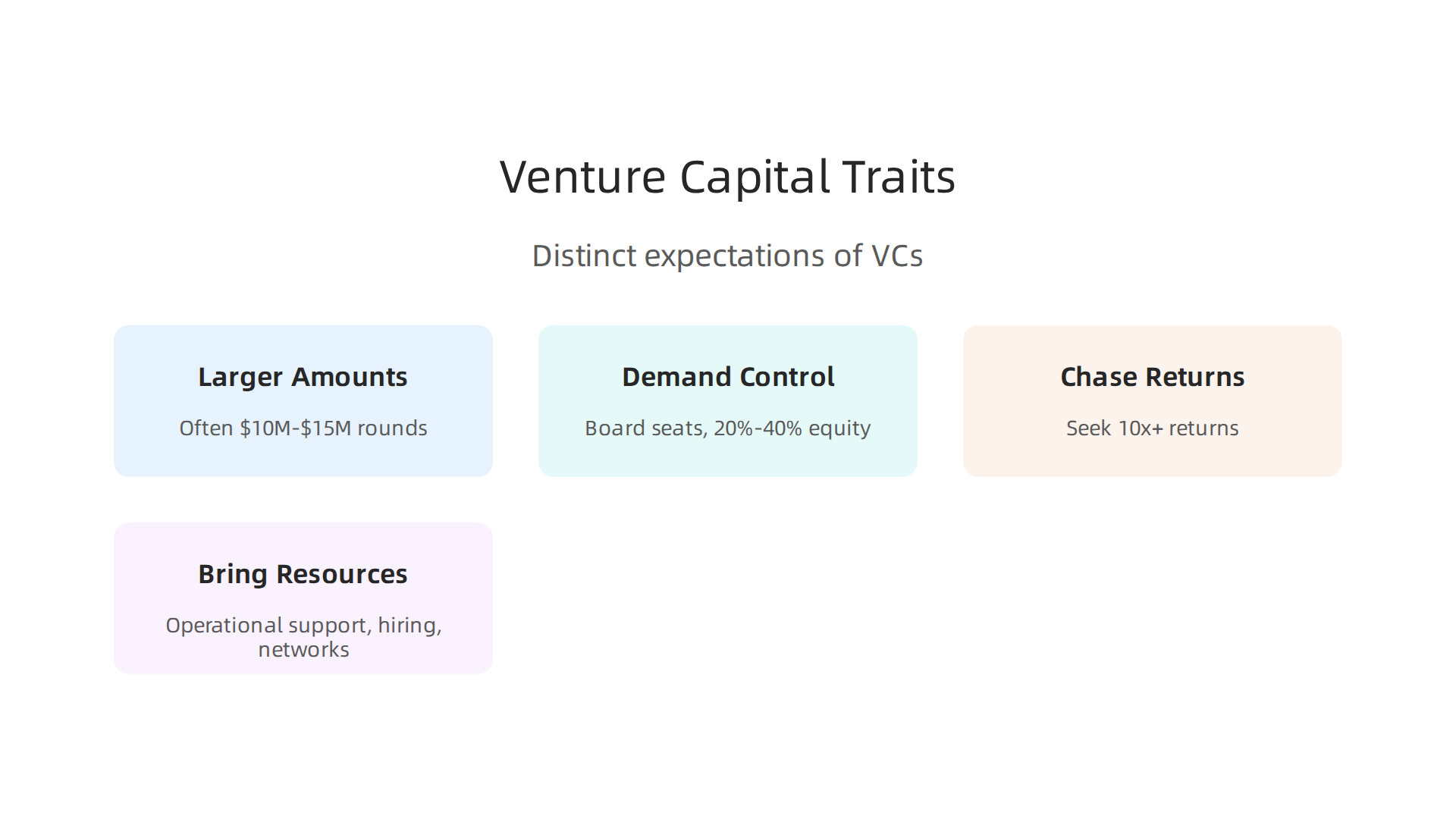
They invest much larger amounts. Where angels write $25,000 to $50,000 checks, VCs typically invest millions. In Q1 2026 alone, US venture deal value reached $267.2 billion according to the Q1 2026 PitchBook NVCA Venture Monitor. A typical VC round falls between $10 million and $15 million for later stages. And the bar keeps rising. The median Series A pre-money valuation hit $62 million in early 2026, nearly three times what it was a few years ago.
They demand much more control. When a VC firm writes a big check, they almost always ask for a board seat. They want a say in major decisions like hiring executives, setting strategy, and planning exits. They also take significant equity, often 20 percent to 40 percent of the company. And they put your business through rigorous due diligence before investing. They interview customers, study your financials, and stress-test your growth assumptions.
They chase outsized returns. VCs need their best bets to return 10 times or more. That is why they focus on startups in massive markets with potential to scale fast. If your business is unlikely to become a billion-dollar company, most VCs will pass.
They bring big resources. Beyond capital, VCs offer operational support, help with hiring, and access to their portfolio network. Many firms have partner teams that help with marketing, legal, and international expansion.
But those resources come with higher expectations. VCs expect faster growth, regular reporting, and a clear path to a big exit. If you want to understand how this compares to the angel path, check out this guide on venture capital firms for small businesses.
The bottom line? Venture capitalists bring institutional money and institutional pressure. They are a better fit once you have proven your model and need fuel for rapid scaling.
Key Differences at a Glance
So you now know what angel investors and venture capitalists do. But how do you decide which one to approach? The short answer comes down to three things: how much money you need, how far along your startup is, and how much control you want to give up.

Here is a quick breakdown of the biggest differences.
Check Size
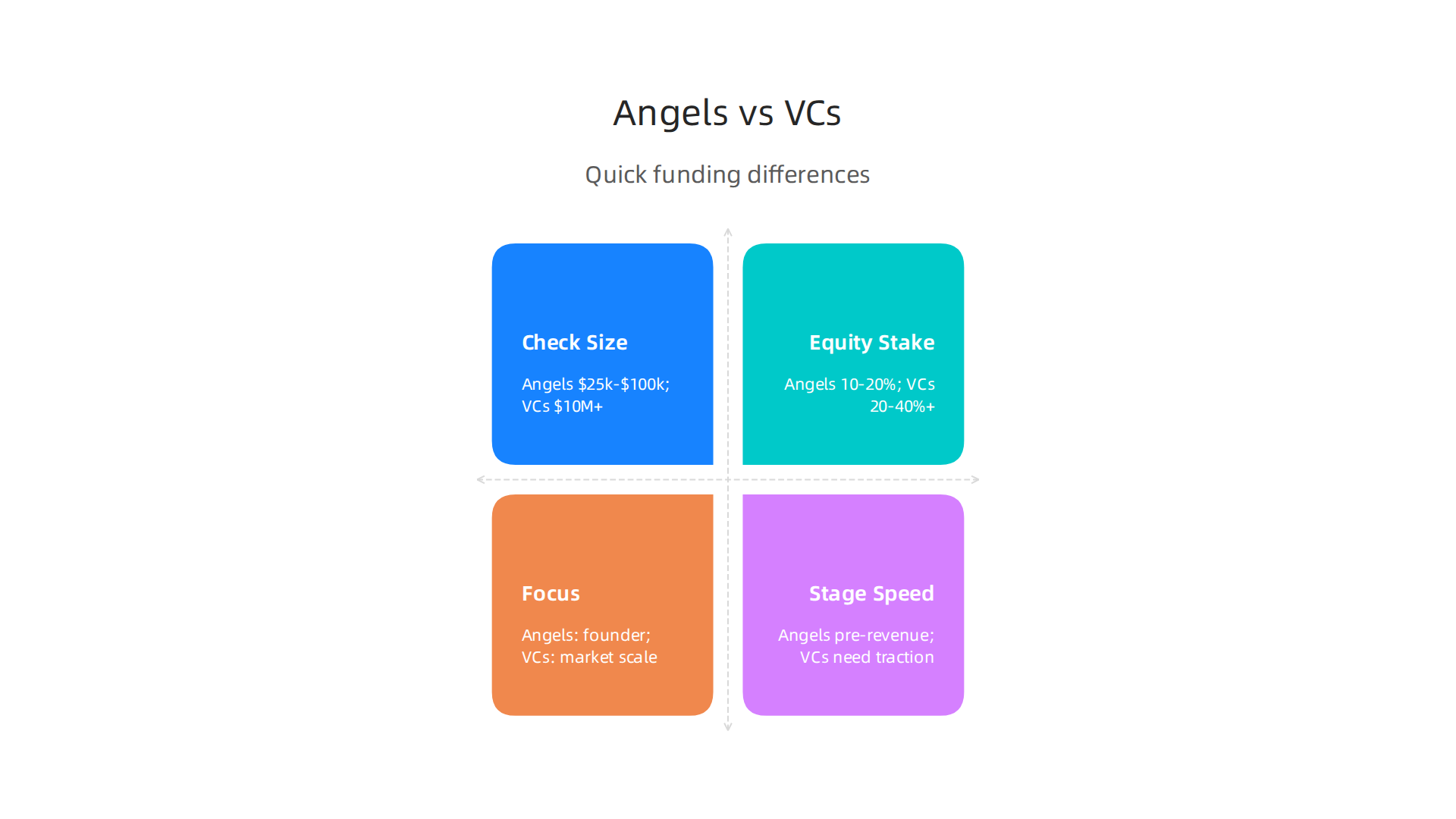
Angel investors write smaller checks. Most angels put in between $25,000 and $100,000 of their own money. Some go as high as $500,000 if they are wealthy and really believe in you. Venture capitalists, on the other hand, invest millions. A typical VC round starts around $10 million and goes up from there. That is a massive gap in startup capital.
Equity Stake
Because angels invest less, they ask for less ownership. Most angels take between 10 percent and 20 percent of your company. VCs need a bigger piece to make their large investments worthwhile. They usually target 20 percent to 40 percent or even more in later rounds. According to the Angel Investors vs VCs: 2026 Funding Landscape report, VCs are taking larger ownership stakes as deal sizes inflate.
What They Care About
Angels invest in you. They bet on the founder’s passion, vision, and early traction. If your product is rough but the idea is bold, an angel might still say yes. VCs care about numbers. They want to see big market size, strong unit economics, and a path to massive scalability. If your business can’t become a billion-dollar company, most VCs will pass.
Stage and Speed
Angels come in early. They fund pre-revenue startups and seed-stage companies. VCs want proof first. They usually invest after you have customers, revenue, and a repeatable sales process. The venture capital stages run from Series A through growth rounds, and each stage gets more demanding.
Involvement Level
Angels are often hands-on mentors. They give advice, make introductions, and cheer you on. VCs bring a whole team of support but also expect more. They want regular reporting, a board seat, and a clear exit plan within a few years.
Still not sure which path fits your situation? Check out this practical guide on how to find investors for a startup to map out your next move.
The main takeaway? Angels are great for early believers. VCs are for proven rockets ready to launch. Choose based on where you are today.
How to Choose Between Angel Investors and VCs
Now comes the real question. After looking at the differences, how do you actually pick the right path? Here is a practical way to think about it.
Your Startup Stage Matters Most
The single biggest factor is where your business sits today. If you have an idea, a prototype, or just a few early customers, you are in angel territory. That is what the data shows. According to the Startup Funding 2026: Stages, Valuations and What Works guide, pre-revenue startups almost always raise from angels first.

VCs need proof. They want to see revenue, traction, and a repeatable model before they write a check.
So ask yourself: do I have a proven product yet? If the answer is no, start with angels. If yes, start researching your first VC round.
Your Industry Changes the Math
Not every business fits the same funding model. Capital-heavy industries like biotech, hardware, or deep tech often need VC money early. Building a factory, running clinical trials, or manufacturing physical products costs millions. Angels cannot cover that.
But software-as-a-service companies and digital services can grow much longer on angel funding. You can build a solid business with a small team and a subscription model before you ever need a VC check. That is where the venture capitalist vs angel investor decision becomes clearer: your industry tells you which door to knock on.
What Kind of Support Do You Want?
This part is personal. Some founders thrive with a close mentor who picks up the phone on a Sunday night. That is an angel investor. Others need institutional resources like legal teams, talent networks, and operational playbooks. That is a venture capitalist.
If you are a first-time founder who values hands-on guidance, look for experienced nyc angel investors who have built companies themselves. If you need a full support system to scale fast, go after VCs. For a deeper look at how startup ecosystems connect, check out this article on nyc tech startups in 2026 funding trends and investor strategies.
The bottom line? Be honest about your stage, your industry, and the kind of support you actually need. That honesty will point you to the right partner.
Pros and Cons of Angel vs VC Funding
Every funding choice has trade offs. Let us lay them out side by side so you can see the full picture.
Angel Funding: What You Gain and What You Give Up
Angel money comes fast. You pitch an idea, build a relationship, and often get a check within weeks. There are fewer lawyers, less paperwork, and no institutional board watching your every move. That means you keep more control. Angels typically take smaller ownership stakes and ask for less formal reporting.
But there is a limit. Most angels write checks between $25,000 and $100,000. Some syndicates push higher, but you are not getting millions from one angel. According to Angel Investing vs Venture Capital: Pros and Cons for Startups, angels offer smaller, flexible cheques with hands on mentorship. That is great for early validation. It is not enough to scale a factory or fund a national ad campaign.
VC Funding: The Upside and the Downside
Venture capitalists bring serious money. A single Series A round can run several million dollars. That kind of startup capital lets you hire aggressively, build technology, and enter new markets. VCs also bring credibility. A respected VC name on your cap table signals to future investors and partners that you passed a rigorous screen.
The trade off is control. VCs take board seats, demand regular performance reports, and push for fast growth. They target 10 to 20 percent ownership because they need large returns for their fund. That means you will dilute your stake significantly. And if you miss milestones, VCs may push for leadership changes.
The Balanced View
Neither option is better across the board. Angels win on speed and founder friendliness. VCs win on capital and strategic weight. The right call depends on your stage and growth goals. If you are pre revenue and need a trusted advisor, start with angels. If you have traction and need rocket fuel, start researching the venture capital stages that fit your business.
For a deeper step by step guide on navigating the entire process, check out this article on how to find investors for a startup in 2026.
And if you want to stay ahead of the rapidly shifting funding landscape, The AI Newsletter Worth Reading delivers clear daily updates on the technology trends that shape where smart money goes.
Tips for Attracting the Right Investor
Knowing the difference between venture capitalists vs angel investors is one thing. Actually getting their attention is another. Each group looks for different signals, so you need to tailor your approach.
How to Attract Angels
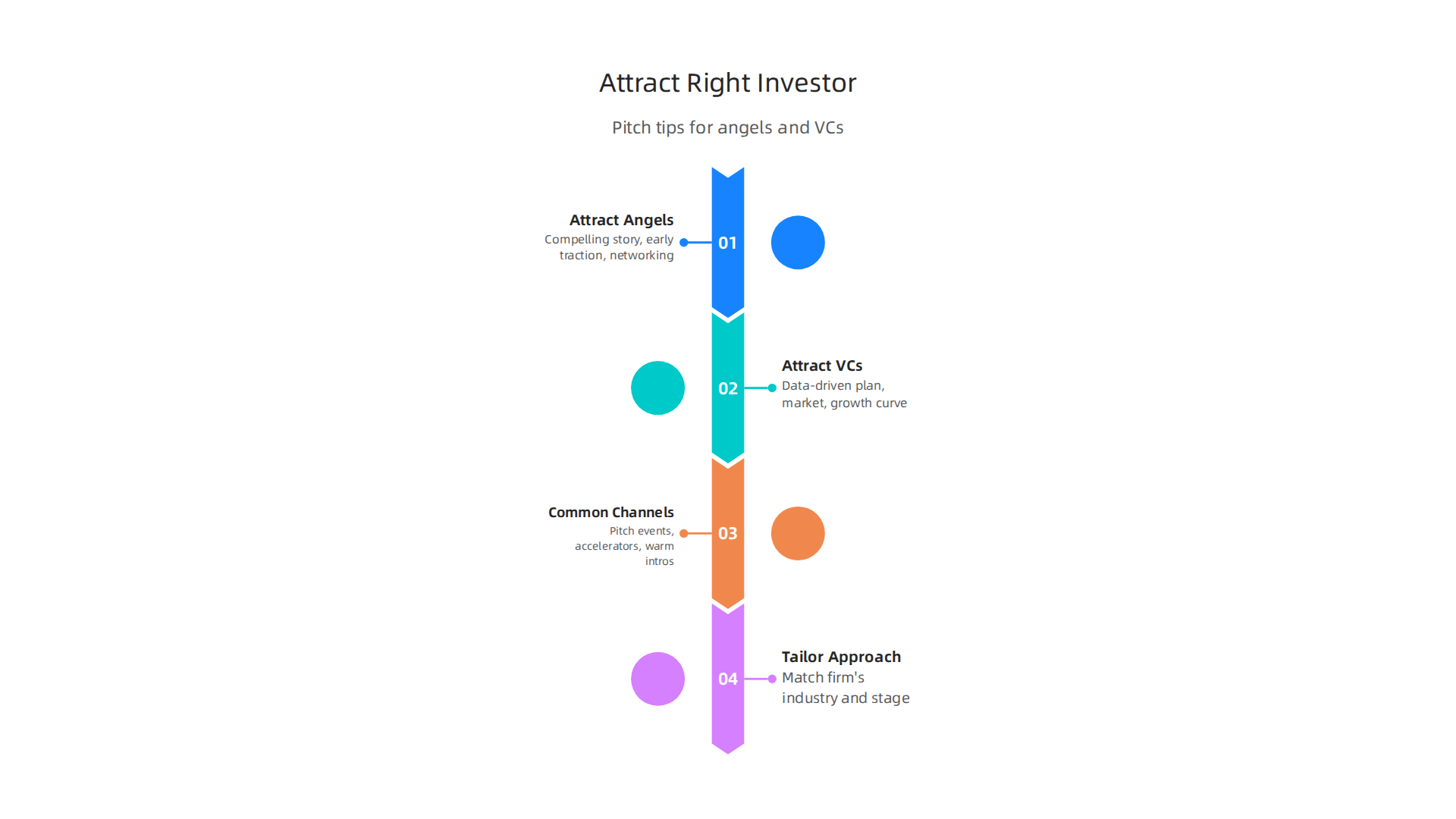
Angels invest in people first. They want to feel a personal connection and believe in your vision. A dry spreadsheet will not close the deal. Instead, tell a compelling story about why this problem matters and why you are the person to solve it. Show early traction, even if it is small.

A few paying customers or a growing waitlist proves you are building something real. According to What Investors Want in 2026, metrics like capital efficiency and unit economics now matter more than ever. Angels want to see that you use money wisely.
Networking matters a lot here. Attend pitch events, join accelerators, and ask for warm introductions. Most angel deals happen through someone you know. If you are targeting specific groups, look into nyc angel investors as a starting point for regional connections.
How to Attract VCs
Venture capitalists are more data driven. They want a detailed business plan backed by numbers. Show them your total addressable market, your growth curve, and how you plan to scale. VCs look for companies that can grow fast and big. They also care about your sector. Do not pitch a health tech idea to a firm that only does fintech. Do your homework and target firms aligned with your industry and stage.
Understanding venture capital stages helps you match with the right firm. A seed stage VC has different expectations than a Series A firm. Prepare for longer due diligence cycles and formal meetings. Warm introductions from other founders or advisors carry a lot of weight here too.
If you want a deeper look at which firms might fit your business, check out this guide to venture capital firms for small businesses. It breaks down firm types and what they look for.
The bottom line is simple. For angels, lead with story and connection. For VCs, lead with data and scale. Use both approaches through the same channels, accelerators, pitch events, and warm intros, and you will find the right fit for your startup capital needs.
Trends in Startup Funding 2026
Now let’s look at what is actually happening in the startup funding world right now. The landscape in 2026 looks very different from just a few years ago. If you want to raise money today, you need to know where the market is heading.
One major shift is the dominance of artificial intelligence. AI startups are grabbing a huge share of both angel and VC dollars. According to Startup Funding Trends: 7 Capital Shifts Founders Need to Know, AI captured $242 billion or about 80% of total global venture funding in the first quarter of 2026 alone.
That is massive. If your startup has an AI angle, investors will pay attention. If not, you still need to show how your business uses technology efficiently.
Another trend is the rise of angel syndicates and micro-VCs. These smaller groups are popping up everywhere. They pool money from many individuals to invest like a small fund. This blurs the line between venture capitalists vs angel investors. A micro-VC might act like an angel by writing smaller checks and offering hands-on help. But they also operate like a VC with a structured process. For founders, this means more options. You can now find investors who fit your exact stage and need without squeezing into just two boxes.
Valuations are also stabilizing. After the crazy boom of 2021 and 2022, things have settled down. Investors no longer throw money at any idea. They want a clear path to profitability. That is a good thing. It means your business needs real numbers and a solid plan. If you can show strong unit economics and a realistic growth curve, you will stand out.
For a deeper look at how AI is reshaping startup funding, check out AI companies in 2026 what founders and investors need to know.
Keeping up with all these changes is tough. That is why smart founders and investors subscribe to newsletters that cut through the noise. If you want clear daily updates on AI and startup funding without the fluff, The AI Newsletter Worth Reading delivers exactly that.
The bottom line: 2026 is a year of opportunity for founders who understand where the money is flowing and who adapt their pitch to match current investor expectations.
Common Myths and Misconceptions
There are plenty of wrong ideas floating around about venture capitalists vs angel investors. If you believe the rumors, you might pitch the wrong person in the wrong way.

Let us clear up two big myths.
Myth: Angel investors are just rich individuals with no process. Actually, many angels are experienced operators who spent years building companies. They do not just write a check and walk away. Most have strict criteria, run their own due diligence, and expect real answers from you. According to a detailed guide on Angel Investors vs. Venture Capitalists: How to Decide Who to Pitch to, angels often invest their own money in the $25,000 to $100,000 range and evaluate startups just as carefully as any VC firm.
Myth: VCs only care about hockey-stick growth. In 2026, that is simply not true. After the market corrections of the last few years, many venture capitalists now prioritize sustainable unit economics over flashy growth at all costs. They want to see a clear path to profitability, real revenue, and efficient customer acquisition. A pitch built on solid numbers beats one built on hype every time.
Understanding these myths helps you approach the right type of investor with realistic expectations. For a deeper look at how to prepare your pitch, check out this step by step guide to finding investors.
Myths About Angel Investors
Let us bust two more myths that trip up founders comparing venture capitalists vs angel investors.
Myth: Angels always invest at a lower valuation than VCs. Many founders assume an angel will try to get a bargain because they write smaller checks. In reality, most experienced angels follow market rates. They know the standard valuation benchmarks for your stage and industry. If you have traction and a solid plan, they pay fair prices. A detailed breakdown of typical check sizes shows that individual angels often write between $10,000 and $100,000, but they do not automatically discount your company. They respect what the market says your startup is worth.
Myth: Angels offer no strategic value beyond the money. This one hurts. The truth is that top angels often have deep industry expertise. Many are former founders, executives, or domain experts who have built companies themselves. They bring connections, advice, and credibility that can be just as valuable as the cash. In early stages, angel-backed startups perform as well as VC-backed ones precisely because of that hands-on support. For example, if you are raising in a major hub, checking out the funding trends and investor strategies for nyc angel investors can reveal how active and experienced those angels really are.
Do not underestimate what a good angel brings to the table. Whether you end up pursuing angels or a formal VC fund, understanding these myths helps you choose the right partner for your startup capital needs. If you want to see how angel funding fits into the bigger picture of raising money, take a look at this overview of venture capital firms for small businesses.
Myths About Venture Capitalists
Now let’s clear up two big misunderstandings about venture capitalists vs angel investors on the VC side.
Myth: VCs always demand majority equity. Many founders picture a venture capitalist taking 51% or more of their company. That is not how it usually works. Early stage VCs typically take minority stakes. A Series A investor might ask for 15% to 25% of your company. They want you to stay highly motivated because your growth is what makes their investment valuable. According to recent industry data, median pre money valuations for Series A rounds hit $62 million in early 2026, and most VCs aim for a meaningful but non controlling ownership position. You keep control of day to day decisions and a big piece of the upside.
Myth: VCs only invest in companies that are already successful. You might think you need millions in revenue before a venture capitalist will look at you. In truth, many VCs fund pre revenue startups with a strong founding team, a clear market, and early traction signals like user growth or pilot customers. They are betting on the team and the idea, not just current revenue. The 2025 NVCA Yearbook shows that seed and Series A rounds still make up a big share of total deal volume, proving VCs actively back early stage companies.
Understanding what VCs actually look for takes the fear out of the process. If you are ready to start your own search, check out this guide on how to find investors for a startup in 2026. It covers the exact steps to connect with the right partners. Knowing the truth behind these myths helps you compare venture capitalists vs angel investors with clearer eyes and a smarter strategy for your startup capital needs.
Summary
This article explains the practical differences between angel investors and venture capitalists and how founders should pick the right funding path. It covers who angels and VCs are, typical check sizes, equity stakes, involvement levels, and the stages when each makes sense. The guide shows how industry, growth needs, and founder preferences determine the best match, and it outlines how to tailor pitches—story and early traction for angels, data and scale for VCs. It also reviews 2026 funding trends, including AI’s dominant role and the rise of syndicates and micro-VCs, and it debunks common myths about both investor types. By reading this, founders will know when to pursue angel money, when to target institutional VC, what trade-offs to expect, and practical steps to attract the right backers.