
Strategic Imperative Find the Most Accurate AI Detector for Business
Why accuracy in AI detection is a strategic business issue
In 2026, artificial intelligence (AI) is everywhere. Companies use AI to create content for many things, like new products, marketing campaigns, and important research. This is great because AI can help businesses save money and do tasks faster. For example, some companies use AI in purchasing to cut costs and lighten workloads by a lot, helping them buy smarter. The problem is, when AI creates so much content, it can be hard to tell what’s real and what’s made by a machine.

This is where AI detection comes in.
For founders, investors, and big company teams, knowing if content is AI-made is very important. Think about it:
- Founders need to be sure their business plans and reports are based on true human insights, not just AI guesses.
- Investors put money into companies, so they need to trust that the information they get about a startup is truly from people and not just AI-generated fluff.
- Enterprise teams have to follow strict rules. They also need to keep an eye on what other companies are doing. If they can’t tell AI content from human content, they might make bad choices or miss important things. Inaccurate AI detection can even lead to critical risks of AI for founders and investors.
This is why having the most accurate AI detector is so important. When we talk about "most accurate," we mean a tool that rarely makes mistakes. It should be really good at finding AI content. But it also needs to be very careful not to say something made by a human was actually made by AI. If a detector gets this wrong too often, it can cause big problems. Imagine a deepbrain AI system creating very human-like content; a detector needs to be smarter to catch it.
Accuracy means balancing how well it catches AI content with how often it falsely accuses human content. If a company uses a poor detector for their AI for business needs, they might approve faulty products, break rules, or lose out to competitors because they couldn’t spot AI tricks. This makes choosing the right AI detection tool a very important business choice.
Do you want to stay up to date on all things AI?
The AI Newsletter Worth Reading
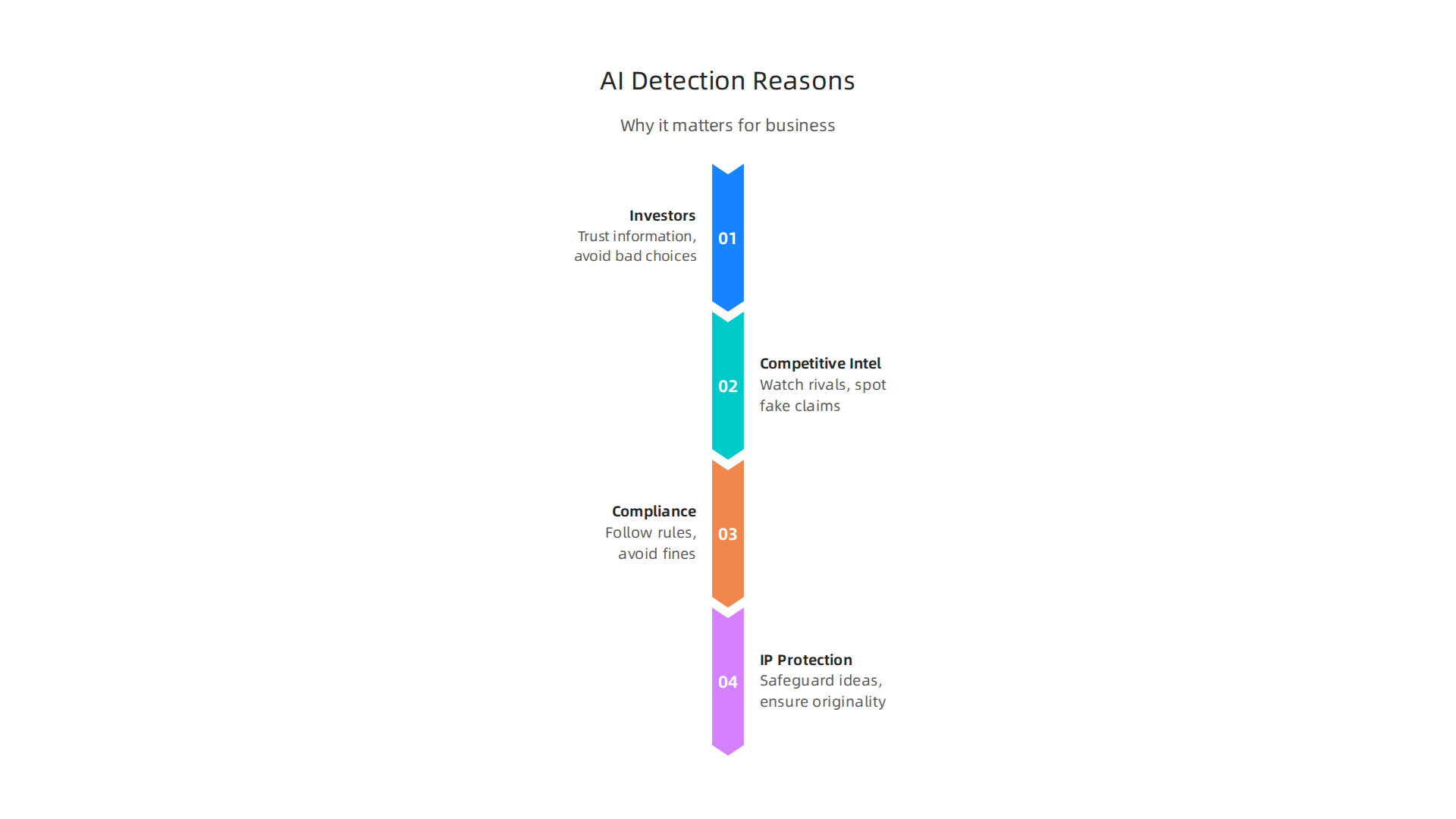
Knowing for sure if content comes from a human or AI is really big for companies. It helps them make smart choices and stay safe. Let’s look at why it’s so important for different groups:
For Investors Who Put Money In
Investors need to trust the information they get. When a startup asks for money, they share plans, numbers, and ideas. Investors use AI detection for due diligence. This means checking everything very carefully. If a startup uses AI to make up parts of their business plan or market research, investors might make a bad choice.

They need to know the ideas are real and from human minds. This helps them secure capital for their investments properly, like with Apex Funding How Startups and Investors Secure Capital in 2026.
For Keeping an Eye on Others (Competitive Intelligence)
Big companies and startups always watch what their rivals are doing. They look at new products, marketing messages, and company news. If a competitor is secretly using AI to make false claims or spread wrong information, a company needs to know. Without a reliable AI detector, they might react to fake news or miss real threats. This is a key part of AI for business strategies.
For Following the Rules (Compliance)
Many industries have strict rules about how information is created and shared. For example, in healthcare or finance, all reports must be fully accurate and often, human-vetted. If a company uses AI-generated content without knowing, they could break these rules without meaning to. This can lead to big fines or losing trust. This is especially true when dealing with advanced systems like deepbrain AI that can create very convincing content.
For Protecting Ideas (IP Protection)
Companies work hard to create new ideas and products. They need to protect their own intellectual property (IP). AI detection helps them make sure their own teams are not accidentally using AI-generated content that might have been copied from somewhere else. It also helps them ensure that content they create is truly original and can be legally protected as their own.
The Problem with Wrong Guesses: False Positives and False Negatives
The wrong guesses from AI detectors can cause real harm.
-
False Positive: This happens when an AI detector says human-made content was actually made by AI.
- What goes wrong? Imagine a bright employee writes a great report, but the detector says it’s AI. This can hurt trust, make the employee feel bad, or even lead to unfair punishments. One study in 2026 showed that some detectors make mistakes more often with non-native English speakers, with a 61.3% false positive rate in some cases. Other tests found that even paraphrased AI content can cause false positives for human writing, with rates of 10-30% for short student essays.
- Business Cost: This leads to wasted time, confusion, and a bad work environment. It can slow down important projects and stop good ideas from moving forward.
-
False Negative: This happens when an AI detector misses content that was actually made by AI and says it’s human.
- What goes wrong? If a competitor sends out fake news created by AI, and your detector doesn’t catch it, your company might make a bad decision based on that wrong info. Or if your own team is using AI-generated data that is faulty, and it goes undetected, it can lead to poor product decisions or marketing campaigns that don’t work.
- Business Cost: This can mean lost money, lost trust from customers, or missed chances to beat competitors. Independent tests in 2026 found that the real accuracy of commercial AI detectors can be much lower than what companies claim, sometimes performing 15-35 percentage points below advertised accuracy. Real-world accuracy often falls in the 66-92% range, which means they don’t catch everything.
To avoid these problems, businesses really need the most accurate AI detector they can find. It’s not just about finding AI; it’s about being right almost all the time. Choosing the right tool requires understanding how to evaluate AI platforms for your startup in 2026.
The wrong guesses from AI detectors can cause real harm, as we just discussed. To truly pick the most accurate AI detector for your business, it’s key to understand how experts measure if these tools are doing a good job. It’s more than just a single number; there are several important ways to look at how well a detector performs.
How Accuracy Is Measured: Metrics, Benchmarks, and Datasets
When someone says an AI detector is "accurate," what does that really mean? It’s not as simple as it sounds. Different numbers tell you different things about how well a detector works.
Core Metrics: Beyond a Single Number
Just saying a tool has "99% accuracy" can be misleading. Imagine a detector that just says everything is human. If 99 out of 100 texts are indeed human, it would seem 99% accurate, but it would miss all the AI content. That’s why we need to look at a few main measures:
- Precision: Think of precision as how trustworthy the detector is when it says something is AI. If it flags something as AI, how often is it truly AI? For businesses, high precision means you won’t falsely accuse your human employees of using AI. This helps avoid the "false positive" problem.
- Recall: Recall is about how good the detector is at finding all the AI content. If there’s AI content out there, how much of it does the detector actually catch? High recall is important for catching all hidden AI content, helping you avoid "false negatives."
- F1 Score: This is a way to combine precision and recall into one number. It helps you see if a detector is good at both being right when it flags something (precision) and finding most of what it should (recall). A good F1 score means the tool is balanced.
- AUC (Area Under the Curve): This is a fancy way to look at how well the detector can tell the difference between human and AI content across many different situations. It gives a broad picture of the detector’s strength. Using advanced AI models, like those powering
deepbrain AIsystems, requires sophisticated detection that these metrics help evaluate.
Many companies claim very high accuracy rates, sometimes over 99% for tools like GPTZero or TextShift, but independent tests often find real-world accuracy can be lower, sometimes in the 66-92% range. This shows why relying on a single advertised number isn’t enough for effective AI for business decisions.
Benchmark Datasets and Their Limits
To figure out how good a detector is, we test it using special collections of text called "benchmark datasets." These datasets usually have:
- Raw AI output: Texts written completely by AI.
- Clearly human-written text: Texts written by people.
- Edited or humanized AI text: Texts that were first made by AI but then changed by a person to sound more human.
A good test set needs all three types of writing to give a full picture of how well a tool works AI Detector Accuracy Comparison 2026: Unbiased Review. Some well-known datasets include HC3 (Human ChatGPT Comparison Corpus) and RAID. HC3, for example, has many examples of both human and ChatGPT answers across different topics, which makes it a useful benchmark A Systematic Review of AI-Generated Text Detection.
The challenge is that public benchmarks don’t always match the specific kinds of content a business uses every day. Your company’s internal reports or marketing materials might look different from a public dataset. So, while benchmarks give us a starting point, they don’t always show how a detector will perform on your specific company’s data. For this reason, many businesses develop their own internal testing methods using their unique content.
When looking for the most accurate AI detector, it’s important to ask about its performance on different types of content and how it handles the kind of writing your business produces. Knowing these details helps ensure you choose a tool that truly protects your interests. If you’re building out your data strategy, you might want to learn more about The Definitive Guide to Data Analysis Software for Business Growth.
To truly pick the most accurate AI detector, you need to know more than just its scores.

You also need to understand how these tools actually work. Different detectors use different "tricks" to spot AI-written text. Let’s look at the main ways they do this.
Core Detection Methods: Statistical, ML, and Watermarking — Strengths and Limits
AI detectors use clever methods to tell if text was written by a human or a machine. These methods can be grouped into a few main types.
How Detectors Find AI Text
-
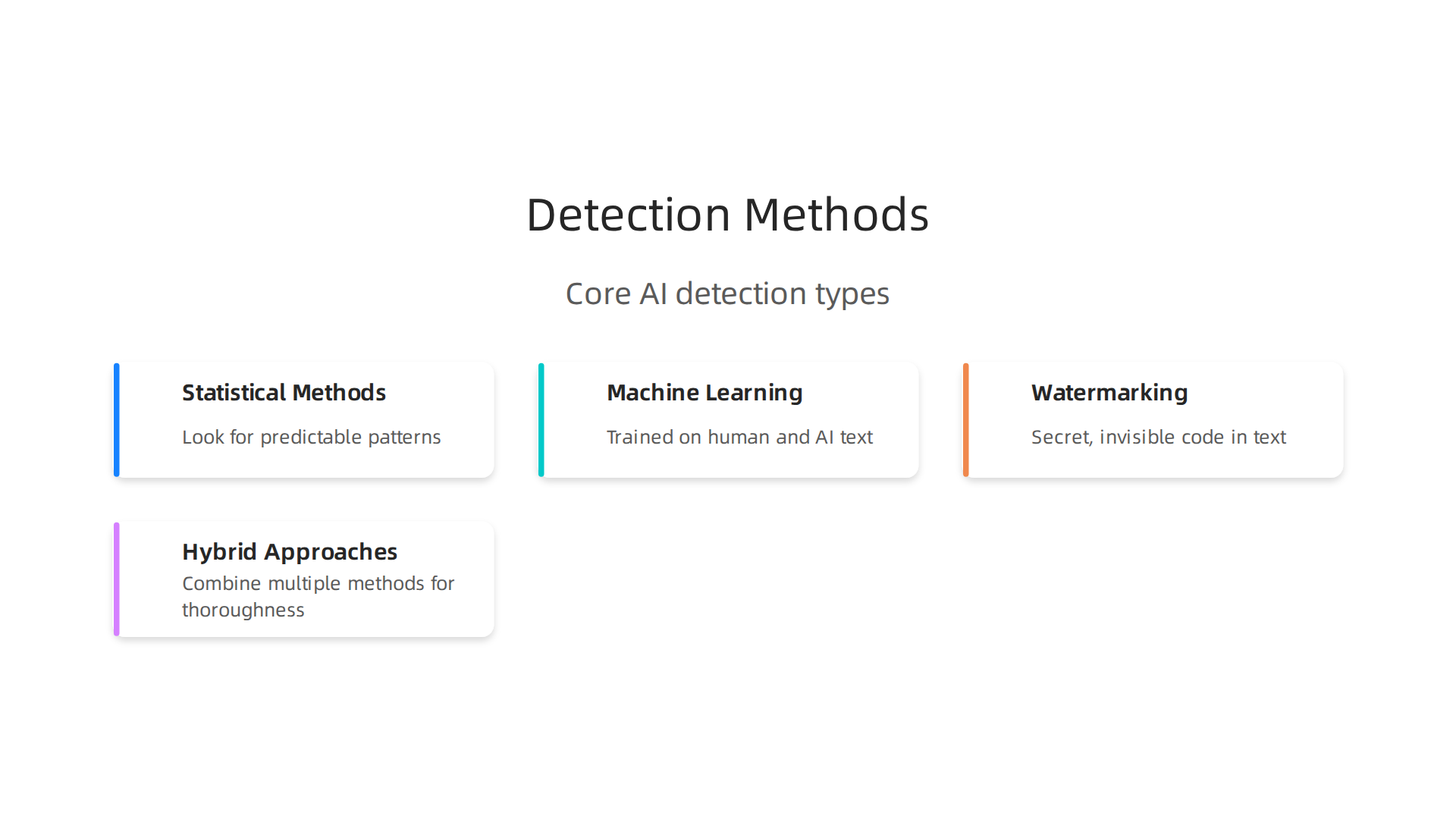
Statistical Methods (Token Distribution Analysis):
- Imagine AI writing like a picky chef who always uses the same few ingredients in the same order. Statistical detectors look for these "predictable" patterns in words or phrases. AI language models often pick words in a very common, expected way. Human writing is usually more random and surprising.
- These tools measure things like "perplexity" (how surprised the model is by the next word) and "burstiness" (how varied the sentence lengths are) to see if the text looks too perfect or too much like what a machine would choose On Detecting AI Writing.
- This is one of the older methods, but it’s still part of many tools, especially for finding simple AI text.
-
Machine Learning Models (Fine-Tuned Classifiers):
- These are like super-smart computer programs that have been trained on mountains of both human and AI-written text. They learn what makes human text human and AI text AI.
- They look for many things at once: grammar, style, word choice, and how ideas flow. When you feed new text to these models, they try to decide if it matches the human examples or the AI examples they’ve seen.
- Many popular AI detectors use these types of models, often called "transformer-based classifiers," which can be very good at telling the difference on text similar to what they were trained on AI Text Detection Methods.
- These models are a key part of powerful AI for business tools, helping companies filter vast amounts of information.
-
Watermarking:
- This is a newer, more direct method. Instead of guessing if text is AI, watermarking actually puts a secret, invisible code into the AI-generated text when it’s being created.
- Think of it like a hidden tag. The AI model is designed to pick words in a certain way that creates this tag, without changing how the text reads. Later, a detector can simply check for this secret code to confirm if the text came from that specific AI Watermarking for AI Content Detection: A Review on Text, Visual ….
- Watermarking has a big advantage: it can "prove" the origin of the text, rather than just "predicting" it Provable Robust Watermarking for AI-Generated Text. This can make it a very reliable way to detect AI content, especially for systems like
deepbrain AIthat might embed such signals.
-
Hybrid Approaches:
- Many advanced detectors use a mix of these methods. They might combine statistical checks with machine learning models and even look for watermarks. This helps them be more thorough and accurate.
Practical Challenges and Trade-Offs
Even with these smart methods, choosing the most accurate AI detector involves understanding their limits.
-
Robustness to Changes (Adversarial Modification):
- What if someone tries to trick the detector? If an AI-generated text is slightly changed or "humanized" by a person, some detectors can get confused. Tools that are robust can still spot AI even after these changes, like paraphrasing or adding human-like errors Post-Hoc Watermarking for Robust Detection in Text Generated by …. But many struggle with heavily edited content Detecting the Machine: A Comprehensive Benchmark of AI-Generated Text Detectors Across Architectures, Domains, and Adversarial Conditions.
- Actually, detecting AI text after it’s been messed with is one of the biggest challenges in 2026, as AI models get better and better.
-
Domain Shift:
- This happens when the text you’re trying to detect is very different from the text the detector was trained on. For example, a detector trained mostly on news articles might not do well on technical reports or creative writing.
- For businesses, this means a detector might perform poorly on your unique internal documents or specific industry content.
-
Language and Model Version Changes:
- AI models are always getting updated, and new ones appear all the time. A detector built for an older AI version might not work well on text from a brand-new model. Also, most detectors are best at English and might struggle with other languages.
These challenges show why no single AI detector is 100% perfect for every situation. When picking a tool, you should consider what kind of text you need to check and how likely it is to be "humanized" or come from a new AI. For more help with selecting the right tools, consider checking out our guide on how to evaluate AI platforms for your startup in 2026.
The difficulties of choosing the most accurate AI detector become even more important when companies use these tools for big business needs. This means looking at how AI detection fits into things like following the law, protecting company ideas, and making smart decisions when buying other businesses.
Enterprise Use Cases: Compliance, IP Protection, and Due Diligence Workflows
For businesses, AI detectors are not just about finding out if a student cheated on homework. They are critical tools for making sure everything runs smoothly and legally.
Keeping Up with Rules and Laws (Compliance)
In 2026, many new rules exist about how companies use AI. The European Union, for example, has the EU AI Act, which requires businesses to be very careful about AI use. AI detectors help companies follow these rules. For instance, they can check if content meant for public release was fully created by humans, as required by some regulations, or if AI played a part that needs to be disclosed. This helps companies avoid big fines and keep trust with their customers. Experts suggest that a technical audit guide is needed for EU AI Act compliance in 2026, highlighting the need for careful tracking of AI use. A good AI compliance checklist for 2026 includes keeping a list of all AI models used and making sure humans oversee important AI decisions.
Protecting Company Ideas (IP Protection)
Imagine a company that creates new software or designs. They want to make sure their unique ideas, called intellectual property (IP), stay safe. If employees use AI tools to help write code or marketing materials, the company needs to ensure that the AI isn’t accidentally copying existing work or creating text that looks too much like competitors. The most accurate AI detector can help check if any new content might have been overly influenced by public AI models, which could put the company’s IP at risk. Companies like deepbrain AI that handle sensitive data must be extra careful about where their content originates.
Checking Things Carefully (Due Diligence Workflows)
When one company wants to buy another, they do something called "due diligence." This means they check everything about the company they want to buy. In 2026, this often includes checking how the company uses AI. For example, are their internal documents or customer communications largely AI-generated? Are they using AI in a way that creates legal risks? AI detection tools can be used in these situations to get a clearer picture of the other company’s practices and potential hidden problems.
Managing Risks and Keeping Records
For every important decision made using AI detection results, businesses need strong rules and good records. This is called a risk-management framework. It means having clear steps for what to do when an AI detector flags something.
Key parts of this include:
- Human Oversight: Always having a person check AI decisions.
- Documentation: Keeping detailed notes about when and how AI detectors were used, what they found, and what actions were taken. This helps prove that the company acted responsibly.
- Audit Trails: Creating special records that track every step of an AI-influenced decision. Regulators expect these AI audit trails to be complete and tamper-proof in 2026. They should answer who triggered a decision, what data was used, how the decision was made, what the outcome was, and which rules guided it, according to an AI audit trails 2026 guide. These records are also needed to meet standards like SOC 2 and GDPR, especially when AI tools handle sensitive data AI Audit Trail: The Complete 2026 Guide.
By using the most accurate AI detector tools within these careful workflows, businesses can use AI safely and responsibly. Understanding the best AI platforms for business in 2026 is key for making these choices.
Want to keep up with the fast-moving world of AI and its impact on business?
The AI Newsletter Worth Reading
After understanding the big business needs for AI detectors, the next step is to pick the right one. This can be tricky, especially with so many options out there. Founders and investors need a clear way to choose wisely.

Choosing the Right Detector: A Checklist for Founders and Investors
Picking the most accurate AI detector is like hiring a new team member. You need to check their skills very carefully. For founders and investors, this means looking at how well a detector works, how clear it is, how fast it is, and what kind of problems it might cause.
What to Look for in AI Detectors
When you evaluate different tools, whether they are from a company or free to use (open-source), here’s what matters most:
- How Accurate Is It for Your Work?
Many companies that make AI detectors claim their tools are over 95% accurate. But the truth is, independent tests often show much lower numbers, sometimes between 66% and 92% in real-world use cases, depending on the tool and the kind of text it checks. A big gap often exists between what companies say and what actually happens when you test the tools yourself. For example, some vendor claims systematically overstate how well their tools perform in real life, sometimes by as much as 15 to 35 percentage points below what they promise. You need to know if the most accurate AI detector for your type of content truly delivers. - Is It Clear How It Works (Transparency)?
Does the detector tell you why it thinks something is AI-generated? Or does it just give a "yes" or "no"? Knowing how it makes its decisions helps you trust the tool more and understand its limits. - How Fast Does It Work (Latency)?
For businesses that need quick answers, like checking content before it goes live, the detector must be fast. A slow tool can hold up important work. - What’s the Risk of Mistakes (False Positives)?
A "false positive" means the detector thinks human-made content was actually created by AI. This can cause big problems, like wrongly accusing an employee of using AI when they didn’t. Some studies show that people who are not native English speakers can face a very high false positive rate, sometimes over 60%, with some major detectors. You want a tool that makes very few of these kinds of mistakes. Understanding these risks is important for any founder or investor to avoid problems. If you’re wondering why is AI bad unpacking critical risks for founders and investors, false positives from detection tools are a key concern. - What Support Does the Company Offer (SLAs)?
If you choose a paid service, what guarantees do they offer? This includes things like how quickly they respond to problems, how often the service is available, and what happens if it doesn’t meet those promises.
Steps for Buying and Testing AI Detectors
When bringing AI tools into your business, you need a smart plan. This is often called "procurement." Using AI in this process can even help businesses make smarter buying decisions themselves.
- Try It Out First (Pilot Evaluations):
Before buying a detector for everyone, test it with a small group or on specific projects. This "pilot" helps you see how well it works with your own team and content. - Use Your Own Data to Test It (Baseline Datasets):
Don’t just trust the numbers from the vendor. Use your company’s own documents and materials to test the detector’s accuracy. This helps you find the most accurate AI detector for your specific business needs. This way, you can properly evaluate AI platforms for your startup in 2026. - Protect Your Business with Contracts (Legal and Contractual Protections):
Make sure your contracts with AI detector companies clearly state what they are responsible for. This includes things like data privacy, how accurate their tool should be, and what happens if something goes wrong.
Choosing the right AI detector means looking beyond flashy marketing. It’s about careful testing and understanding the true strengths and weaknesses of each tool for your business. For those looking for top tools, a guide to the best AI platforms for business in 2026 compared and rated can be very helpful.
After picking the right AI detector, the next big step is to make it a smooth part of how your business works every day. This means connecting the detector to your existing tools and processes. It’s about making sure your chosen most accurate AI detector helps, not slows things down.
Bringing AI Detection into Your Daily Work
Thinking about how AI detection fits into your "ai for business" plan helps a lot. Here are common ways companies are doing it in 2026:
- API-first Tools: Imagine your AI detector has a special door that other computer programs can use to talk to it. This is called an API. Many modern AI detectors offer an API, letting you plug them directly into your own software. This means as soon as new content is made, your system can automatically send it to the detector for a quick check.
- Batch Scanning: Sometimes, you don’t need to check things one by one. Maybe you have thousands of old documents or a huge list of new articles. Batch scanning lets you send a large group of items to the detector all at once. It’s like putting a big pile of papers into a machine that sorts them for you.
- Embedding into Content Pipelines: For businesses that create a lot of content, like articles, reports, or marketing materials, AI detection can become a natural step. This means that after a writer finishes a piece, but before it’s published, the AI detector automatically scans it. This ensures all content meets your standards for originality and trust.
- Human-in-the-Loop Escalation: Even the most accurate AI detector can make mistakes. That’s why it’s smart to have a "human-in-the-loop." This means if the AI detector flags something as possibly AI-generated, a real person reviews it to make the final decision. This step is key to avoiding false alarms and building trust. Experts even talk about different ways AI detection works, like checking for patterns in language or using special "watermarks" to prove content came from AI tools during its creation, which can sometimes make detection more reliable. This helps in understanding the various methods like passive and active detection approaches for AI-generated text detection.
Keeping Your AI Detector Running Smoothly
Putting an AI detector in place is just the start. You also need to keep an eye on it to make sure it keeps working well for your business over time.
- Drift Detection: AI tools, including detectors, can sometimes "drift." This means their performance might change over time as new AI models come out or as the type of content you create changes. You need to watch for this drift. If your detector starts giving more false positives or missing more AI-generated content, you know something needs to be adjusted.
- Re-evaluation Cadence: Just like you would check on a new employee’s work, you need to regularly check how well your AI detector is doing. This means setting a schedule to re-evaluate its accuracy with your own data. This could be every few months or once a year, depending on how quickly your business and the AI world are changing.
- Feedback Loops to Improve Accuracy: The best way to have the most accurate AI detector for your specific needs is to teach it. When a human reviews content flagged by the AI and finds the AI was wrong or right, that information can be fed back to the detector. This helps the tool learn and get better at understanding your company’s unique content over time. Creating good audit trails for AI is crucial here. They provide a clear record of when and how AI detection tools are used, which is important for staying compliant with rules in 2026. These audit trails should log what the AI was asked to do and how it made its decision.
Keeping your AI detection tools updated and monitored helps ensure they remain a valuable part of your business strategy, helping you manage the risks and benefits of AI content effectively.
For those eager to stay on top of the rapidly evolving AI landscape and get daily, curated insights, consider subscribing to The AI Newsletter Worth Reading.
Summary
This article explains why accurate AI-content detection has become a strategic business issue for founders, investors and enterprises in 2026. It shows how unreliable detectors — whether they miss AI output or falsely flag human work — create real costs for due diligence, compliance, IP protection and competitive intelligence. The piece breaks down core performance metrics (precision, recall, F1, AUC), discusses benchmark datasets and domain limits, and compares detection approaches such as statistical analysis, fine-tuned classifiers and watermarking. It also outlines practical enterprise workflows, procurement and vendor-check steps, and how to integrate detection via APIs, batch scanning and human-in-the-loop reviews. Readers will learn how to test tools on their own data, set monitoring and audit-trail practices, and pick detectors that minimize business risk while remaining operationally practical.