
Stability AI 2026 Enterprise Growth Legal Risks and Investor Outlook

Introduction: The AI Race Heats Up – Stability AI’s Next Move
The world of generative AI is moving fast. Really fast. Every week brings a new model, a fresh funding round, or a bold claim about what artificial intelligence can do next. For anyone trying to keep up, it can feel like drinking from a fire hose.

In the middle of all this noise stands Stability AI. You probably know them as the company behind the open-source Stable Diffusion model. Unlike many big tech players that keep their AI locked behind paywalls, Stability AI chose a different path. They released their technology for anyone to use, modify, and build upon. That decision changed the game for creators, developers, and startups alike.
But here’s the thing. With so much happening so quickly, it’s hard to separate real breakthroughs from hype. You need curated insights that cut through the clutter. You need to understand what Stability AI’s latest moves mean for innovation, funding, and your own strategy.
That’s exactly what this article delivers. We’re going to take a deep dive into Stability AI’s current position in the market. We’ll look at their technical breakthroughs, their funding story, and what comes next. Whether you’re a founder tracking the competition or an investor looking for the next big opportunity, this analysis will help you make smarter decisions.
If you want to stay on top of AI developments without the noise, you can get clear daily AI updates from The Deep View Newsletter. It’s a fast way to keep your finger on the pulse.
We’ll also connect these trends to practical lessons for startup founders. For example, understanding how to evaluate AI platforms for your startup in 2026 can give you an edge when choosing the right tools for your business.
Let’s start by looking at why Stability AI matters more than ever in this crowded field.
The Evolution of Stability AI: From Open Source to Commercial Leader
When Stability AI first released Stable Diffusion, it was a big deal. The company gave away a powerful image generator for free. Anyone could download it, modify it, and build their own apps. That open-source move created a massive community of developers and creators. Within a short time, Stable Diffusion became the engine behind a huge chunk of AI-generated images online. According to recent estimates, the models have been used to create over 12 billion images and power about 80% of all AI visuals on the web in 2024. You can see the full financial picture in the Stability AI revenue and funding details from Sacra.
But here’s the twist. That open-source model gave the company reach, but it didn’t pay the bills. Running AI at scale costs millions of dollars every month. So Stability AI began shifting gears. Instead of giving everything away for free, they started charging for commercial use. They launched usage-based pricing for API access. Companies that want to use Stable Diffusion in their products now pay per image or per credit. Enterprise customers can sign annual deals that include custom model fine-tuning, dedicated support, and compliance certifications like SOC 2.
This pivot from open source to commercial leader didn’t happen overnight.
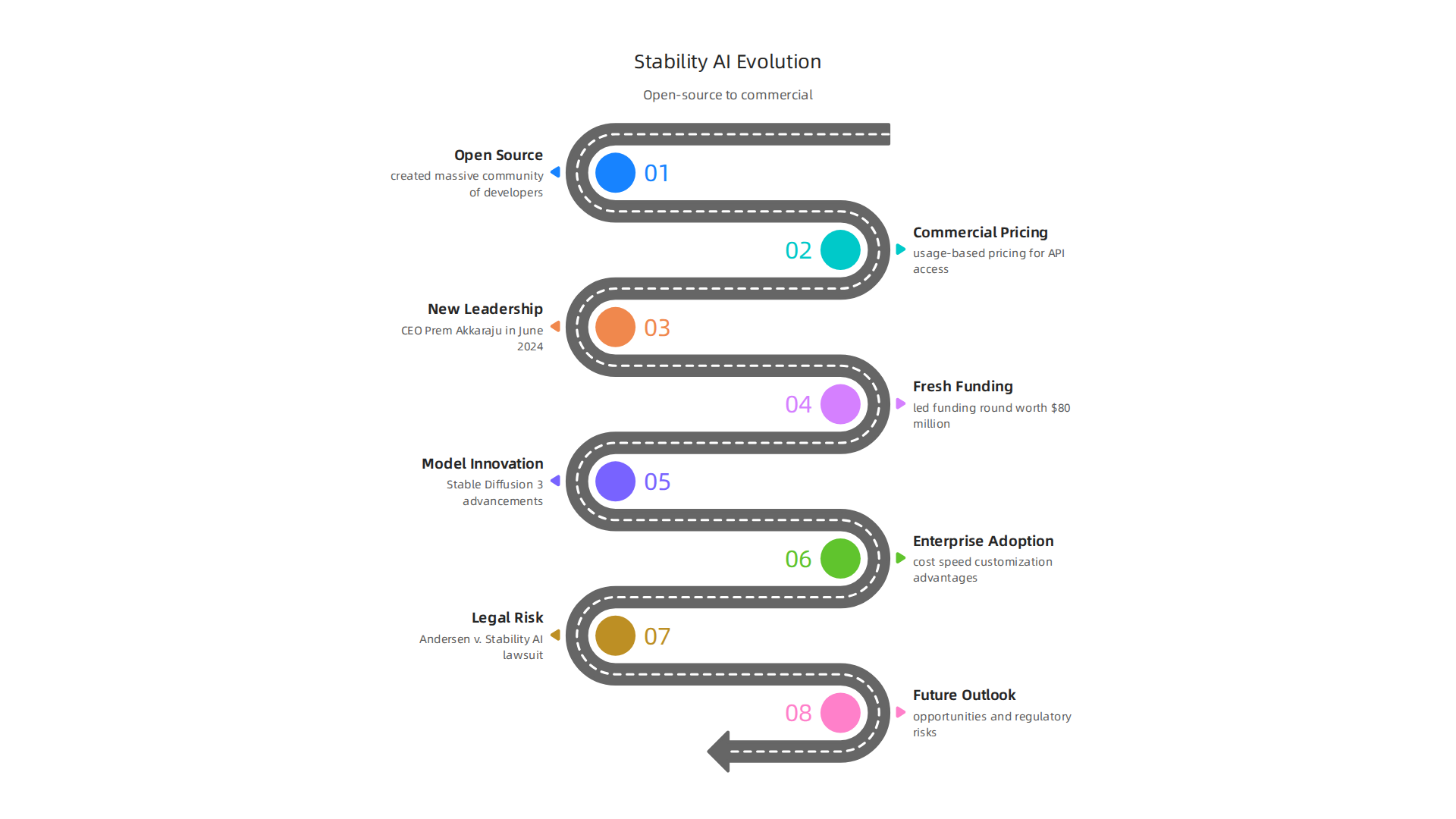
It required new leadership and fresh money. In June 2024, the company brought in a new CEO named Prem Akkaraju. He led a funding round worth around $80 million from big names like former Google CEO Eric Schmidt, former Facebook president Sean Parker, and top venture funds like Coatue and Lightspeed. That cash injection, combined with debt forgiveness from suppliers, gave Stability AI breathing room to build its enterprise business.
For investors watching the AI space, this evolution matters. Stability AI proved that open source can be a powerful marketing tool. But the real value comes from converting that community into paying customers. The company now relies on a mix of API credits, enterprise licenses, and custom models instead of trying to keep its technology secret. That’s a smarter, more sustainable approach.
If you are a founder trying to understand where AI is headed, the story of Stability AI offers a real world lesson. The shift from free to paid is hard, but it can work. You can learn more about how AI is changing startup strategies in this guide on how generative AI assistants are reshaping startup innovation and funding in 2026.
Stability AI’s Model Innovation: Stable Diffusion 4 and Beyond
The business pivot we just covered is only one side of the story. Under the hood, Stability AI has also been pushing hard on technology. The result is a string of model upgrades that keep getting better. The latest release, Stable Diffusion 3, set new records for image quality and prompt understanding.
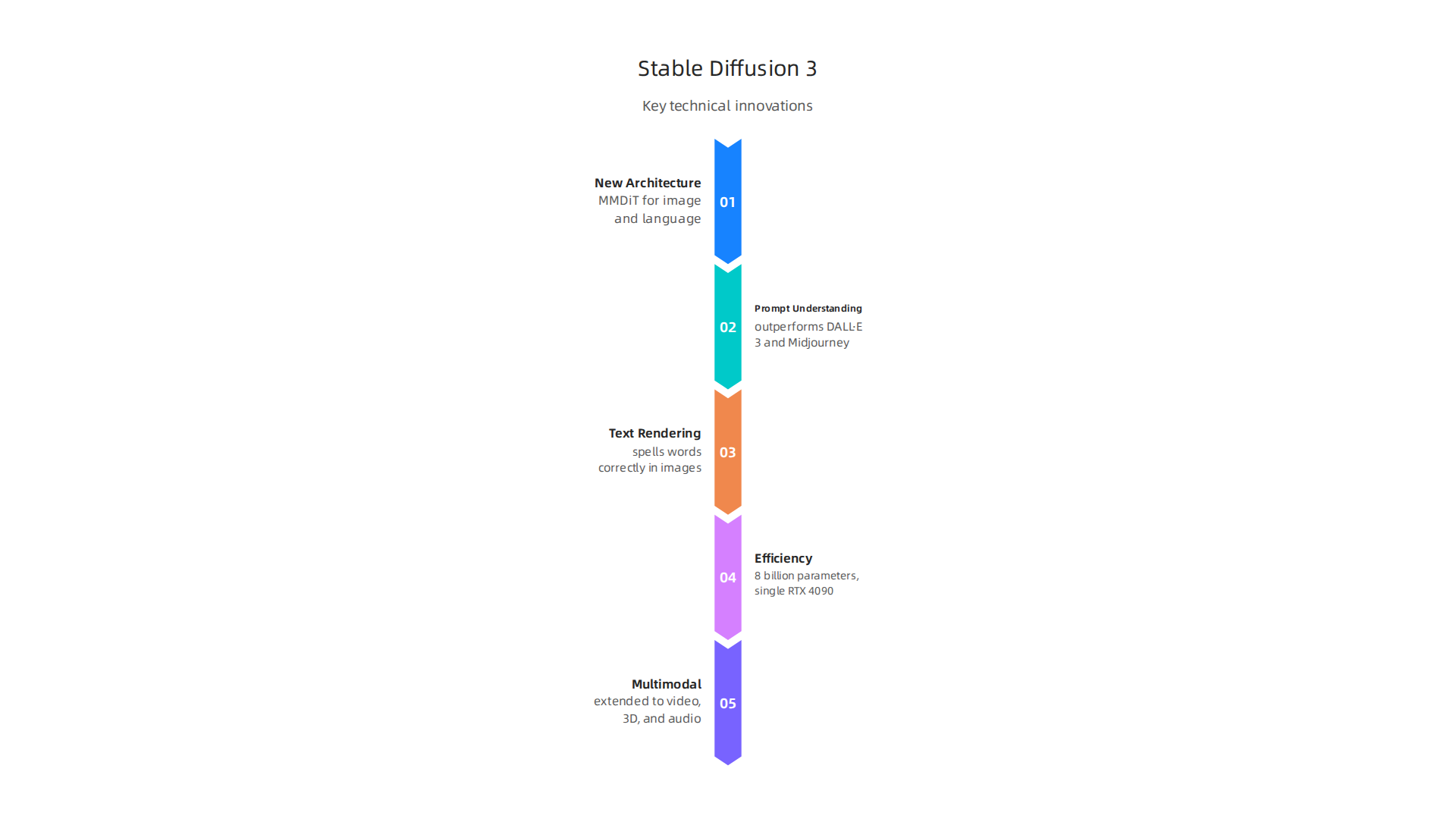
According to Stability AI’s own research paper, Stable Diffusion 3 outperforms competitors like DALL·E 3 and Midjourney v6 in both prompt adherence and text rendering. This is a big leap over earlier versions.
The secret is the new architecture called MMDiT, which uses separate weight sets for image and language data. That lets the model understand complex prompts much better. It can handle multi-subject scenes, spell words correctly in images, and follow instructions more closely. The largest version has 8 billion parameters but still runs on a single RTX 4090 GPU, generating a 1024×1024 image in about 34 seconds. That speed and quality combination is hard to beat.
But Stability AI isn’t stopping at images. The same architecture is being extended to video, 3D, and audio. Early previews suggest that the next generation of models will handle multiple modalities in one unified system. That means you could generate a video, turn it into a 3D object, and add sound, all using the same core engine. This is exactly the kind of versatility that founders and investors should watch. The tech buzz around these capabilities is growing fast, and tools like Creatify AI and Seamless AI are already integrating these models into their products.
For developers and startups, this means more choices and better performance. The model’s ability to accept multimodal inputs opens doors for creative applications that were not possible before. If you are evaluating which AI platform to build on, understanding these technical improvements matters. Learn more about how to evaluate AI platforms for your startup to make an informed decision.
The pace of innovation in this space is relentless. New models drop every few months, each one pushing the envelope further. To stay on top of every update and breakthrough without drowning in noise, Get clear daily AI updates from The Deep View Newsletter. It curates the most important developments so you can focus on building your business.
Funding Rounds and Investor Confidence in 2026
All that model innovation we just covered takes money. And in 2026, investors continue to put serious capital behind Stability AI. The company has raised a total of around $225 million since its founding, according to Stability AI’s funding history and revenue model. The biggest chunk came in 2025 when the company closed a $101 million Series A at a $1 billion valuation, led by Coatue and Lightspeed Venture Partners. That round signaled a strong vote of confidence in the open-source generative AI vision.

But the story really starts earlier. In June 2024, Stability AI reportedly raised $80 million from a group that included former Google CEO Eric Schmidt, former Facebook president Sean Parker, venture capitalist Robert Nelsen, and firms like Greycroft and Sound Ventures. According to the $80 million funding round and new CEO appointment, that same investor group also convinced suppliers to forgive more than $100 million in debt and $300 million in future spending obligations. That kind of support shows serious belief in the company’s long-term trajectory.
As of June 2026, the implied valuation sits around $657 million according to PM Insights data, not far off the unicorn mark. Investors see Stability AI as a key player in the generative AI boom, even as the broader market corrects for overhyped startups.
The macro environment backs that up. In Q1 2026 alone, venture capital investment hit $297 billion, with AI startups capturing a staggering 81% of all funding, according to Q1 2026 venture capital stats showing AI dominance. That tells you the appetite for AI is not cooling down anytime soon. For founders and investors watching where the smart money flows, Stability AI remains a name to track.
If you want to understand the big players writing those checks, check out the biggest investment companies of 2026 and how they shape startup funding.
Competitive Dynamics: How Stability AI Stacks Up
The generative AI space is fierce in 2026. Stability AI goes up against giants like OpenAI (behind DALL-E and ChatGPT), Midjourney, Google (with Imagen and Gemini), and a growing pack of open-source alternatives such as Black Forest Labs FLUX.

So how does Stability AI hold its ground?
The biggest differentiator is its open-source DNA. While competitors lock their models behind paywalls, Stability AI gives developers and creators free access to Stable Diffusion. That strategy has built a massive community. According to Stability AI usage and revenue growth statistics, over 900,000 individual users generate AI art each month. Developers have launched more than 2,500 apps and plugins on top of Stability’s APIs. And total images created with Stable Diffusion have passed 7 billion. Those numbers give Stability AI real developer mindshare.
On the pricing front, Stability AI undercuts the competition. Its API plans start at $19 per month, while Midjourney charges $30 to $120 per month. That gap matters for startups and small creative teams watching their budgets.
But the company is not just fighting on price. In 2026, Stability AI is making a strategic pivot from a consumer app to an enterprise infrastructure layer. As detailed in Stability AI’s 2026 revenue strategy and enterprise pivot, the company now locks in $50,000 to $200,000 per year SaaS contracts with design and marketing teams. It also licenses model weights to big names like Adobe and Unreal Engine for OEM deals worth $5 million to $20 million. That move turns the open-source "problem" into a moat.
Overall, the AI market is massive and growing. The AI market share by company statistics for 2026 show the global AI market hit $514.5 billion this year, with generative AI alone growing 45% to $91.57 billion. Within that pie, Stability AI’s enterprise revenue jumped 120% year-over-year as Fortune 100 companies adopted its tools for creative workflows.
For founders and investors trying to pick the right AI platform for their startup, it helps to know what questions to ask. Check out this guide on how to evaluate AI platforms for your startup in 2026 to make a smarter choice.
Want to stay ahead of these fast-moving AI shifts? The Deep View Newsletter delivers clear daily AI updates straight to your inbox.
Real-World Enterprise Applications of Stability AI
So where are companies actually putting Stability AI to work in 2026? The answer is everywhere: from marketing teams cranking out product shots to architects exploring design concepts in seconds. The common thread is value delivered fast.
Take HubSpot, for example. The marketing platform needed a way for its customers to generate on-brand images at scale. By using Stability AI models through Amazon Bedrock, HubSpot scaled image generation by 150%. That means marketers can create professional visuals without waiting for a designer. You can find this story and others in the Stability AI customer success stories page.
Then there is Mercado Libre, Latin America’s largest ecommerce marketplace. They built a tool called GenAds that uses Stable Diffusion to create ad images for sellers. The result? A 25% jump in click-through rates. Small sellers suddenly get professional-grade advertising without a big budget.
Education is another big area. Stride Learning launched a reading comprehension app for K-12 students that produces over 1,000 images per minute. Kids get personalized story visuals that boost engagement. All built in just six months using Stability AI on Amazon Bedrock.
Beyond these case studies, enterprises choose Stability AI for three main reasons.
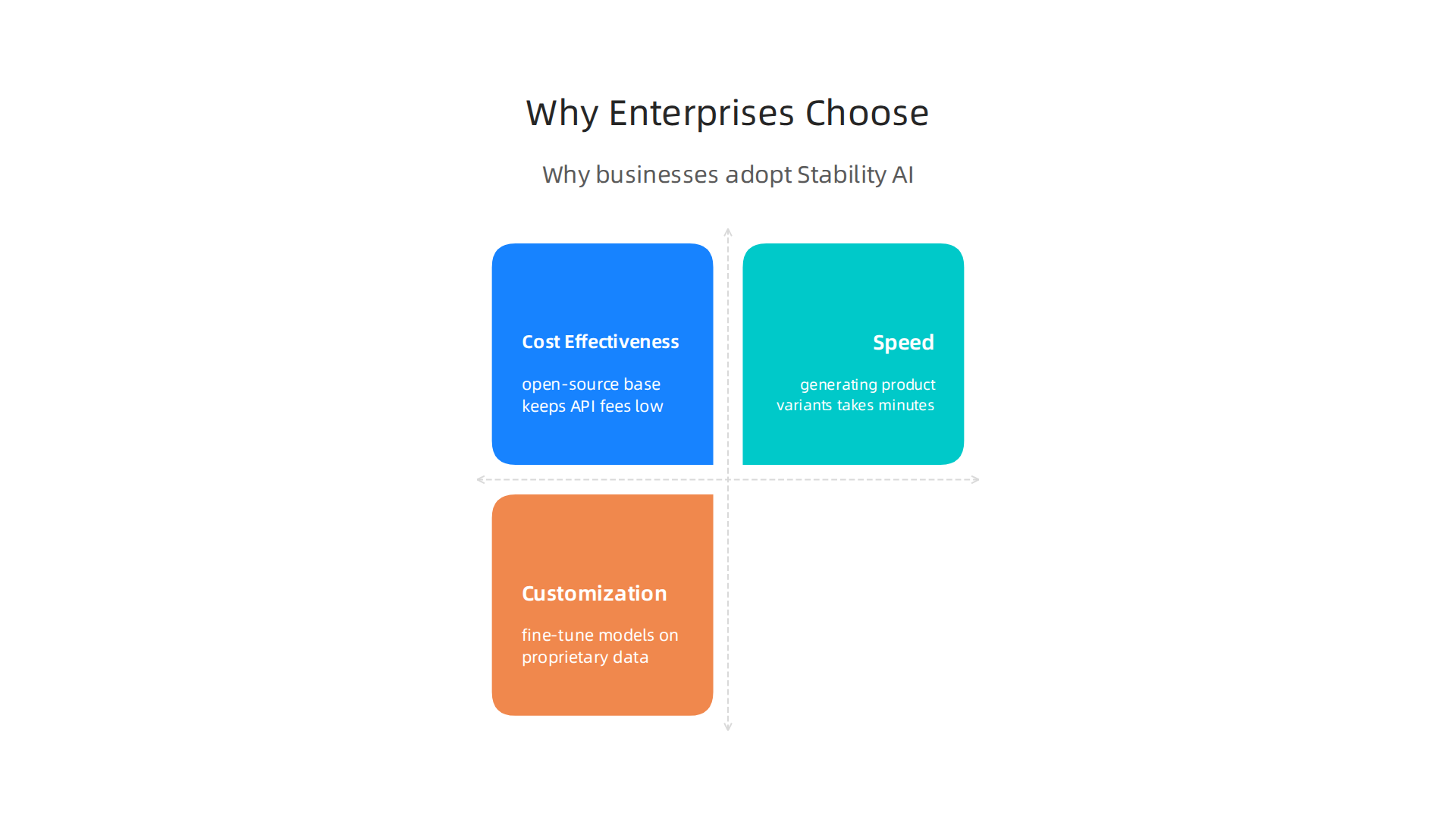
First, cost. The open-source base keeps API fees low compared to competitors. Second, speed. Generating a batch of product variants takes minutes instead of days. Third, customization. Companies can fine-tune models on their own proprietary data, so the output matches their brand style exactly.
For startups looking to build similar AI-powered tools, understanding these real-world patterns is useful. Check out this guide on generative AI assistants reshaping startup innovation to see how the same technology can power your own product.
The bottom line: Stability AI is not just a model. It is a creative engine that enterprises in media, retail, education, and beyond are using to save money, move faster, and deliver work that stands out.
Navigating Ethical and Legal Challenges
For all the power Stability AI puts in your hands, it also raises serious questions.

The technology does not exist in a vacuum. In 2026, the company sits at the center of major legal battles that could reshape how every AI company operates.
The biggest test is the Andersen v. Stability AI lawsuit. Visual artists claim Stability AI used their copyrighted works to train Stable Diffusion without permission. The case has had many twists. Parts were dismissed early on. But in August 2024, a judge let the core copyright claims move forward. The trial is now set for September 2026. If the artists win, it could change how AI companies build their training data forever.
Then there is the fight with Getty Images. In the UK, Getty argued Stability AI scraped millions of its photos without consent. In November 2025, the High Court delivered a mixed ruling. Getty won on trademark infringement. But the court rejected Getty’s main copyright claim. The Getty Images v Stability AI High Court ruling found that Stable Diffusion does not store or reproduce copyrighted works inside the model itself. That was a big win for Stability AI.
These two cases are just the start. As of March 2026, there were 87 active copyright lawsuits against AI companies in the United States alone. That number keeps climbing.
Beyond copyright, real concerns remain about bias in AI outputs, the spread of deepfakes, and how to deploy these tools responsibly. Regulators are paying close attention. The EU AI Act puts strict rules on high-risk AI systems, which includes image generators. Stability AI has to follow these rules to keep operating in Europe.
What does this mean for you? If you are building a startup around AI, you need to choose your tools carefully. One smart step is to learn how to evaluate AI platforms for your startup so you pick solutions that respect copyright and follow emerging regulations.
The legal landscape shifts almost weekly. Staying up to date matters. The AI Newsletter Worth Reading delivers clear daily updates on AI rulings, regulations, and the tech behind them straight to your inbox.
Developer Ecosystem and Community Engagement
While the legal fights make headlines, something quieter and just as important keeps happening behind the scenes. The developer community around Stable Diffusion has become one of Stability AI’s biggest competitive advantages. And in 2026, it is only getting stronger.
The numbers tell the story. Developers have built over 2,500 unique applications and plugins using Stability AI’s APIs. Community members have contributed more than 250,000 custom trained models and fine-tunes. Over 900,000 individual users generate AI art and media using Stability’s open models every month. These statistics on the Stability AI developer community in 2026 show how much people invest their time and skills into the platform.
Why does this matter for you as a founder or investor? A strong developer ecosystem creates what tech people call platform stickiness. When thousands of developers build tools on top of your model, they are not leaving anytime soon. Each custom model, each plugin, each integration makes the whole network more valuable.
Stability AI has leaned into this hard. The company now offers dedicated SDKs and API packages for businesses of all sizes. You can fine-tune models on your own data. You can set safety filters that match your brand. You can license outputs for commercial use without worrying about legal surprises.
For startups looking to build on this foundation, understanding the difference between approaches helps. You can read more about the agentic AI vs generative AI debate to figure out which strategy fits your product roadmap better.
The community does not just consume Stability AI’s work. It pushes the technology forward. New fine-tunes appear daily. People share prompts, workflows, and best practices openly. This constant flow of innovation keeps Stable Diffusion ahead of closed-source alternatives that rely only on internal teams.
For any startup thinking about building on Stability AI, the developer ecosystem is the real prize. It is not just about the model itself. It is about the hundreds of thousands of people who make the model better every single day.
Future Outlook: Investment Opportunities and Risks
So where does Stability AI go from here? The company sits at a crossroads with huge upside and real danger on both sides.

For founders and investors watching this space, understanding the balance matters.
The opportunity is real. Enterprise demand for generative AI tools keeps exploding. Companies in every industry want to generate images, video, and design assets faster. Stability AI’s open model approach gives it a unique advantage here. Businesses can fine-tune Stable Diffusion on their own data without giving up control. That flexibility is a strong selling point as more organizations adopt AI in 2026.
If you are evaluating where to place bets, you might want to read more about how to evaluate AI platforms for your startup in 2026. This guide walks through the key factors founders and investors should check before committing.
But the risks are just as big. Competition is fierce. Midjourney, OpenAI with DALL-E, and Google’s Imagen are all fighting for the same users. Stability AI’s open model helps, but it is not a guaranteed moat.
Regulation is the bigger wildcard. The legal battles are far from over. The landmark case Andersen v. Stability AI is heading toward trial on September 8, 2026. That trial could reshape how AI training data works in the US. If the court rules against Stability AI, the costs and restrictions could be massive. The Andersen v. Stability AI case details show how deep the copyright questions go.
For investors, the valuation story is tied to exits. Stability AI has raised significant funding, and the clock is ticking. A public IPO or an acquisition by a larger tech company are both possible paths. But the outcome depends heavily on how the legal and competitive landscapes settle over the next 12 to 18 months.
Also, reliance on public cloud infrastructure carries hidden risk. Training and running large models at scale is expensive. If cloud costs spike or if access becomes restricted, margins could shrink fast.
The bottom line? Stability AI has the technology and the community to win. But the risks around regulation, competition, and infrastructure are real. Anyone considering an investment should watch the September trial closely and keep an eye on competitor moves.
If you want to stay on top of these developments without the noise, subscribe to The AI Newsletter Worth Reading. It delivers clear daily updates on AI companies, funding news, and legal shifts that matter.
Summary
This article analyzes Stability AI’s current position in the fast-moving generative AI market, tracking its shift from open-source pioneer to a commercial enterprise player. It covers the company’s technical advances (notably Stable Diffusion upgrades and the MMDiT architecture), recent funding rounds and valuations, and how those moves enable enterprise contracts and OEM deals. The piece also explains real-world deployments—marketing, ecommerce, education—and why a large developer community gives Stability durable advantages. At the same time it lays out legal and regulatory risks, including major copyright lawsuits and EU rules that could reshape training data practices. Readers will learn how Stability AI’s strategy affects startup choices, what to evaluate when picking an AI platform, and which operational, legal, and competitive signals matter for founders and investors in 2026.