
Tech for Social Good in 2026 Ethical AI Principles and Real World Impact

Introduction
Artificial intelligence is moving faster than ever. In 2026, conversations about the ai singularity and private ai systems are no longer science fiction. They are real debates happening in boardrooms, government halls, and tech hubs around the world. But here is the tension: as advanced technology races ahead, we have to ask ourselves if it is actually making life better for people. Or is it just making a few companies richer?
That is where tech for social good comes in. This idea is not just a nice slogan. It is a practical framework for building technology that solves real problems.

According to the World Economic Forum, tech for good means using digital tools to take on big social and environmental challenges, from improving access to education to protecting the planet. In this article, we will break down what tech for social good looks like in 2026, why ethical AI is the foundation of lasting impact, and how you can apply these ideas to your own work.
We will explore the latest trends, real world examples like how the landscape of AI companies in 2026 is shaping responsible innovation, and actionable strategies.

If you want to stay ahead of these developments, a quick daily read like The AI Newsletter Worth Reading can keep you informed without the noise.
Let us dive in.
Defining Tech for Social Good and Its Growing Importance
So what exactly is tech for social good? At its core, it means using technology to solve real problems for people and the planet. The World Economic Forum describes it as a space where digital tools take on big social and environmental challenges, from improving education to protecting our climate. You can read their full breakdown in this Tech for Good definition and framework.

It is not just about building cool gadgets. It is about building things that actually help.
This idea did not start in 2026. Early efforts focused on bringing basic internet and computers to underserved communities. That was the ICT4D (information and communication technology for development) era. But now things look very different. In 2026, we have private AI models running on your phone. We have AI singularity discussions happening in government offices. These tools are powerful, and that power can either widen the gap or close it. That is the inflection point we are at right now.
Here is the thing. Without ethical guardrails, tech for good can turn into tech for harm. A facial recognition system built with biased data does not help anyone. An AI chatbot designed to teach kids can spread wrong information. That is why ethical AI is not a nice extra. It is the foundation. It means building technology that is fair, transparent, and accountable from day one. If a project skips ethics, it should not be called tech for good at all.
As you explore this space, knowing which best AI platforms for business in 2026 actually put these principles into practice can help you make smarter choices. The companies that lead with ethics are the ones that will last.
Core Ethical AI Principles for Social Impact: Fairness, Accountability, Transparency, Privacy
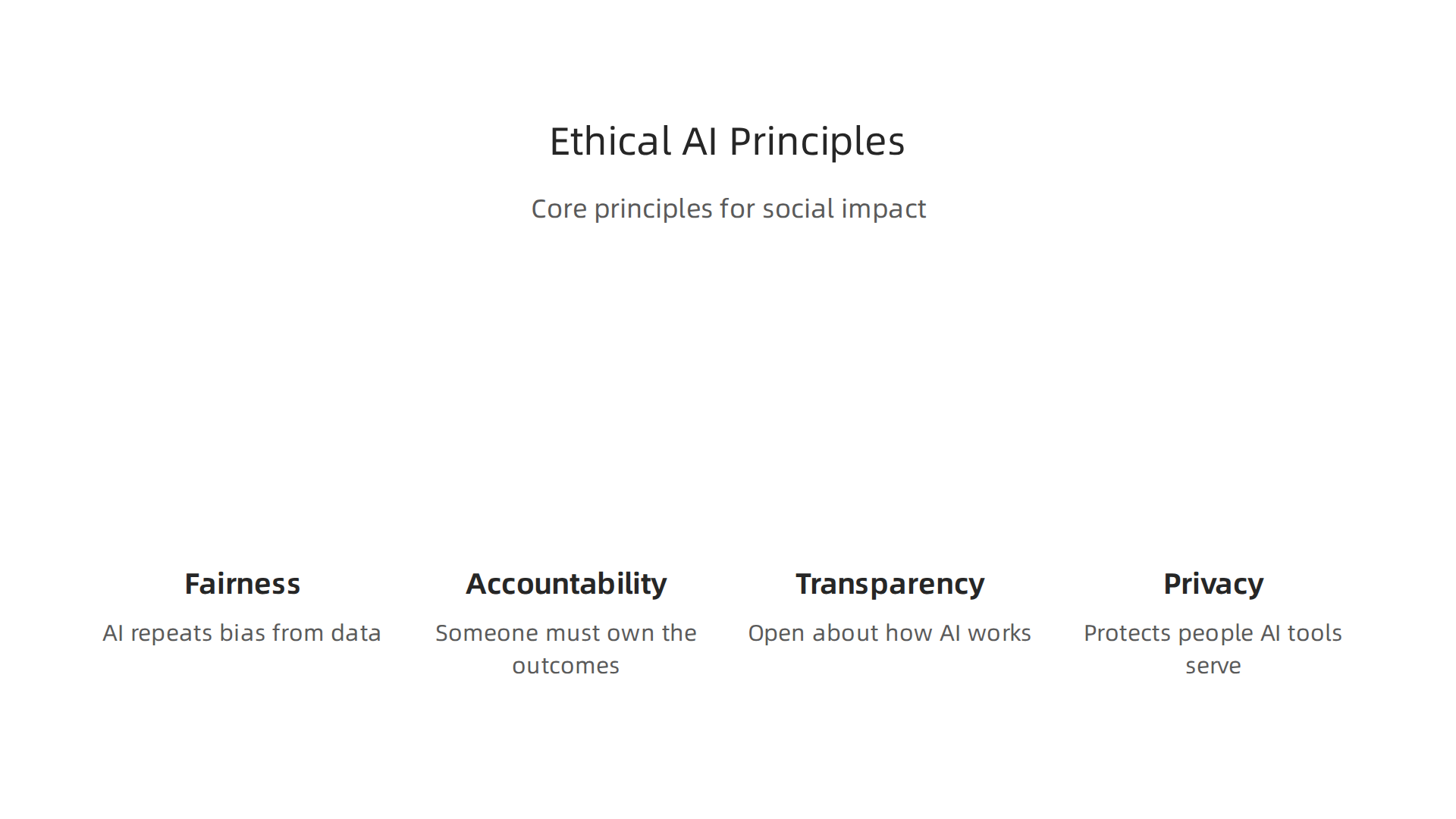
So how do we make sure tech for social good actually helps rather than hurts? It comes down to four core principles: fairness, accountability, transparency, and privacy.
Think of these as the guardrails that keep advanced technology on the right track.
Let’s start with fairness. AI models learn from data. If that data contains past biases, the AI repeats them. For example, studies have found that some healthcare AI models require patients of color to show more severe symptoms than white patients to get the same diagnosis. That is not fair at all. Addressing this requires diverse teams, representative data, and constant testing. The Brookings Institution explores this in depth in their piece on ethical AI for all communities.

Globally, regulations like the EU AI Act now demand fairness testing for high-risk systems. The US Blueprint for an AI Bill of Rights pushes for similar protections.
Next is accountability. Someone has to own the outcomes. If an algorithm makes a bad call, who is responsible? In tech for social good, accountability means having a clear chain of responsibility. In healthcare, for instance, AI should support clinicians but never replace their final judgment. A human must always review critical decisions. That creates a feedback loop where mistakes get caught and fixed.
Transparency is about being open about how AI works. Black box models that nobody understands erode trust. In social good projects, transparency means explaining what data the AI uses, how it reaches conclusions, and what its limits are. Community members have voiced that they want to know when AI is being used and want a say in its governance. That is why clear communication builds trust.
Finally, privacy protects the people these tools are meant to serve. Many social good initiatives handle sensitive data: health records, financial info, location data. Strong privacy safeguards are nonnegotiable. They prevent exploitation and ensure that vulnerable communities are not harmed by the very technology designed to help them.
These four principles are not just nice ideas. They match what global regulators are demanding. The EU AI Act classifies systems by risk and requires transparency and accountability. The US Blueprint for an AI Bill of Rights centers on fairness and privacy. Aligning with these frameworks is smart strategy for any tech for social good project.
If you want to stay sharp on how AI ethics and regulation evolve, a trusted daily briefing can make all the difference. Consider subscribing to The AI Newsletter Worth Reading for clear daily updates that cut through the noise.
And when you are ready to put ethical principles into practice, you need tools that let you evaluate AI platforms for your startup with confidence.
Real-World Applications: AI for Good in Healthcare, Climate, and Education
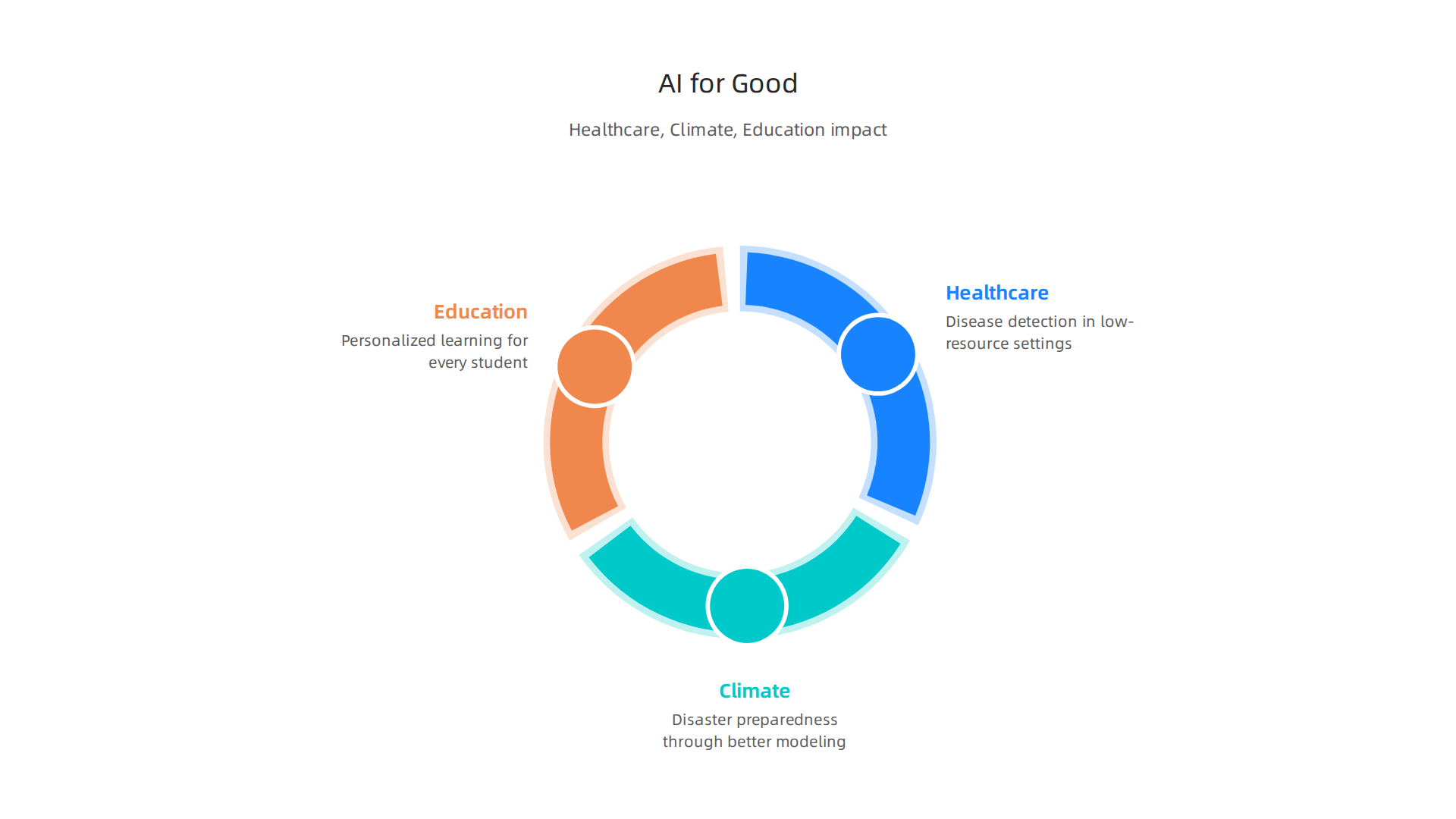
Now that we understand the ethical guardrails, let’s see them in action. In 2026, tech for social good is already changing lives in three big areas: healthcare, climate, and education.
When fairness, accountability, transparency, and privacy guide the work, these tools earn real trust.
Healthcare: disease detection in low-resource settings.
Imagine a rural clinic with no specialist doctor. An AI tool can analyze a chest X-ray in seconds and flag signs of tuberculosis. That is happening right now in parts of Africa and South Asia. But without ethical design, the same tool could miss cases in darker skin tones or send false alarms. That is why communities must be involved from the start. As the community perspectives on health AI research shows, patients want clear communication about when AI is being used and who oversees it. They also want their data kept private. When these needs are met, adoption goes up and outcomes improve. For founders and investors looking to understand which AI platforms are best suited for social impact, our guide on AI companies in 2026 provides a useful overview.
Climate: disaster preparedness through better modeling.
AI is also helping communities get ready for floods, hurricanes, and wildfires. Advanced technology can analyze satellite images and weather data to predict where a storm will hit days in advance. That gives people more time to move to safety. But accountability matters here. If a prediction is wrong, someone must own the mistake and improve the model. Transparency around how the AI reaches its conclusions helps emergency teams trust the warnings and act fast.
Education: personalized learning for every student.
In classrooms around the world, AI platforms now adapt lessons to each child’s reading level and pace. A student struggling with fractions gets extra practice. A student ready for algebra moves ahead. This kind of tech for social good can close learning gaps, but only if it is built with fairness and privacy in mind. The algorithm must not steer certain groups toward lower expectations. Student data must stay safe. When schools implement these tools with ethical oversight, families and teachers embrace them rather than fear them.
These real-world examples show that the principles from earlier are not just theory. They are the foundation of AI that actually helps people.
Measuring Impact: Metrics and Frameworks for Social Good Tech
So how do you actually know if a tech for social good project is working? You cannot just look at monthly active users or revenue. Those standard business metrics miss the whole point. A health AI tool might have low user numbers but save hundreds of lives. A climate model might never turn a profit but prevent a flood disaster. Measuring social impact requires a different set of tools.
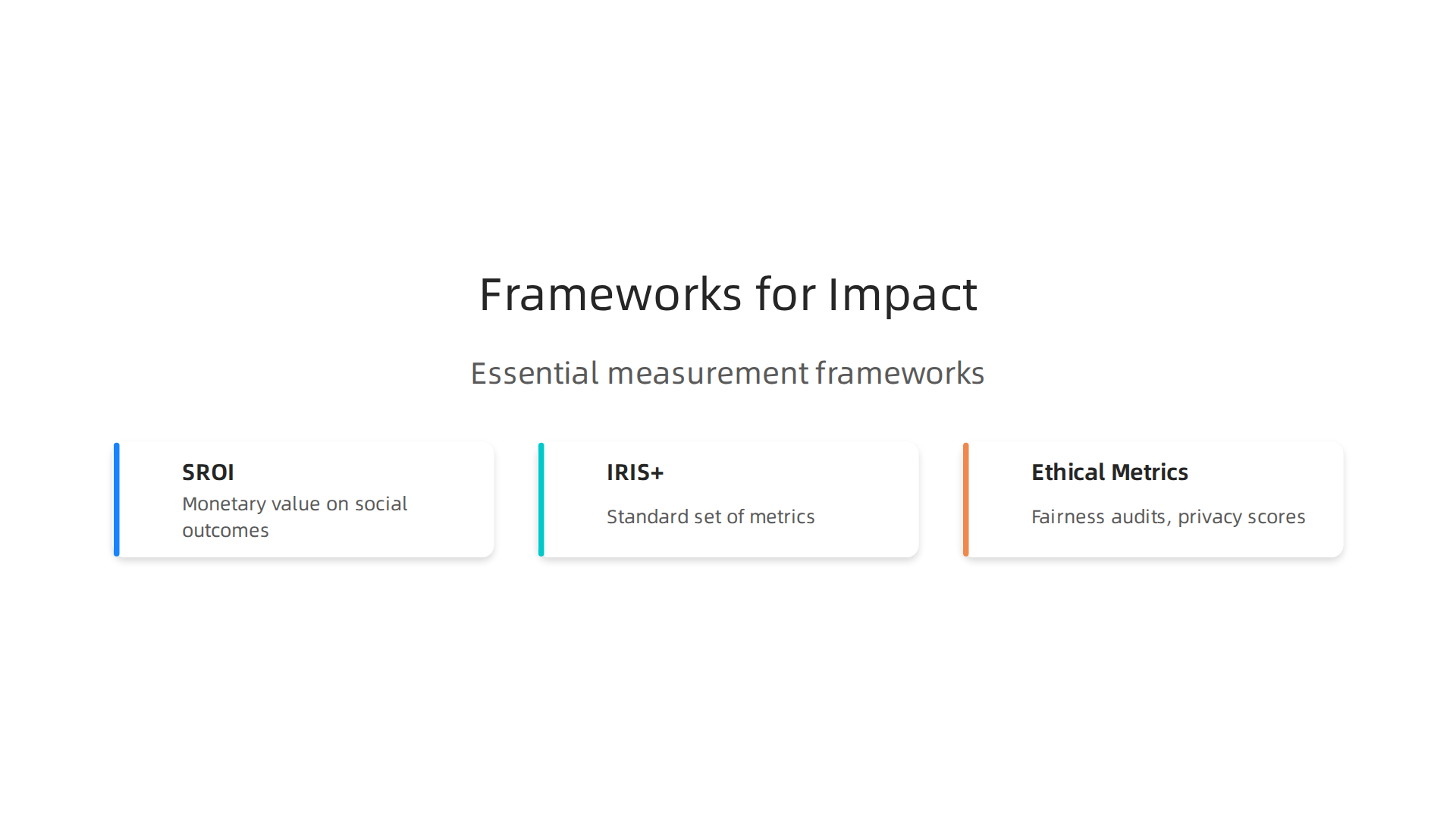
One of the most respected approaches is the Social Return on Investment (SROI) framework. SROI puts a monetary value on social outcomes, so you can compare the benefit to the cost. For example, if a private AI health screening program catches tuberculosis early and saves hospital costs, SROI captures that value. The Role of SROI and IMP Social Impact Measurement Frameworks article explains how to use SROI alongside the Impact Management Project (IMP) to track what changes, who benefits, and how much.
Another powerful system is IRIS+ from the Global Impact Investing Network (GIIN). IRIS+ offers a free, standard set of metrics that align with the UN Sustainable Development Goals. You simply select your organization type and objectives, and the system gives you the core indicators to track. The IRIS+ Impact measurement, management and optimisation page walks through how this tool helps investors and founders measure social, environmental, and financial performance together.

For AI specifically, you also need ethical metrics. Fairness audits check if your algorithm treats all groups equally. Privacy preservation scores measure how well you protect user data. These fit into the broader impact evaluation. When you combine SROI, IRIS+, and ethical scorecards, you get a complete picture of whether your tech for social good is truly making a difference.
For founders building impact-focused startups, understanding these frameworks helps you attract the right investors. Our guide on best AI platforms for business in 2026 reviews tools that can support your impact measurement journey.
Staying on top of AI developments and impact tools can feel overwhelming. That is why many leaders rely on a daily newsletter that cuts through the noise. The AI Newsletter Worth Reading delivers clear, actionable updates on AI and its social impact straight to your inbox.
Funding Trends: Where VC and Grant Money Is Flowing in 2026
Money talks, right? In 2026, the money flowing into tech for social good says something loud and clear: investors are not treating impact as a side project anymore. Venture capital firms, impact funds, and government grant programs are pouring serious capital into companies that solve real world problems.
The fastest growing sub sectors tell the story. Climate tech is still the heavyweight champion, pulling in billions for carbon capture, renewable energy software, and sustainable supply chain tools. But health equity AI is rising fast. Imagine private AI diagnostic tools designed specifically for rural clinics or underserved urban neighborhoods. That is where grant money from foundations like the Gates Foundation is landing. EdTech is another hotspot, especially platforms that use advanced technology to personalize learning for students in low income districts.
Geographically, the hotspots are shifting. Sure, San Francisco and New York still dominate. But 2026 is the year of the secondary tech hubs. Cities like Denver, Austin, and Miami are seeing a surge in impact focused deals. Internationally, Nairobi and Bangalore are emerging as serious players, thanks to strong local talent pools and government backed innovation centers.
Here is the big change: ethical AI credentials are no longer a nice to have. They are a due diligence requirement. Investors now run fairness audits and privacy checks before they write a check. If your AI model has bias problems, you will not get funded. Period. The AI companies in 2026 what founders and investors need to know guide breaks down exactly what ethical standards investors are looking for this year.
Grant money is also changing. Government programs like the NSF’s new Social Impact Tech Initiative are prioritizing projects that combine technology with measurable community outcomes. They want to see the kind of rigorous metrics we talked about earlier. The IRIS+ system from GIIN remains the gold standard for reporting, and the Getting Started with IRIS guide gives you a practical starting point for choosing the right performance indicators.
The bottom line? In 2026, doing good and making money are no longer separate goals. Investors want both.

And they have the tools to verify it.
Challenges and Risks: Bias, Privacy, and the Danger of Overhyped Solutions
Tech for social good sounds like a clear win. But here is the hard truth: the same advanced technology that helps people can also harm them, especially when it is rushed or not carefully tested.

In 2026, three major risks stand out for anyone building or funding these tools.
Systemic bias is baked into many AI systems. A 2026 study found that 44 percent of AI systems showed gender bias, while more than a quarter showed both gender and racial bias. That is not a small problem. Facial recognition tools used in policing misidentify people with darker skin far too often, leading to false arrests. Loan approval algorithms deny credit to whole communities based on biased training data. And healthcare AI can be less accurate for minority patients. The data on AI gender bias from UN Women shows how widespread this really is.
Data privacy risks get worse when you work with vulnerable populations. Tech for social good often handles sensitive health data, refugee information, or financial records of low income families. AI can infer private details from seemingly harmless data. Voice recordings can reveal emotional or health states. Location data can track movements. And new research shows that AI can undo traditional anonymization, putting people at greater risk. The review of privacy risks in AI systems explains exactly how this happens across different domains.
Beware of AI washing. This is when a product or startup claims to be ethical, fair, and privacy friendly but has no real evidence to back it up. In 2026, investors are checking for bias audits and transparency reports. But many solutions still slip through with flashy promises and no validation. Do not take claims at face value. Before you invest or adopt, look for third party audits and clear documentation. Our guide on how to evaluate AI platforms for your startup breaks down what to look for.
The bottom line? Tech for social good only creates real impact if it is trustworthy. Bias, privacy failures, and empty promises can undo all the good you are trying to do. Stay curious and keep learning. The AI Newsletter Worth Reading delivers clear daily updates on these critical topics.
Building Trustworthy Ethical AI Systems: A Practical Guide for Startups
Now that you know the risks, here is the good news. You can build tech for social good that actually earns trust. And for startups, trust is your hidden competitive advantage. Investors and partners are looking for companies that take ethics seriously. Here is a step by step approach.
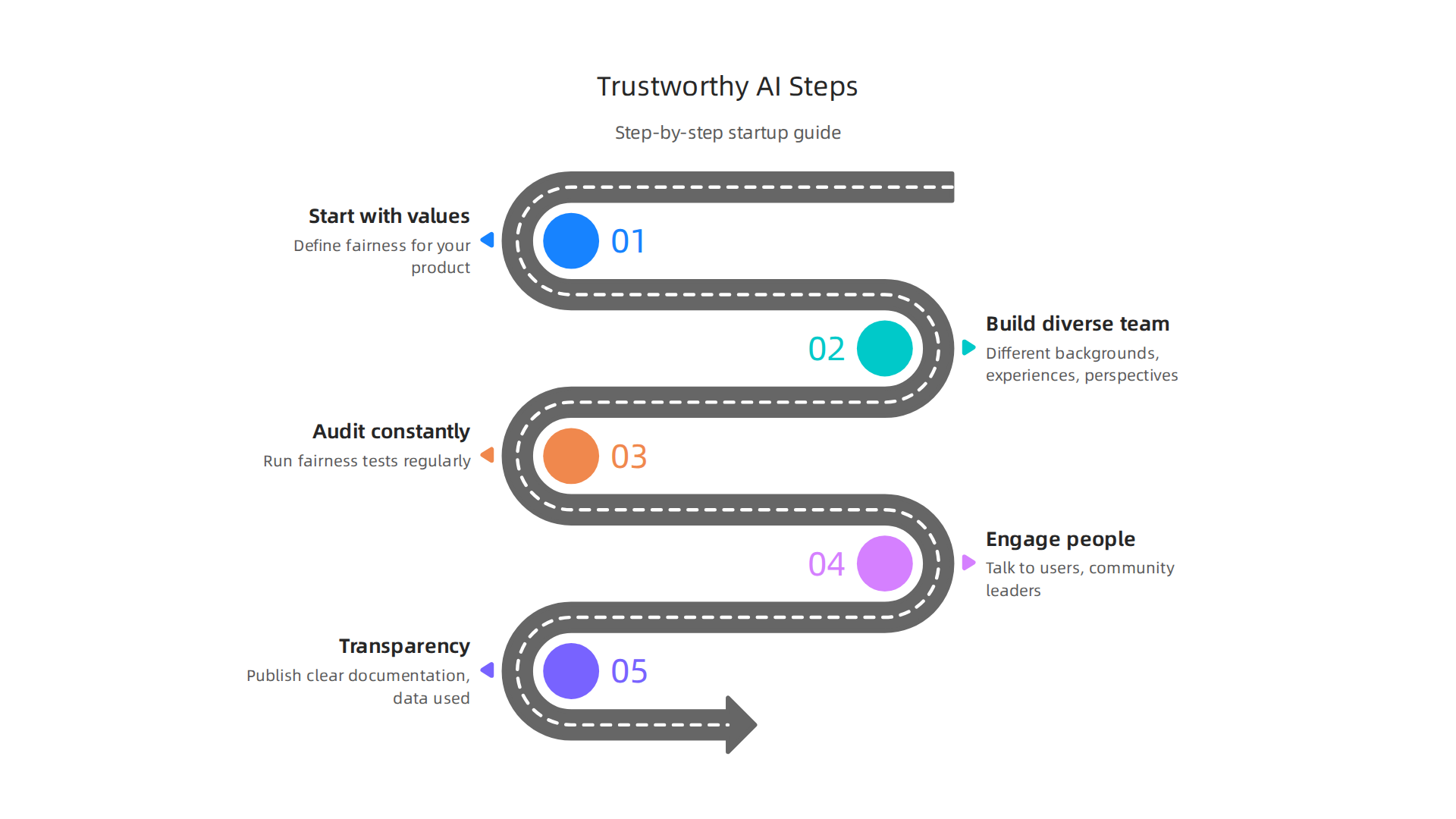
Start with your values before you write a single line of code. Define what fairness means for your product. Do you want to avoid bias? Protect privacy? Be transparent about how decisions are made? Write these values down and share them with your whole team. This is not fluff. The International AI Safety Report 2026 shows that systems without clear governance are more likely to cause harm.
Build a diverse team from day one. If everyone building the AI looks the same and thinks the same, the system will reflect that. You need people with different backgrounds, experiences, and perspectives. A diverse team catches problems that a homogenous team would miss. This is especially important when your advanced technology touches vulnerable communities.
Audit your AI constantly, not just at launch. Bias can creep in over time as the system learns from new data. Run fairness tests regularly. Use tools like IBM’s AI Fairness 360, Google’s What If Tool, or Microsoft’s Fairlearn. These are free and will help you spot issues before they become scandals. Also consider getting IEEE certification for ethical AI design. It is a strong signal to investors that you are serious.
Engage the people your tech affects. You cannot design ethical private AI in a bubble. Talk to users, community leaders, and advocacy groups. Let them test your system and give feedback. When people feel heard, they trust you more. And you will build a better product.
Transparency is your best marketing tool. In 2026, consumers and investors are skeptical of AI. If you publish clear documentation about how your system works, what data it uses, and how you handle bias, you stand out. Our guide on how to use AI for startup success shows how transparency can actually help you raise money.
The bottom line? Ethics is not a checkbox. It is a daily practice. But for startups that get it right, it is also a powerful way to win.
The Future of Tech for Social Good: Trends to Watch Beyond 2026
So you’ve got your ethical foundation in place. What comes next? The world of tech for social good is moving fast. If you want your startup to stay ahead, you need to know what is coming. Here are the big trends that will shape the next few years.
Generative AI for everyone. Imagine a farmer in rural India getting crop advice in her own language. Or a student in a remote village learning math from an AI tutor that speaks his dialect. That is where generative AI is headed. It is breaking down language barriers and bringing knowledge to people who were left out before. This is real advanced technology with a human face.
Federated learning keeps data private. Most AI models need to gather data in one place. That creates privacy risks. Federated learning flips that. The model travels to the data, learns from it, and leaves the raw data where it is. This is a game changer for private AI. Hospitals can share insights without sharing patient records. Banks can spot fraud without exposing customer details. Your startup can use this to build trust from day one.
Decentralized AI for transparent impact. Blockchain plus AI might sound like hype. But it has real potential for social good. You can track exactly how an AI makes decisions and where the money goes. Donors can see that their funds actually helped people. No black boxes. No hidden fees. It is a powerful way to prove your impact.
And here is the key. All of this only works if you embed ethical principles from the start. The ILO report on applying AI for social good makes it clear: inclusive, responsible AI reduces inequalities. If you wait until your product is built, it is too late.
Want to stay on top of these shifts? You need to keep learning. Our guide on evaluating AI platforms for your startup can help you choose tools that match your values. And if you want daily, no-fluff AI updates, try The AI Newsletter Worth Reading. It will keep you ahead of the curve.
Summary
This article explains what "tech for social good" means in 2026 and why ethical AI is the foundation for real, lasting impact. It defines the four core principles—fairness, accountability, transparency, and privacy—and shows how they apply across healthcare, climate, and education projects. You’ll learn practical ways to measure impact using SROI, IRIS+, and ethical audits, and why investors now demand bias testing and privacy safeguards before funding. The piece also covers funding patterns, rising global hubs, and the practical risks of biased models, privacy leakage, and AI washing. For startup founders it gives a clear roadmap: set values, hire diverse teams, run continuous audits, engage communities, and publish transparent documentation. Finally, the article looks ahead to generative models, federated learning, and decentralized systems as the next tools for trustworthy social impact.