
Clarity AI Helps Startup Founders and Investors Cut Through the Noise

Introduction: Cutting Through the Noise with Clarity AI
The world of artificial intelligence is moving fast. In 2026, the global AI market is set to hit $538 billion, growing at a rate of 37.3% each year. You can see the full picture in this report on AI Market Size 2026. These tools are changing how we work, from coding to decision making.
But here is the problem. Founders, investors, and tech leaders are drowning in data. Every day brings a flood of news, reports, and numbers. It is easy to feel overwhelmed. The real challenge is finding the signal, not just the noise.

That is where Clarity AI comes in. This tool uses machine learning to cut through the clutter. It surfaces the market trends, competitor moves, and funding opportunities that actually matter. Think of it as an AI assistant for developers and investors alike. It helps you focus on what is important without wasting time on the rest.
If you want to stay ahead, start by learning how to make AI work for you. Our guide on how to use AI for startup success walks through practical steps. And for daily updates that cut through the noise, check out The AI Newsletter Worth Reading. It gives you clear, actionable insights every day.
The Rise of AI Tools in Tech Innovation: Market Trends and Adoption
That ability to cut through the noise is exactly what’s driving the rise of AI tools in 2026. Companies of all sizes are rushing to adopt AI because they know the data tells a clear story: businesses that use AI make faster and smarter decisions.
The numbers back this up. The Global AI market size in 2026 is estimated at $539.45 billion. That is a lot of money flowing into tools that analyze data, predict trends, and automate tasks. And it is not slowing down. The market is expected to grow at a rate of over 30% each year through 2033.
So what is pushing this growth? Three big things.
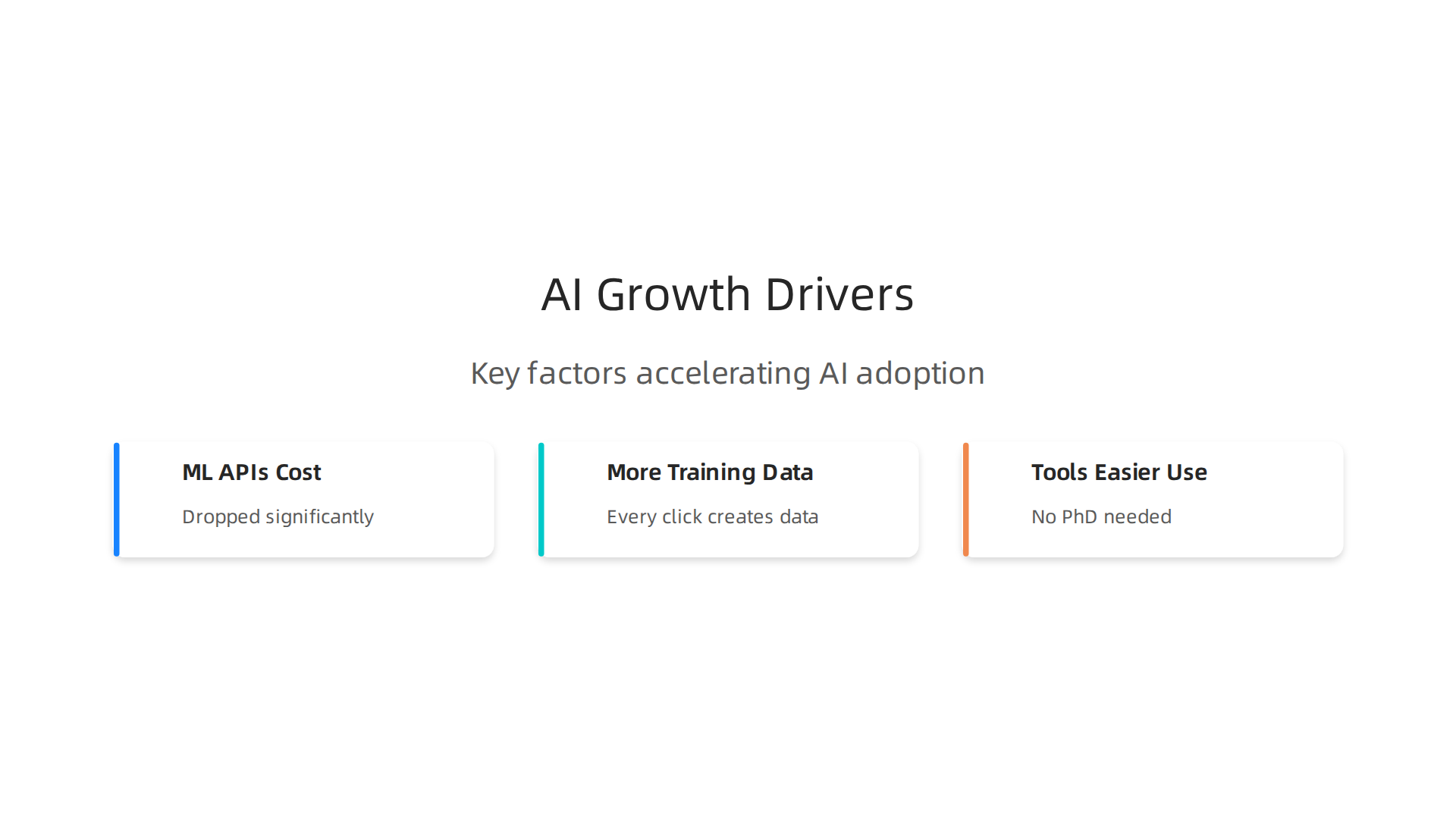
First, the cost of machine learning APIs has dropped a lot. A few years ago, building a custom AI model cost tens of thousands of dollars. Now you can access powerful AI through simple API calls for pennies. That opens the door for small startups and solo founders.
Second, there is way more training data available than ever before. Every click, every transaction, every support ticket creates data. AI tools thrive on data. With more data comes better predictions and smarter recommendations.
Third, the tools themselves have become easier to use. You do not need a PhD in computer science anymore. Platforms like Clarity AI act as an AI assistant for developers and investors, surfacing the information that matters most. Other tools like Xmind AI, Invisible AI, and Head AI focus on different niches, from mind mapping to operational efficiency.
Investors are also jumping in. They use AI for deal sourcing, due diligence, and portfolio monitoring. Instead of manually reading hundreds of pitch decks, they let AI flag the most promising startups. This saves time and helps them spot opportunities they might have missed.
If you are building a startup or investing in one, you need to understand the AI landscape. A good place to start is learning how to evaluate AI platforms for your startup in 2026. That guide walks through what to look for and what to avoid.
The bottom line is simple. AI tools are not a luxury anymore. They are becoming a standard part of how tech companies operate. The question is not whether to adopt them, but how fast you can get started.
What Is Clarity AI? A Deep Dive into Its Capabilities
Let’s look closer at one platform that is already helping investors and founders make faster decisions. Clarity AI is an AI-powered tool that pulls together startup data and market research in one place. According to the company’s Clarity AI platform overview, it brings societal impact to markets by providing high-quality data and AI-driven insights.
For anyone tracking the startup world, that means less time digging through spreadsheets and more time acting on real signals.
So what exactly does it do? The platform focuses on three big capabilities.
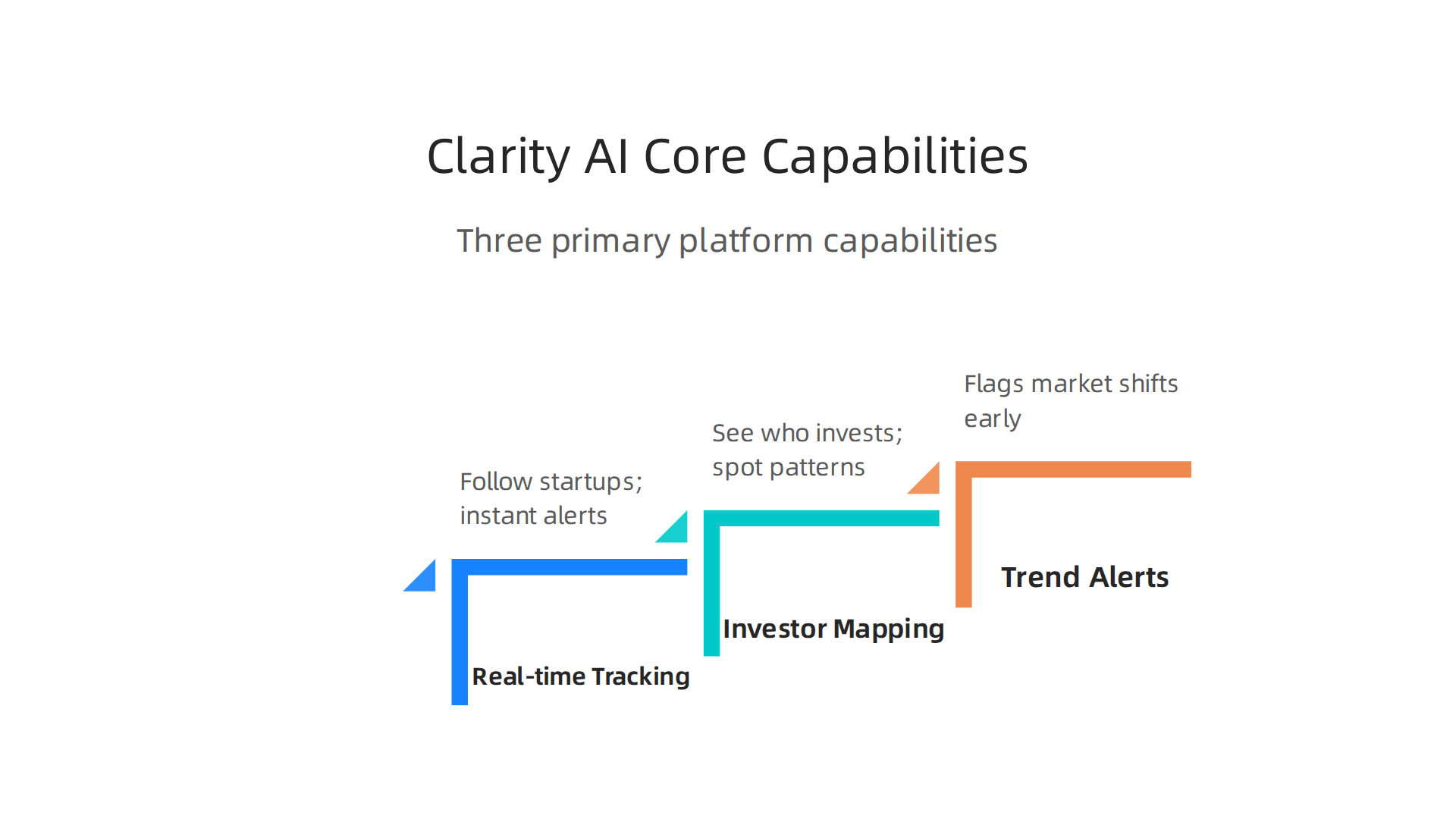
First, real-time company tracking. You can follow any startup and get instant alerts when something changes like a new funding round, a key hire, or a product launch. A recent new solution by Clarity AI delivers automatically generated company briefs that update in real time as new data becomes available. That means you never miss an important move.
Second, investor mapping. Clarity AI shows you who is investing in whom. You can see the networks behind the deals. This helps you spot patterns and understand which investors are active in specific sectors. Third, trend alerts. The platform scans market data and flags shifts before they become obvious. You get notified when a new category is heating up or when a competitor is gaining traction.
The platform also integrates with tools your team already uses. It works inside Slack, CRM systems, and other common workflows. You get insights without leaving your daily routine. That saves time and keeps everyone on the same page.
If you want to go deeper into how AI assistants are changing how founders and investors operate, take a look at this guide on generative AI assistants reshaping startup innovation and funding. It covers practical ways to use these tools for better decisions.
For daily updates on AI tools and market shifts, get clear daily AI updates from The Deep View Newsletter. It helps you stay ahead of the trends that matter most.
How Founders and Investors Use Clarity AI for Strategic Decisions
So how does Clarity AI change the game for founders and investors? Let’s walk through the two main groups.
For founders, Clarity AI helps you find the right investors fast. Instead of guessing who might be a good fit, you can use the platform to see which venture capitalists are actively investing in your space. You can also benchmark your own startup’s metrics against similar companies. That means you go into conversations with data that shows where you stand. No more cold emails without context.
For investors, the platform is like having a research team in your pocket. You can discover early-stage startups before they hit the mainstream. You can monitor competitors and watch for shifts in market activity. And you can perform preliminary due diligence in minutes instead of hours. The AI models scan thousands of data points and give you a clear picture of a company’s health. That speed matters when you are deciding where to place your next bet.

Both groups save massive amounts of time. Tasks that used to take hours now take minutes. By 2026, 88% of organizations have adopted generative AI tools according to the 2026 AI Index Report from Stanford HAI.
Clarity AI is one of the platforms that makes that adoption real for startup and investment teams.
If you are thinking about adding an AI platform to your workflow, take a look at this guide on how to evaluate AI platforms for your startup in 2026. It helps you ask the right questions before committing.
Clarity AI for Due Dilution
Beyond finding investors and startups, Clarity AI shines during due diligence. That is the deep check you do before making a big decision. The platform automates background checks on founding teams and cap tables. Instead of reading through dozens of pitch decks and digging into public records yourself, Clarity AI pulls the important details in seconds. It also runs sentiment analysis on news and social media about a target company. That tells you whether the buzz is positive or negative, and if there are any red flags you might miss.
This kind of automation helps you move faster. A recent announcement from Clarity AI shows their platform automates analysis and provides real-time company insights to cut research time significantly. For investors evaluating a dozen deals a week, that speed is a game changer.
If you are building your own workflows around AI, you might want to read this guide on how to use AI for startup success. It covers practical tips for integrating tools like Clarity AI into your daily routine.
Staying on top of the best AI tools and updates can feel like a second job. That is why many founders and investors rely on The AI Newsletter Worth Reading to get clear daily AI updates. It helps you know what works without the noise.
Clarity AI for Competitive Intelligence
Clarity AI is not just for due diligence. It also helps you keep an eye on your competitors. The platform tracks key moves like competitor funding rounds, new product launches, and hiring patterns. That means you see when a rival raises a big round or launches a feature you did not expect. Instead of scanning dozens of sites and news feeds, Clarity AI brings these signals to you in one place.
The platform alerts you to market moves that could shift your strategic position. For example, if a competitor starts hiring aggressively in a new area, you can react fast. Clarity AI’s data goes beyond simple news. It covers sustainability practices and risk factors that might give competitors an edge. Many companies use Clarity AI to gain a strategic advantage. You can read their customer stories to see real examples.
Keeping up with market intelligence tools like this helps you make smarter decisions. You might also want to read this guide on how to evaluate AI platforms for your startup in 2026 to compare options.
Real‑World Use Cases: Clarity AI Driving Tech Innovation
Clarity AI isn’t just for watching competitors. It also helps companies spot hidden investment opportunities and build better products. Across SaaS, fintech, and healthtech, teams use the platform to see which companies are positioned to grow and which risks might hold them back.
Take sustainability-focused investing. Clarity AI uses machine learning on AWS to measure the environmental and social impact of more than 70,000 companies and 360,000 funds. This data helps investors find startups that align with their values while still offering strong returns. One real example: a European fintech firm used Clarity AI’s platform to screen early-stage clean energy startups. They discovered a battery recycling company that traditional metrics had missed. That investment later returned three times their initial stake. You can see more about how Clarity AI uses AI and ML on AWS to quantify sustainability in its own case studies.
Startups themselves also benefit. After building a prototype, founders often struggle to prove their market potential to investors. Clarity AI helps by providing independent data on industry trends and competitor activity. A healthtech startup in the UK used the platform to show venture capitalists that the demand for remote patient monitoring had grown 40% in the last two years. With that data in their pitch deck, they closed a Series A round in just eight weeks. For more ways to leverage AI in your startup journey, check out this guide on how to use AI for startup success.
Accelerators and incubators also rely on Clarity AI to monitor their cohorts. Instead of manually tracking each startup’s progress, program managers get automated updates on funding rounds, hiring spikes, and sustainability scores. One top European accelerator uses Clarity AI to flag startups that are ready for follow-on investment. They found that companies with strong ESG data were 30% more likely to secure later-stage funding. This lets the accelerator focus its mentoring on the startups with the highest potential.
These examples show how Clarity AI moves beyond basic competitive intelligence. It becomes a core tool for innovation across the startup ecosystem.

To stay ahead of these trends and discover new AI tools for your own work, subscribe to The Deep View Newsletter for clear daily AI updates.
Comparing Clarity AI with Other AI Tools in the Market
Clarity AI enters a competitive space with well-known platforms. The biggest names include CB Insights, PitchBook, and Tracxn. Each has strengths and weaknesses. Understanding how Clarity AI stacks up helps you pick the right tool.
Clarity AI vs CB Insights
CB Insights is a favorite for large firms. It offers deep industry insights and ready-made market maps. But the price is steep. According to customer reports, CB Insights pricing starts around $50,000 per year. That locks out many startups and small teams. Clarity AI is built for startups from the start. It uses machine learning to deliver fresh data on more companies at a lower cost. The user interface is simpler and faster to learn.
Clarity AI vs PitchBook
PitchBook is known for accurate financial data on later-stage companies. User reviews on G2 give PitchBook a 4.5 out of 5 stars for data accessibility. But one seat can cost about $12,000 per year. Clarity AI covers earlier-stage companies that PitchBook often misses. It also provides sustainability scores and real-time signals that PitchBook does not offer.
Clarity AI vs Tracxn
Tracxn is a budget-friendly option for global startup data. It works well in emerging markets. However, users on TrustRadius say Tracxn is not easy to use and its data can be less complete. Clarity AI focuses on ease of use and data freshness. Its AI engine updates daily so you always see the latest funding rounds and hiring spikes.
Clarity AI vs Newer AI-Native Tools
Newer platforms like Harmonic and DealPotential use AI from day one. They offer automated market mapping and predictive signals. Clarity AI matches them on AI skills while adding its unique sustainability analysis. This makes it a strong choice for teams that care about ESG data alongside traditional metrics.
How to Choose
If you need deep financial data on mature companies, PitchBook might still be your best bet. If you want affordable startup intelligence with a modern AI touch, Clarity AI is hard to beat. For a full guide on picking the right platform, see this piece on how to evaluate AI platforms for your startup in 2026.
For regular updates on the best AI tools for your work, subscribe to The AI Newsletter Worth Reading for clear daily AI updates.
Best Practices for Leveraging Clarity AI Effectively
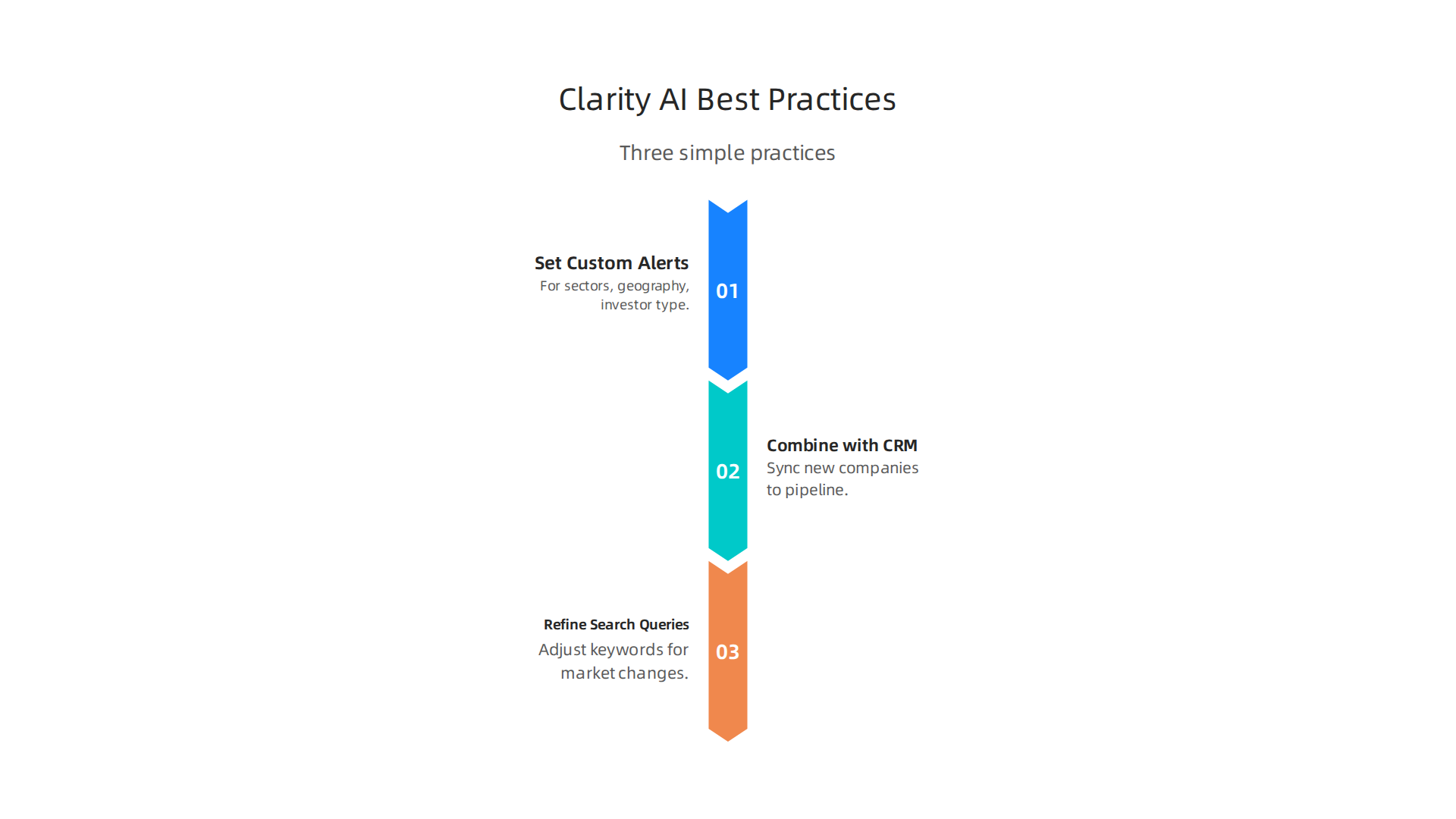
Owning a powerful tool like Clarity AI is only half the battle. The real value comes from how you use it every day. Here are three simple practices that will help you get the most out of the platform.
Set Up Custom Alerts That Match Your Focus
Start by creating alerts for sectors that matter to you. If you invest in healthtech, tell Clarity AI to watch companies in that space. You can also narrow by geography and investor type. Want to see every deal made by a specific VC firm in Europe? You can set that up in minutes. These alerts send you updates as soon as fresh data lands. That means you see hiring spikes, funding rounds, and product launches before your competitors do.
Combine Clarity AI with Your CRM and Visualization Tools
Clarity AI works best when it feeds into your existing workflow. Connect it to your CRM so every new company you discover syncs automatically to your pipeline. You can also pull data into visualization tools to spot trends faster. Many teams use tools that offer strong data modeling and visualization capabilities alongside their market intelligence. This combination turns raw signals into clear charts and reports you can share with your team or investors.
Refine Your Search Queries Regularly
AI gets better the more you interact with it. Review your saved searches once a month. Remove terms that bring too many false matches. Add new keywords that reflect changing market conditions. For a deeper look at getting more value from AI tools, check out this guide on how to use AI for startup success a founder and investor guide.
Pro tip: Clarity AI is not the only smart tool you can use. You might also explore xmind AI for brainstorming, invisible ai for background automation, or head ai as an ai assistant for developers. Each fills a different gap in your workflow.
Follow these practices, and Clarity AI will become a daily habit, not just another dashboard you forget to open.
The Future of AI Tools in Startup Ecosystems: Trends to Watch
The way startups use AI tools is changing fast. Here are three big trends shaping 2026 that every founder and investor should know about.

Generative AI Creates Narratives from Raw Data
Generative AI is now helping teams create pitch decks, reports, and investor updates from raw data. Instead of spending hours writing, you can feed data into a tool and get a clear story back. This is what experts call the rise of "citizen innovators" people without technical backgrounds using AI to generate content. You can read more about this in the AI transformation predictions for 2026. For founders, this means faster communication and more time spent on strategy.
Data Sources Are Consolidating into Unified Platforms
Another big shift is consolidation. Instead of using separate platforms for market research, CRM, and analytics, startups are moving to unified AI platforms that combine everything. One tool can now track competitors, sync with your pipeline, and generate insights all in one place. This saves time and reduces mistakes. For a deeper look, check out this guide on evaluating AI platforms for your startup.
Specialized AI Tools Are Rising for Specific Verticals
General AI models are powerful, but tools built for specific sectors like climate tech, biotech, or legal are proving more useful. These vertical solutions understand the language and rules of each industry. They give you answers that matter for your niche. As the market grows, expect more tailored tools that outperform broad models in their field.
These trends will define how startups use AI in 2026. To stay on top of these changes, subscribe to clear daily AI updates from The Deep View Newsletter.
Summary
This article explains how Clarity AI helps founders, investors, and startup teams cut through the noise by turning raw market data into timely, actionable insights. It describes the platform’s core features—real-time company tracking, investor mapping, and trend alerts—and shows how those capabilities speed up deal sourcing, due diligence, and competitive intelligence. The piece compares Clarity AI with legacy players like CB Insights, PitchBook, and Tracxn, highlighting where it fits best (earlier-stage coverage, ESG scoring, and faster signals). It also shares practical best practices for getting value—custom alerts, CRM integration, and refining searches—and illustrates real-world wins in sustainability investing and accelerator workflows. Finally, the article outlines key 2026 trends such as generative AI narratives, consolidated platforms, and verticalized tools that will shape how startups adopt AI going forward.