Best AI Platforms for Business in 2026 Compared and Rated

Introduction: Navigating the AI Platform Landscape
The numbers are honestly staggering. In 2026, worldwide AI spending is set to hit $2.59 trillion, according to a recent analysis of AI spending forecasts from Gartner, IDC, and Stanford. That is a 47% jump from last year alone. AI now accounts for roughly 41% of all IT spending globally.
But here is the hard truth. Between 70% and 95% of enterprise AI projects still fail. That means companies could waste up to $1.9 trillion this year on AI initiatives that never deliver real value.
So how do you separate the real platforms from the hype?
As a founder, investor, or business leader, you face an impossible choice.

Every week brings a new "best AI platform" claim. Every vendor promises to transform your operations. Every competitor seems to be moving faster than you.
The problem is not a lack of options. The problem is a lack of framework. You need a reliable way to compare platforms, assess their real capabilities, and pick the one that actually solves your specific challenge.
That is exactly what this guide delivers.
We have evaluated the top AI platforms for business in 2026 using rigorous criteria: real-world performance, enterprise readiness, pricing transparency, and proven ROI across industries. Whether you need AI applications for customer service, AI powered coding assistants to accelerate development, or a general AI problem solver for your team, this curated list will help you cut through the noise.
Want to dig deeper into what makes a platform worth your investment? Check out our practical guide on how to evaluate AI platforms for your startup before you commit.
And if you want to stay ahead of the curve every single day, grab The AI Newsletter Worth Reading from The Deep View. It delivers clear, daily AI updates straight to your inbox so you never miss what matters.
Let us walk through the best AI platforms of 2026 and find the right fit for your business.
How We Evaluated the Best AI Platforms for Business
You do not want to waste money on a platform that sounds great but fails in daily use. That is why we built a strict scoring system before picking the best AI platforms in 2026.
We rated every platform on five key dimensions:
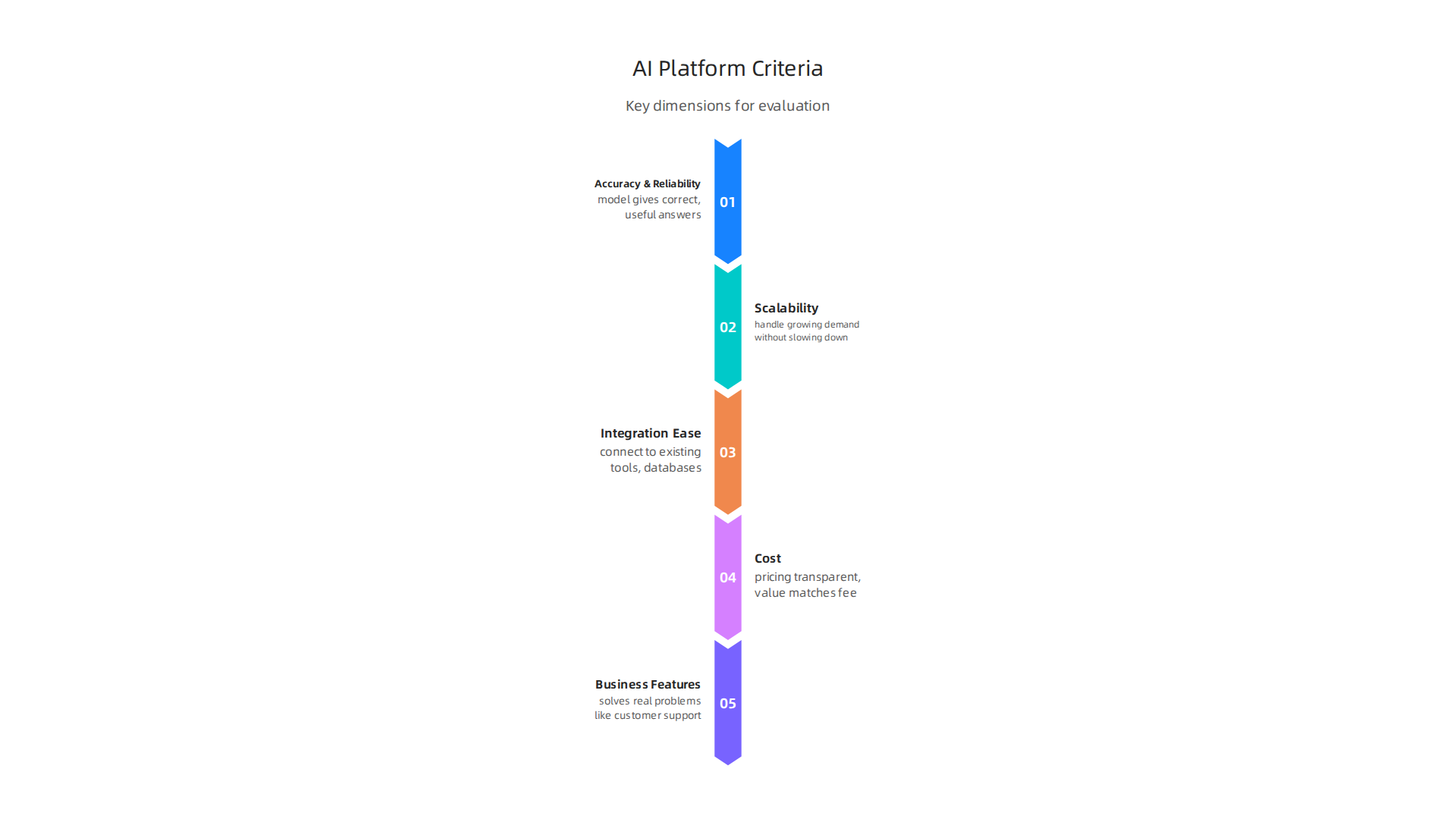
- Accuracy and reliability – How often does the model give correct, useful answers? We tested it against common mistakes and edge cases.
- Scalability – Can this tool handle growing demand without slowing down or breaking your budget?
- Integration ease – How fast can you connect it to your existing tools, databases, and workflows?
- Cost – Is the pricing transparent? Does the value match the monthly or per-use fee?
- Business-specific features – Does it solve real problems like customer support, content generation, or data analysis, or is it just a generic chat bot?
Each platform went through hands-on trials using everyday business workflows.

We ran customer service scenarios, asked it to write marketing copy, fed it messy data sets, and even tried using it as an AI problem solver for operational questions. We also tested AI powered coding assistants to see how well they accelerated development tasks.
But we did not rely only on our own experience. We cross-referenced our findings with trusted industry sources, including Forrester’s AI Platforms Landscape report for 2026. That report surveys technology and business leaders to understand the real value these platforms deliver. We also combed through user reviews and adoption metrics from 2026 surveys to make sure our picks matched what actual teams are using.
The result is a practical list of platforms that survive real-world pressure, not just marketing hype.
If you want to understand a key distinction when comparing AI tools, check out our breakdown of agentic AI vs generative AI. It will help you decide which type fits your business needs best.
Now let us get into the top platforms themselves.
1. ChatGPT Enterprise – Best for Generalist Generative AI
If your business needs a Swiss Army knife for AI, ChatGPT Enterprise is the gold standard in 2026.
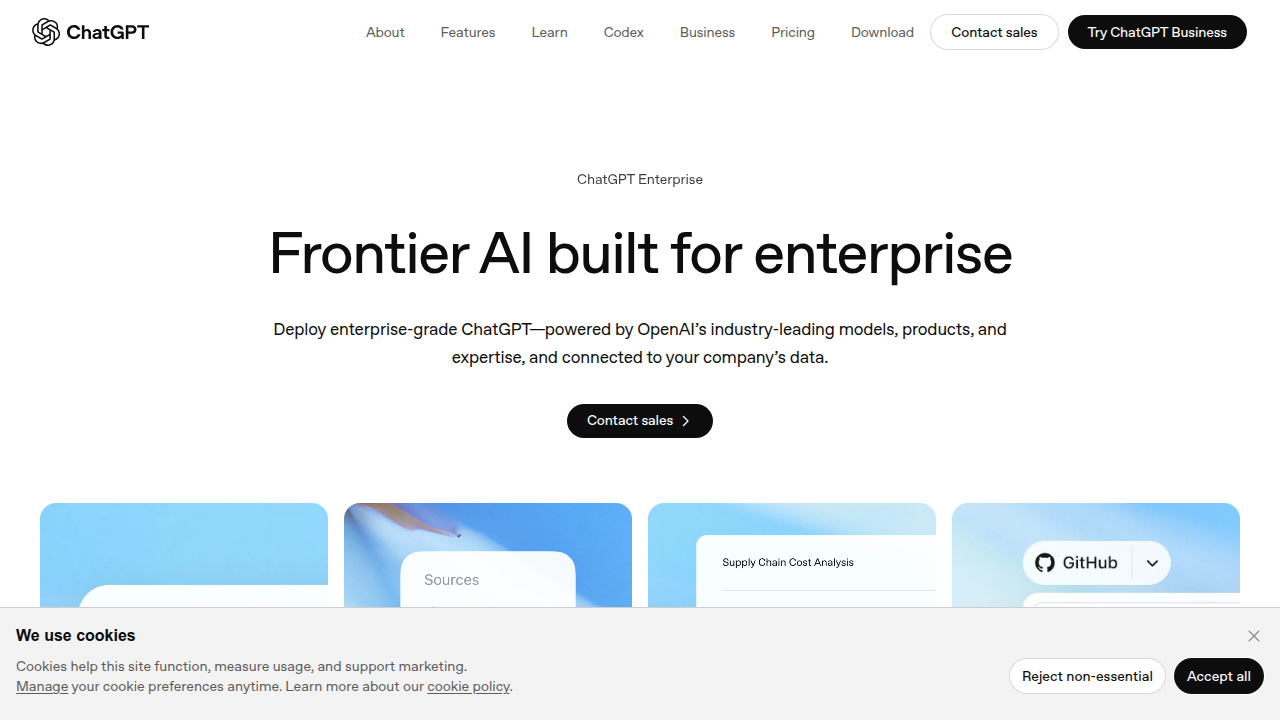
It gives you GPT-class reasoning with enterprise-grade security, data privacy controls, and the ability to fine-tune models on your own data. That means you get the raw power of the world’s most popular AI, wrapped in the protections your legal team demands.
What can you actually do with it? Plenty. Teams use it as an AI problem solver for customer support chatbots, content drafting, code generation, and even meeting summarization. It handles a wide range of AI applications out of the box, so you do not need a separate tool for every task. OpenAI also offers AI powered coding assistants built into the platform, which speeds up development work significantly.
The real differentiator is the ecosystem. ChatGPT has the largest user base of any AI platform, which means a massive library of plugins, integrations, and community knowledge. You can connect it to your existing tools quickly, and your team likely already knows how to use it.
On the security side, ChatGPT Enterprise includes SOC 2 compliance, HIPAA availability, and audit logs. You can read more about the exact data protections in the detailed ChatGPT Enterprise pricing guide for 2026.
For a deeper look at how to choose the right tool for your startup, check out this practical guide on how to evaluate AI platforms for your startup in 2026.
And if you want to stay ahead of every AI shift, here is a smart move. Subscribe to The Deep View Newsletter for clear, daily AI updates that cut through the noise. Your inbox will thank you.
2. Google Vertex AI & Gemini – Best for AI-Native Cloud Solutions
If ChatGPT Enterprise is the generalist, Google Vertex AI is the specialist for teams already living in the cloud. This platform gives you one unified place to build, deploy, and scale machine learning models. And in 2026, it comes with tight integration to Google’s Gemini models.
What makes this one of the best AI platforms for cloud-native teams? Think of it as Google’s full AI stack in a single package. You get access to Gemini’s multimodal reasoning, plus tools for vision AI, recommendation engines, and personalized search. That means you can handle many different ai applications without stitching together five separate services.
The real secret weapon is the hardware underneath. Google builds its own Tensor Processing Units (TPUs), which are custom chips designed specifically for AI workloads. This gives you incredibly fast, low-latency inference. If your app needs to serve personalized product recommendations in milliseconds, Vertex AI can deliver that.
Another big advantage is how deeply Vertex AI plugs into Google’s existing search infrastructure. If your business already relies on Google Cloud, you can pull data from BigQuery, tap into Google Search patterns, and deploy models that learn from the same intelligence that powers Google’s own products.
For teams that need an ai problem solver that can handle custom models and production-scale deployment, Vertex AI is hard to beat. And if you are curious about how other cloud giants compare, check out this list of the top digital transformation companies in 2026 for a broader look at the landscape.
3. Anthropic Claude – Best for Safety and Long-Context Understanding
Now let’s shift from cloud-native AI to a platform built with a very different priority: safety and long-context reasoning. Meet Anthropic Claude.
Claude, which includes models like Claude 3 Opus and Sonnet, is one of the best AI platforms for teams that need to work with enormous amounts of text. It can handle up to 200,000 tokens in a single pass. That is roughly the length of a 500-page book. For business use, this means you can feed it an entire legal contract set, a full research paper, or a year’s worth of financial reports and get a clear summary back.
What makes Claude special? Its training method. The company uses a technique called constitutional AI. This means Claude learns to follow a set of rules about helpfulness, honesty, and harmlessness. The result is fewer biased or unsafe outputs. For industries like law, healthcare, and finance where accuracy and ethics matter, this is a big deal.
Businesses use Claude for legal document analysis, research summarization, financial report synthesis, and compliance audits. It also handles ai applications that require careful reasoning over long texts. If you are choosing between AI platforms for document-heavy work, Claude deserves a close look.
And if you want to understand how to pick the right AI for your startup, check out this guide on how to evaluate AI platforms for your startup in 2026 for a step-by-step approach.
For daily insights on the AI world, including updates on platforms like Claude, you can subscribe to The AI Newsletter Worth Reading for clear, daily AI news.
4. Microsoft Azure OpenAI Service – Best for Microsoft Ecosystem Integration
If your company already runs on Microsoft tools like Office 365, Teams, or Dynamics 365, Azure OpenAI Service might be the most natural choice among the best AI platforms in 2026.
Azure OpenAI Service gives you enterprise-grade access to the same models that power ChatGPT, including GPT-5 and GPT-4o. But instead of a standalone chat interface, you get full control over deployment on Azure’s secure cloud infrastructure. Pricing follows a token-based model. GPT-5 costs $1.25 per million input tokens and $10 per million output tokens, as shown in this Azure OpenAI pricing models and costs overview.
The real advantage is integration. Microsoft has woven AI directly into its product suite. You get Copilot built into Word, Excel, and PowerPoint. You can build automated customer service bots using Dynamics 365 AI. And you can deploy custom models on Azure with strong enterprise security compliance. For digital transformation companies in 2026 looking at AI adoption, this tight fit is a major plus.
Security is another strength. Azure OpenAI Service meets compliance standards including SOC 2, HIPAA, and GDPR. You also get data residency options so your data never leaves your chosen region.
Common use cases include AI powered coding assistants for developers using GitHub Copilot, automated document generation in Office, and custom chatbots trained on your company data. If your organization is already on the Microsoft stack, this platform removes a lot of the friction that comes with adopting new AI tools.
5. AWS Bedrock – Best for Customization and Flexibility
But what if your team lives on AWS, or you want the freedom to switch AI models without rewriting everything? That is where AWS Bedrock shines among the best AI platforms in 2026.
Bedrock gives you access to a wide range of foundation models from Anthropic (Claude), Meta (Llama), Cohere, and Amazon Titan. You pick the one that fits your task. The extensive model marketplace means you are never locked into a single provider.
The big advantage is data control. Your data stays inside your AWS environment and never gets used to train the underlying models. That is a huge relief for founders handling sensitive customer information.
Pricing is pay-as-you-go, so you only pay for what you use. And because it plugs directly into Lambda, S3, and SageMaker, building ai applications feels like extending your current cloud setup.
Common use cases include personalized shopping assistants, call center automation, fraud detection, and content generation. If you need an ai problem solver that fits your exact workflow, Bedrock is a strong choice.
Still comparing options? This guide on how to evaluate AI platforms for your startup breaks down what matters most.
Want to stay ahead on which AI platforms are actually winning in the enterprise? The AI Newsletter Worth Reading delivers clear daily updates straight to your inbox.
6. Google Cloud AI Platform – Best for Data-Driven Enterprises
What if your business runs on vast datasets every single day? Or maybe you already use Google Cloud for storage and analytics. In that case, Google Cloud AI Platform (Vertex AI) might be the best AI platform for your needs.
Vertex AI gives you a single place to manage the whole machine learning lifecycle. You can build models from scratch, use AutoML to train high-quality models with minimal code, or use pre-trained APIs for vision and language.
Here is what makes it different for data-heavy teams. Vertex AI plugs directly into BigQuery, Dataflow, and Pub/Sub. That means you can train models on billions of rows stored in BigQuery without moving data around. And with Pub/Sub, your models can act on real-time data streams like clickstreams or sensor readings.
Common ai applications on this platform include demand forecasting, fraud detection, and customer sentiment analysis. Data science teams love the built-in MLOps tools that track experiments, manage feature stores, and automate model deployment.
Compared to other top contenders, this platform stands out when your goal is turning raw data into predictions. If you want to see how the major cloud providers stack up in the broader landscape, check out this list of top digital transformation companies in 2026.
And if you need to compare it against another heavy hitter like Azure, you can read this Azure OpenAI Service vs Direct OpenAI API enterprise comparison to see how pricing and flexibility match up.
For teams that want to dig deeper into which AI companies are actually making moves right now, exploring the latest AI companies winning in 2026 can give you a clearer picture of the competitive landscape.
7. Salesforce Einstein GPT – Best for Sales & CRM Automation
What if your sales team could generate personalized emails, score leads, and forecast revenue without leaving the CRM? That is the promise of Salesforce Einstein GPT.
This platform brings generative AI directly into the Salesforce ecosystem.
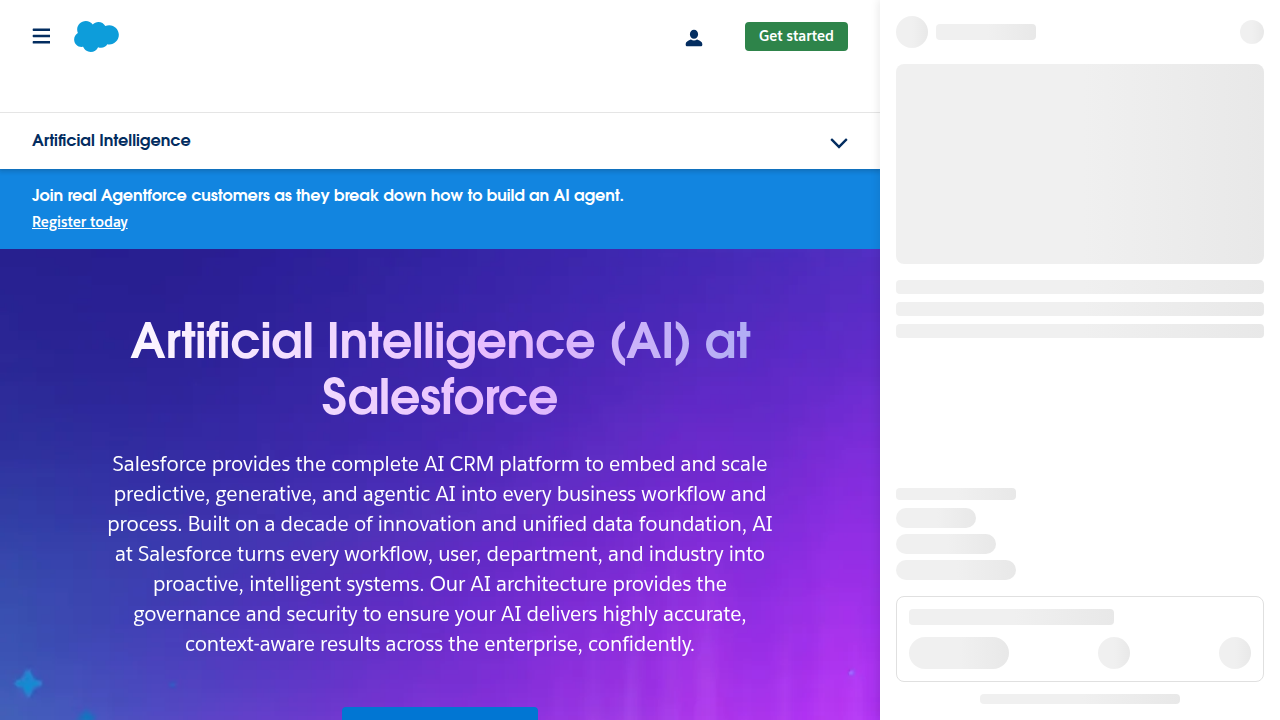
It pulls context from your accounts, contacts, and opportunities to create outputs that actually match your business. According to a detailed breakdown of Salesforce Sales Cloud Einstein AI: Features, Benefits & Pricing, the system includes Einstein Lead Scoring (which ranks leads from 1 to 99 based on conversion likelihood), Einstein Forecasting for pipeline predictions, and Einstein GPT for Sales to auto-generate emails and call summaries.
The use cases cover the full customer lifecycle. A rep can ask Einstein to draft a follow-up email using past conversation history. A service agent can get reply suggestions grounded in knowledge articles. A sales leader can see predictive forecasts that flag risks early.
The real differentiator? Data. Salesforce has more structured CRM data than almost any other platform. Einstein GPT uses that data to make AI outputs context-aware. And the Einstein Trust Layer handles data masking, toxicity detection, and audit trails for compliance.
For any team that runs on Salesforce, this is one of the best AI platforms to consider. To learn more about how AI is reshaping startup sales and marketing, check out this guide to AI-powered sales and marketing tools for startup growth.
And if you want daily updates on how AI is changing the business landscape, get The AI Newsletter Worth Reading for clear daily insights.
8. HubSpot AI (Breeze) – Best for Small to Mid-Size Marketing Teams
What if you could generate blog posts, draft emails, and qualify leads all from one dashboard without writing a single line of code? That is the promise of HubSpot’s new Breeze AI suite.
Breeze brings generative AI directly into the HubSpot ecosystem. It is built for small to mid-size teams that need powerful tools without the enterprise price tag. The suite covers content generation, smart CRM enrichment, and chatbot creation.
The use cases are practical and ready to use. You can write blog posts, schedule social media content, and send personalized email campaigns all within the same platform you already use. Breeze also handles lead qualification by analyzing behavior and engagement data, so your sales team only talks to the most promising prospects.
The real differentiator is simplicity. HubSpot is known for being user-friendly, and Breeze follows that same philosophy. No coding skills are required. No complex setup. If you can click a button, you can use Breeze.
It is also one of the most affordable options on the market. That makes it a strong choice for startups and growing businesses that want AI without the big investment.
Pricing is tied to your HubSpot subscription tier, with the AI add-on starting at a modest monthly fee per user. For teams already using HubSpot, this is a no-brainer upgrade.
If you are still evaluating different tools, you can read this guide on how to evaluate AI platforms for your startup to compare options side by side.
9. Jasper AI – Best for Marketing Content and Copywriting
What if you could write ad copy, blog posts, and social captions all while keeping your brand voice perfectly consistent? That is exactly what Jasper AI does. Originally known as Jarvis, Jasper has grown into a full-fledged marketing AI platform built for teams, agencies, and solo creators who produce content day in and day out.
The standout feature is brand voice customization. Jasper learns your tone, style, and terminology from uploaded documents, so every piece of content sounds like your brand. It also supports over 30 languages and integrates with SEO tools like Surfer SEO to help your content rank. According to a detailed Jasper AI review for 2026, the platform offers over 50 pre-built templates and a Campaigns workflow that generates multiple marketing assets from a single prompt.
You can use Jasper for blog posts, email sequences, social media captions, ad copy, and product descriptions. The templates are optimized for conversion, so your copy is designed to sell, not just inform. A strong community of copywriters also shares tips and templates, making it easier to learn the craft.
If you want to go deeper on using AI for your marketing strategy, check out this guide on unlocking startup growth with AI-powered sales and marketing tools.
Staying ahead in content marketing means keeping up with the latest AI tools. Get clear daily AI updates from The Deep View Newsletter to stay informed about new platforms, features, and best practices without the noise.
10. Notion AI – Best for Knowledge Management and Internal Productivity
If Jasper is built for marketing content, Notion AI is built for the way your team actually works every day. Instead of being a separate writing tool, Notion AI lives right inside the Notion workspace you already use for notes, wikis, databases, and project boards.

What makes it stand out is context. Because Notion AI sees your existing documents, meeting notes, and task lists, it can suggest, summarize, and auto-fill based on real data from your team. You do not have to explain your entire project from scratch. Just ask it to summarize last week’s customer feedback or draft a new onboarding doc using your existing templates.
The use cases are practical. You can automate meeting notes by recording a summary directly into your brainstorming page. You can create a knowledge base by asking Notion AI to organize scattered notes into a clean FAQ. You can even generate task lists from a simple prompt and assign them to team members. According to a detailed comparison between Notion AI and Jasper, Notion AI shines best for teams that already rely on the Notion platform for daily operations.
For startups, this means less time switching between tools and more time acting on insights. If you are evaluating the best AI platforms for your company’s internal workflows, Notion AI deserves a close look. It turns your existing workspace into an AI problem solver for everyday productivity.
To see how this fits into a broader strategy, check out this practical guide on evaluating AI platforms for your startup in 2026.
Summary
This guide surveys the best AI platforms for business in 2026 and gives a practical framework to separate useful tools from hype. It explains the five evaluation dimensions we used—accuracy, scalability, integration ease, cost, and business-specific features—and applies them in hands-on reviews of market leaders like ChatGPT Enterprise, Google Vertex AI (Gemini), Anthropic Claude, Azure OpenAI Service, AWS Bedrock, Salesforce Einstein GPT, HubSpot Breeze, Jasper, and Notion AI. The article highlights real-world use cases (customer service, marketing, coding assistants, document analysis), platform tradeoffs (data residency, model context length, hardware advantages), and pricing models so teams can budget and compare more realistically. Readers will learn which platforms fit cloud-native deployments, which excel at safety or long-context reasoning, and how to pick a platform that aligns with existing infrastructure, compliance needs, and business workflows. The guide focuses on practical decisions—integration paths, pilot strategies, and cost signals—so founders, investors, and business leaders can choose AI that delivers measurable value instead of wasted spend.