
NYC Tech Startups in 2026: Funding Trends, Key Verticals, and Investor Strategies

Introduction
Not long ago, New York City was known mainly for Wall Street and finance. Today, it is one of the world’s top destinations for technology and innovation. The shift has been remarkable. From the buzzy tech events NYC hosts every month to the rapid growth of startup accelerator programs, the energy is impossible to miss. The entire city tech scene has exploded into a global powerhouse.

This article gives you a clear, data-driven overview of the nyc tech startups ecosystem in 2026. Whether you are a founder searching for capital, an investor tracking the next big deal, or just someone who loves technology, this guide is for you. We promise actionable insights on key industries, current funding small business startup trends, the real challenges founders face, and the best opportunities available right now.
If you are ready to take the next step in your funding journey, learning about top venture capital firms for small businesses is a smart move.
To stay ahead of the rapid changes in artificial intelligence and tech, you need a reliable source. The AI Newsletter Worth Reading delivers clear daily updates straight to your inbox.
Let us dive into what makes the NYC tech scene so special in 2026.
The Evolution of NYC as a Tech Hub: From Silicon Alley to Global Powerhouse
The New York City you see today did not appear overnight. Its rise as a tech hub took decades of ups and downs. Let us walk through the key moments that turned the city into the global powerhouse it is in 2026.
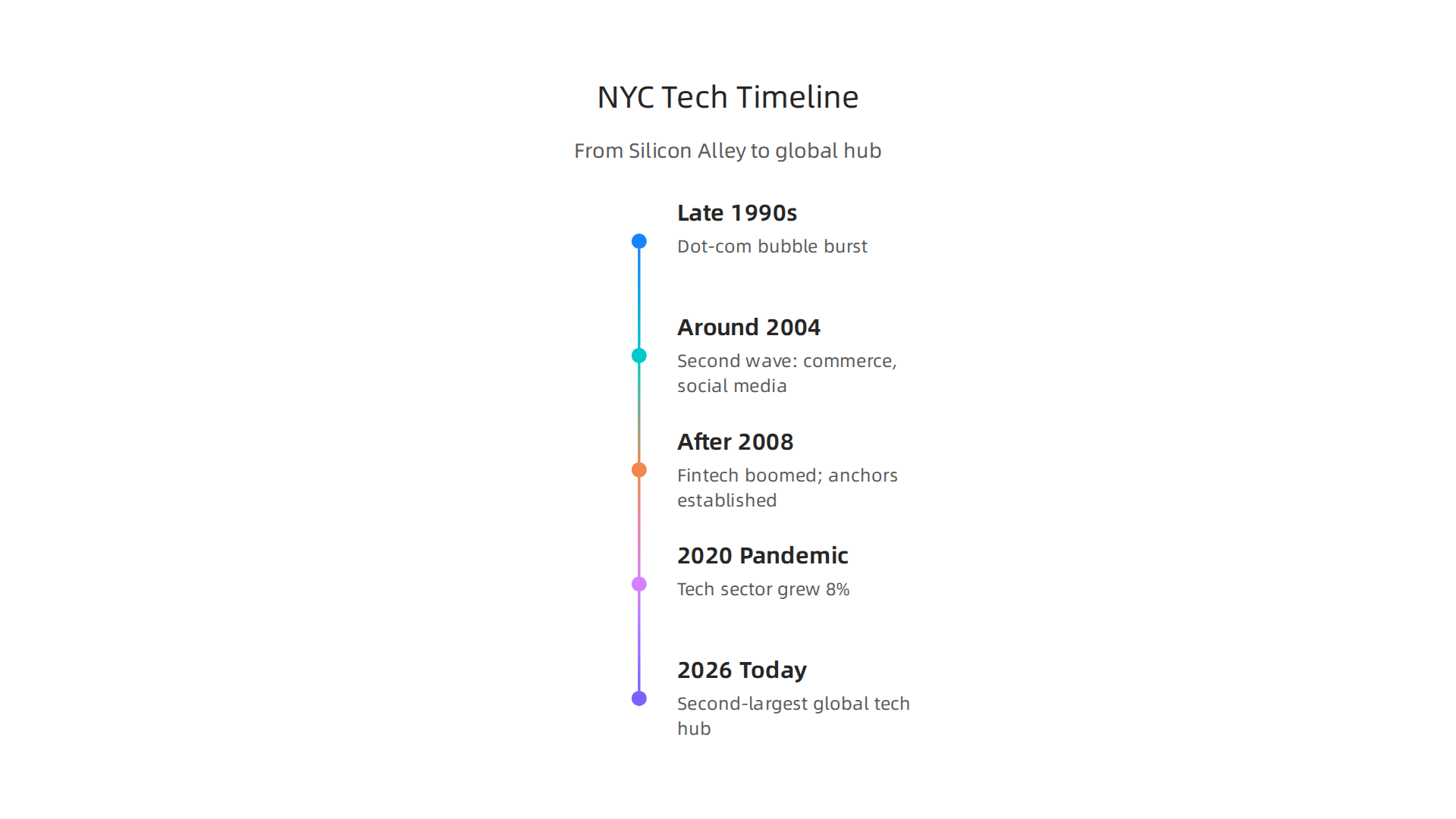
It all started in the late 1990s. Back then, people called it Silicon Alley. A small group of internet companies like DoubleClick and TheStreet.com set up shop in Manhattan. The energy was electric. But then the dot-com bubble burst in 2001. Money dried up. Many startups shut their doors. For a few years, the scene went quiet.
Then came the second wave. Around 2004, a new layer of startups emerged. Companies like Etsy, Gilt, Tumblr, and Foursquare grew out of New York. This time, the focus was on commerce and social media. You can trace the full story by reading about the early Silicon Alley evolution phases written by someone who watched it happen firsthand.
The real game changer happened after the 2008 financial crisis. Tech companies started to see New York as more than just a finance town. Fintech boomed. Big anchor companies like Google and Meta set up massive offices in the city. They brought thousands of well-paid engineers and created a talent pool that startups could tap into. Those offices became magnets for the best minds.
Then the pandemic hit in 2020. While many industries shrank, the tech sector in NYC did something unexpected. It grew. According to one study, the tech ecosystem expanded by 8% from 2017 to 2021 even as the rest of the city’s workforce dropped. That ability to adapt is a big reason why the innovation center model has taken off so strongly in the five boroughs.
Today, New York is the second largest tech hub in the world. It has more than 25,000 tech enabled startups and a workforce of over 400,000 tech professionals. The journey from a tiny alley of internet firms to a diverse, global innovation engine has been anything but straight. But that is exactly what makes it so exciting to be part of the scene in 2026.
Key Verticals Driving NYC Startup Growth in 2026
New York City is not a one-trick town when it comes to startups. In 2026, several key verticals are fueling the city’s rise, each building on the strengths of its traditional industries.
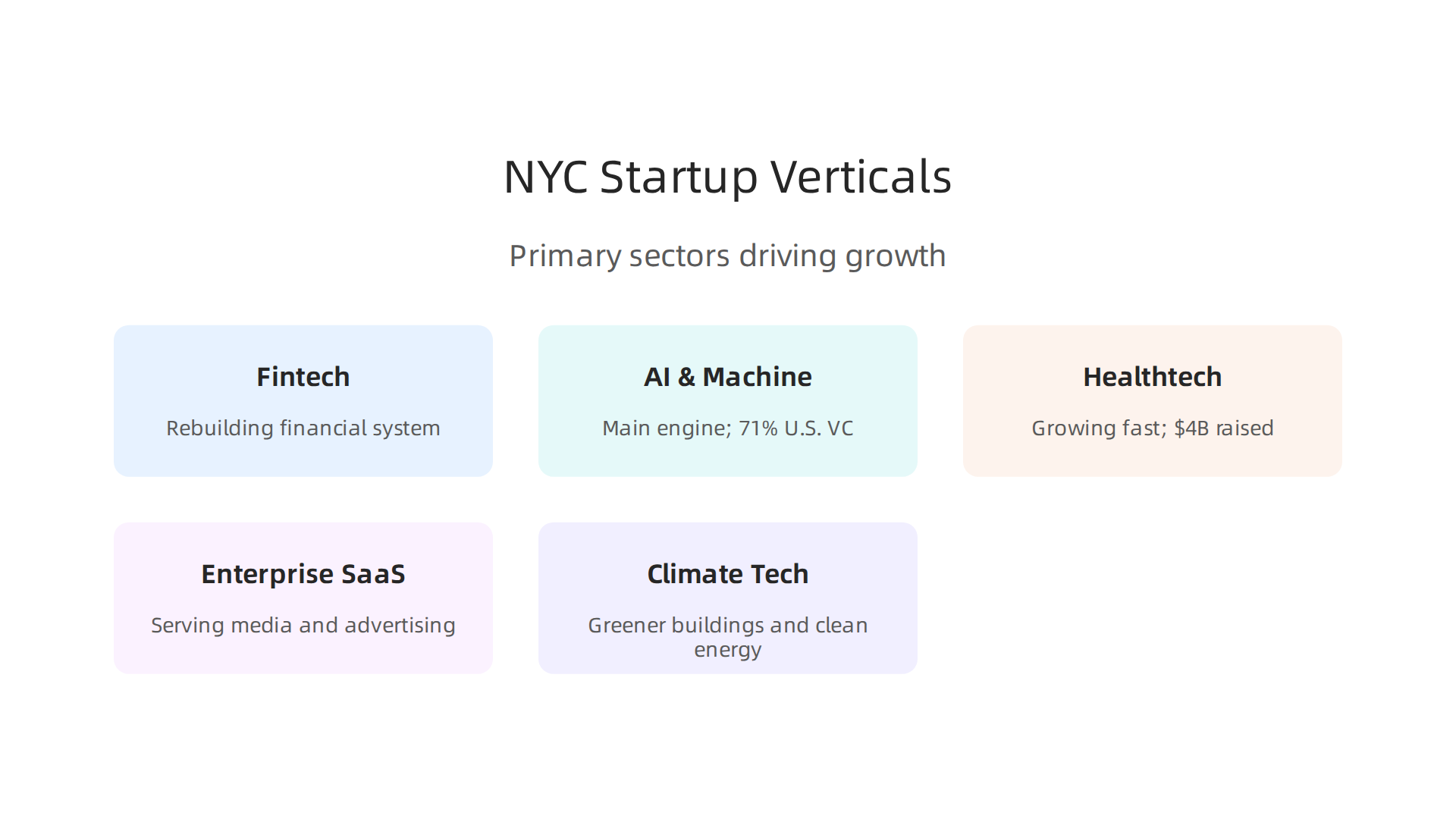
Let’s look at the main sectors that are attracting the most investment and talent right now.

Fintech: The Natural Leader
It is no surprise that fintech leads the pack. New York is the global capital of finance, so startups here are rebuilding the financial system from the ground up. AI is now woven into everything from underwriting to trading tools. According to recent data, NYC-based fintech companies raised over $46 billion in venture funding between 2014 and 2023, and the momentum has only grown. Companies like Kalshi and Imprint are examples of this fintech-AI blend. You can explore the full list of the best fintech startups in New York to watch in 2026 if you want to see who is leading the charge.
AI and Machine Learning: The Main Engine
Artificial intelligence is the standout growth engine for NYC right now. In the first quarter of 2025, 71% of all U.S. venture capital dollars went into AI, and NYC grabbed a meaningful share with 81 AI deals worth about $1.5 billion. That is far ahead of other major cities like Los Angeles and Boston. The state has also committed $90 million to the Empire AI initiative, bringing total funding for that project to more than $565 million. If you are a founder looking to build in this space, you might want to read about how to evaluate AI platforms for your startup in 2026. The depth of AI activity here spans enterprise tools, healthcare applications, and consumer products.
Healthtech: Growing Fast with AI Help
Healthtech is another vertical on fire. In 2024, 113 New York-based health tech companies raised $4 billion, the highest total since 2021 and a 60% jump from 2023. AI is driving much of that growth, with startups building clinical documentation tools and diagnostic platforms. Companies like ExaCare and Ambience Healthcare are representative of this wave. You can see the top NYC health tech companies in 2026 for a closer look.
Enterprise SaaS and Climate Tech
Enterprise SaaS continues to be a steady force, with startups serving industries like media, advertising, and real estate. Climate tech is also gaining steam as New York pushes for greener buildings and cleaner energy. These verticals may not grab the biggest headlines, but they attract serious funding and talent.
Why It All Works Together
The real magic of NYC’s startup scene is the synergy between old and new. Fintech builds on Wall Street. Healthtech connects with world-class hospitals. AI tools serve media, advertising, and fashion. This cross-pollination makes the city a unique place to build a company.
If you want to stay on top of these fast-moving trends, consider subscribing to a daily digest that cuts through the noise. The ecosystem changes fast, and the best founders and investors never stop learning.
The Funding Landscape for NYC Tech Startups
Understanding how money flows into New York City tech startups is key to grasping the full picture. In 2024, NYC-based companies raised $23.8 billion in venture capital, a 41% jump from the year before. That comes from the most recent State of the New York City Economy report by the NYC Economic Development Corporation. The city also captured a bigger slice of the national pie, accounting for 11.3% of all U.S. venture funding in 2024, up from 10.5% in 2023.
But not every startup gets the same treatment. The money is concentrating on fewer, larger rounds. In the first quarter of 2025, the number of deals dropped from 468 to 305, yet quarterly capital peaked at $7.6 billion earlier in 2024. That means investors are picking their bets more carefully, especially in hot areas like AI.
Breaking Down the Stages
The stage of your startup matters a lot in 2026. Early-stage rounds (seed and Series A) still see plenty of activity, but the bar is higher.
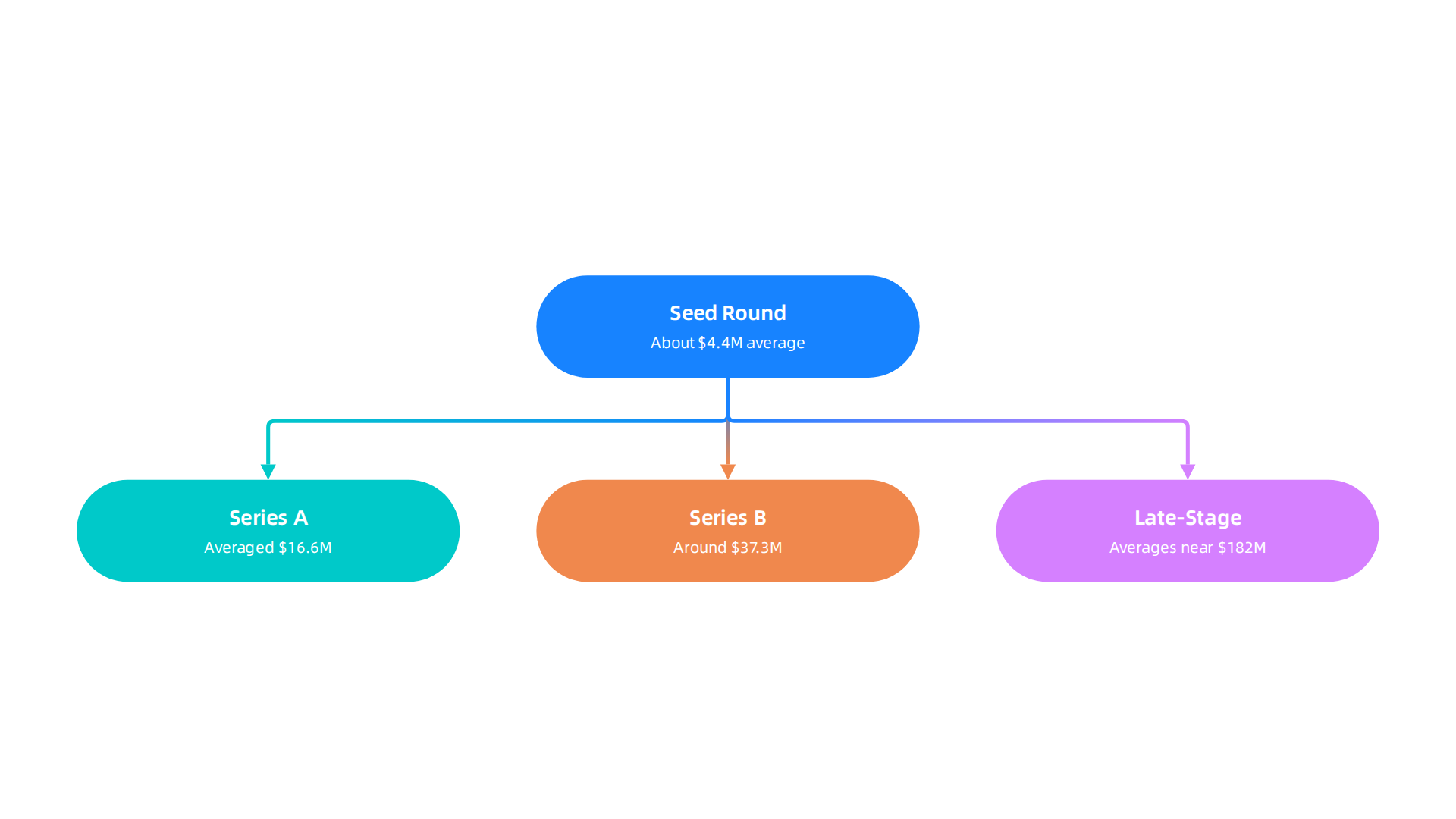
According to the January 2025 US venture capital report, the average seed round was about $4.4 million, while Series A averaged $16.6 million. Series B rounds landed around $37.3 million on average. If you are raising late-stage, expect averages near $182 million, but only if you have clear traction.
For founders outside the AI boom, securing Series A or B has become tougher. Seed checks are also smaller and harder to come by. This is why many founders turn to structured guidance. If you are just starting your fundraising journey, check out this practical guide on how to find investors for a startup.
Who Is Writing the Checks
New York City has a deep bench of active venture capital firms.

Union Square Ventures, First Round Capital, and Lerer Hippeau remain staples. But newer players like Notation Capital and the AI-focused funds are also making moves. Angel investors, especially those who have exited their own startups, are more active than ever. Networks like NY Angels and the Harvard Business School Alumni Angels frequently invest locally.
Beyond traditional VC, non-traditional funding sources are growing. Corporate venture arms from JPMorgan and Goldman Sachs are putting money into fintech and AI startups. Government grants, including the $90 million New York State Empire AI initiative, provide non-dilutive capital for early-stage research and development. Crowdfunding platforms like Republic and StartEngine also help consumer-focused startups raise smaller amounts from their own communities.
Keep Your Finger on the Pulse
The funding landscape shifts fast. What worked six months ago might not work today. The best way to keep up is to stay informed daily. That is why many founders and investors subscribe to The AI Newsletter Worth Reading. It delivers clear, daily AI updates so you never miss a trend that could affect your next round.
The Investor Perspective: Why NYC Remains a Magnet for Capital
So why do investors keep pouring money into New York City startups? The answer comes down to a few key advantages that other cities struggle to match.
First, the talent pool is unmatched. New York draws ambitious people from all over the world. You get engineers, marketers, finance experts, and creatives all in one dense metro area. When a founder needs to hire fast, they can find the right person within a few subway stops.
Second, the market access is huge. NYC is the home of Wall Street, major media companies, healthcare systems, and retail giants. A B2B startup can land its first enterprise customer blocks away from its office. For fintech startups especially, being in New York means being where the banks and regulators actually are. Fintech companies based in NYC captured 30% of all U.S. fintech investment in 2024, up from 22.7% in 2020, according to a comprehensive look at over 1,800 funded NYC startups from GrowthList.
Third, the industry diversity protects investors. Unlike cities that depend on one sector, New York has strength across AI, fintech, healthtech, climate tech, media, and enterprise software. If one sector cools down, others heat up. This spread makes the city a safer bet for venture capital dollars.
What VCs Look for in 2026
The investors I talk to are getting more specific. They want startups with real traction, not just a good pitch. The days of funding a deck and a dream are fading fast. The data backs this up. NYC startups raised $1.68 billion across 113 deals in January 2026 alone, a 93.5% year-over-year surge according to the AlleyWatch January 2026 report on New York venture capital. That jump shows that when investors see quality, they move fast.
But the bar is higher. VCs now spend more time evaluating a startup’s distribution strategy, not just its technology. They want to see that a team can actually reach customers and grow efficiently. Culture and adaptability within the founding team matter more than ever too.
Remote Work Changed the Game
Remote work has reshaped where investors place their bets. Before 2020, being in New York was almost mandatory for raising capital. Now, investors are comfortable funding teams that are spread across cities.
Here is the twist. NYC firms are adapting by leaning into what remote work cannot replace. They invest more in in-person demo days, networking events, and accelerator programs. The value of face-to-face connection has actually gone up. For early-stage founders, being able to walk into a coffee shop in SoHo and run into a fellow founder or angel investor still matters. If you want to understand which venture capital firms are actively backing small businesses in this environment, check out this overview of venture capital firms for small businesses to find the right path in 2026.
The bottom line? NYC tech startups still attract serious capital because the fundamentals are solid. The city has the talent, the markets, and the resilience to keep investors interested even as the world changes how it works.
Challenges Facing NYC Startups: Cost, Talent, and Competition
Building an nyc tech startup in 2026 comes with real hurdles.
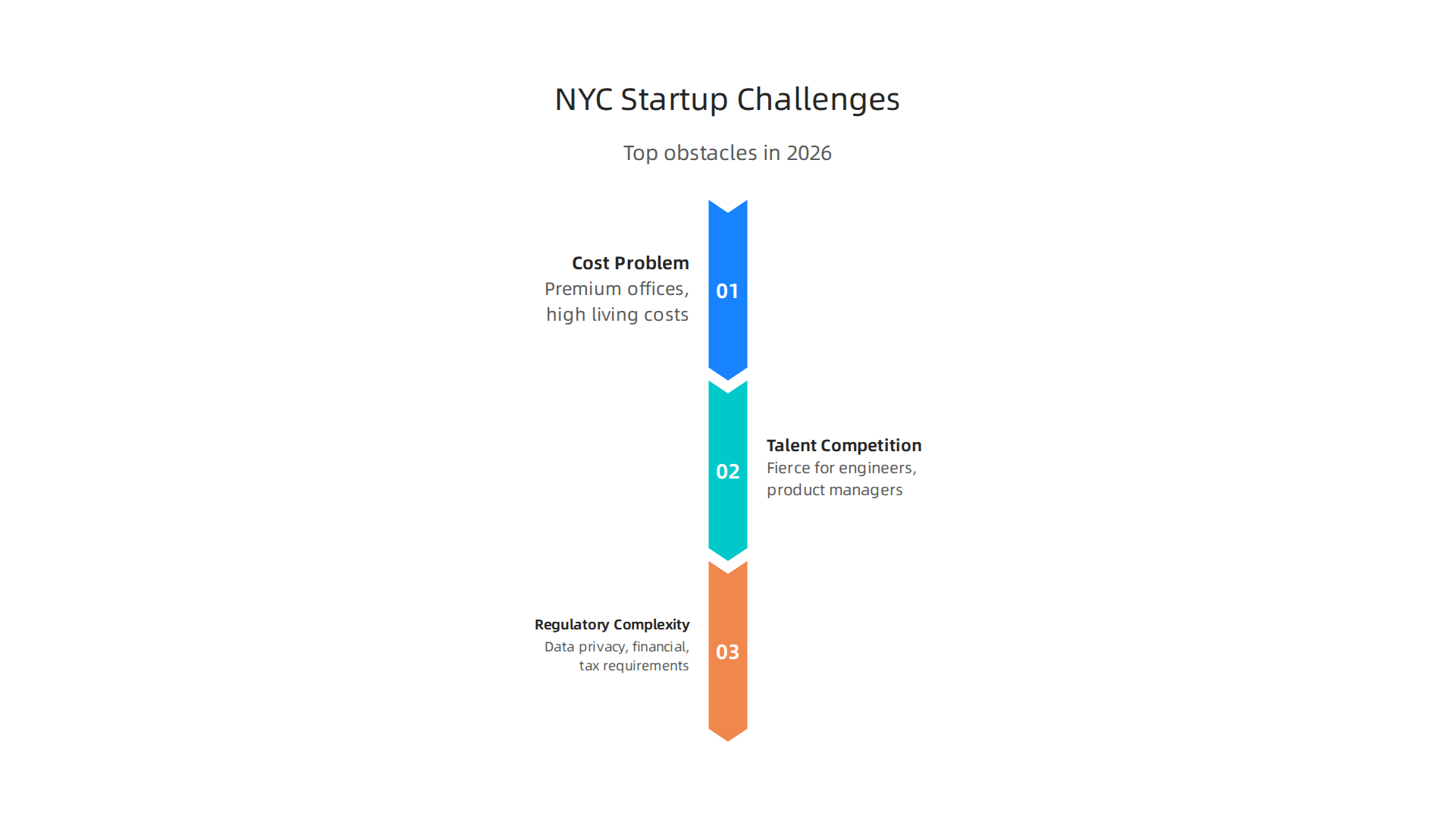
The same density that makes New York powerful also creates pressure. Let’s talk about the biggest challenges and how founders are navigating them.
The cost problem is real. Office space in Manhattan still commands premium rates. Even with remote work softening demand, prime locations remain expensive. The high cost of living also means founders need to raise more capital just to cover salaries. That creates a higher bar for survival compared to building in lower cost cities.
Talent competition is fierce. Every nyc tech startup fights for the same pool of engineers, product managers, and AI specialists. Big Tech offices from Google, Amazon, and Meta sit right next door to early-stage companies. They offer bigger salaries and established brands. That makes hiring a constant struggle for newer teams. To adapt, many founders use remote and hybrid models to pull in talent from outside the city. They also partner with local universities like NYU, Columbia, and Cornell Tech to tap into fresh graduates before the big companies scoop them up.
Regulatory complexity adds another layer. New York has specific data privacy rules, financial regulations, and tax requirements that can trip up early-stage teams. The city itself is working on this. A recent report on reducing regulatory friction for startups from the New York City Bar Association proposed clearer data privacy compliance guides and other reforms. That kind of help matters because legal uncertainty can slow down growth.
These challenges affect how startups survive. The venture capital market in 2026 shows a clear flight to quality. A report on venture capital investment in New York City from the state comptroller notes that investors are favoring larger, later-stage deals. That makes it harder for smaller seed-stage companies to get their first round of funding. Founders need to show real traction earlier than ever before.
So how are startups fighting back? Coworking spaces have replaced long term leases for many early-stage teams. Accelerator programs offer mentorship that can offset the lack of easy capital. And AI tools help lean teams do more with fewer people.
If you want to stay on top of how technology is reshaping the startup landscape, The AI Newsletter Worth Reading delivers clear daily updates that can help you make smarter decisions.
For founders navigating these challenges, having a solid funding strategy is critical. Check out this step-by-step guide on how to find investors for a startup in 2026.
Despite the obstacles, NYC remains the second strongest startup ecosystem in the world. The founders who acknowledge the challenges and adapt to them are the ones who survive and thrive.

NYC’s Talent Magnet: Attracting and Retaining Top Tech Workers
One of the biggest reasons NYC tech startups can handle the challenges we just covered is the city’s incredible access to talent. New York pulls in some of the brightest minds from around the world. By 2025, the city’s tech workforce had grown to over 400,000 professionals, according to a report on top New York tech companies for SMB growth. Demand is especially high for experts in AI, cloud computing, and cybersecurity. The average software engineer in NYC earns around $148,000, and top AI architects can command up to $234,000.
Local universities are a huge part of this. Schools like Columbia, NYU, and Cornell Tech feed a steady stream of skilled graduates into the market. Cornell Tech, for example, has built a $750 million campus and now enrolls over 500 students per year, as described in their report on expanding NYC’s tech ecosystem. Many startups partner directly with these universities to hire fresh talent before bigger companies can scoop them up.
Talent flows into New York from other hubs too. People move here from the Bay Area, Boston, and even other countries. The city’s diversity gives startups a wide range of perspectives. Black and Latinx workers make up 20 percent of NYC’s tech workforce, a share twice as large as in the Bay Area or Boston.
City programs help level the playing field. Initiatives like the NYC Tech Talent Pipeline and the CUNY 2X Tech program train and place thousands of workers every year. The NYC Economic Development Corporation also runs internship programs that place over 110 students at startups and VC firms annually. These efforts make it easier for startups to find the specialized talent they need without breaking their budget.
For founders trying to compete with big companies for top talent, having the right tools is key. Learn how to evaluate AI platforms for your startup to make sure you’re hiring the right skills for your team.
Policy and Infrastructure: How City and State Initiatives Support Startups
Beyond great talent, New York City and New York State have built a strong support system for nyc tech startups. Government programs and investments make it easier to start and grow a company here.
Tax breaks and grants help cut costs. The state offers the START-UP NY program, which lets eligible businesses operate tax-free for up to 10 years. The city also provides small business grants and subsidized coworking spaces through local development groups. These programs reduce the financial pressure on early-stage founders.
Infrastructure gets serious attention. The city has invested heavily in broadband expansion, especially in underserved neighborhoods. Public transit improvements make it easier for workers to reach tech hubs in Manhattan, Brooklyn, and Queens. More than a dozen new incubator and lab spaces have opened in the last few years, including the Brooklyn Navy Yard’s tech campus.
Non-profits and accelerators fill the gaps. The New York City Economic Development Corporation runs programs that connect startups with funding and mentorship. Techstars NYC is one of the top startup accelerator programs in the world, helping dozens of startups each year. The state also committed over $565 million to the Empire AI initiative, which supports AI research and startup growth. This public-private partnership shows how serious the region is about becoming a global AI leader, as highlighted in the Tech:NYC quarterly dashboard on New York’s venture capital trends.
For founders looking to build their support network, understanding these resources is key. You can learn more about innovation centers for startups and how they help companies scale.
Staying current on tech trends is also important for any founder. AI is reshaping every industry, and getting clear daily updates can give you an edge. Check out the AI Newsletter Worth Reading for curated insights straight to your inbox.
Emerging Trends and Opportunities for NYC Startups in 2026
The landscape for nyc tech startups is shifting fast in 2026. Three big trends stand out: artificial intelligence is eating up more venture capital than ever, climate tech is gaining real momentum, and B2B software as a service keeps growing steadily. Each one opens new doors for founders and investors.
AI remains the strongest growth engine. In 2025, venture funding rebounded to $469 billion, up 47% from the year before, according to the State of Venture 2025 report. AI companies captured nearly half of that total. For NYC startups, that means investors are actively looking for AI-native solutions in healthcare, finance, and enterprise software. Founders building AI tools should focus on clear use cases to stand out. If you are new to weaving AI into your product, check out this guide to using AI for startup success. Many startup accelerator programs around the city now specialize in AI cohorts, giving early-stage teams direct access to mentorship and capital.
Climate tech is becoming a major category. New York City has set ambitious sustainability goals, and startups are stepping up to help. Companies working on carbon tracking, renewable energy software, and green logistics are finding eager buyers. The city’s investment in infrastructure and its large commercial real estate market create a natural testing ground for climate tech products. This sector is attracting both traditional venture capital and impact investors. For founders, that means a growing pool of funding small business startup grants and green-focused VC funds to tap into.
Web3 and decentralized finance are finding their footing again. After the market correction in 2023 and 2024, web3 startups in NYC are back to building real products. The focus has shifted from speculative tokens to practical blockchain applications like supply chain tracking, digital identity, and cross-border payments. Early-stage investors are spending more time with founders who have working products, not just white papers.
B2B SaaS continues to be the backbone of the ecosystem. New York City has always been strong in business software, and that hasn’t changed. Startups serving the legal, real estate, media, and financial services industries continue to raise steady rounds. The key trend here is that SaaS companies are layering AI features into their existing products to increase value and defend against new competitors. Tech events NYC are full of conversations about this hybrid approach, and attending them can help you spot the next big opportunity.
What this means for founders and investors in 2026. If you are raising capital this year, focus on telling a clear story about market need and traction. Investors are being selective, but they are still writing big checks, especially in AI and climate tech. For founders in B2B SaaS, proving unit economics and customer retention will matter more than growth at all costs.
Looking ahead for the rest of 2026, we expect more mega-rounds in AI and a steady increase in climate tech deals. The city’s share of national VC funding should hold steady as NYC solidifies its position as the second-largest city tech ecosystem in the country. Founders who stay agile and follow these trends will have the best shot at success.
Summary
This article maps the New York City tech startup ecosystem in 2026, explaining how the city evolved from Silicon Alley into a global innovation hub and why it still attracts capital and talent. It reviews the dominant verticals—fintech, AI, healthtech, SaaS and growing climate tech—shows how funding is concentrated into fewer, larger rounds, and gives stage-by-stage averages founders should expect. The guide also covers investor preferences, the city’s talent pipeline from universities and programs, and the major operational challenges of cost, competition, and regulation. Practical advice includes where to find investors, how public initiatives and accelerators help, and how AI and cross-sector synergies create new opportunities. After reading, founders and investors will understand current funding dynamics, hiring realities, policy supports, and the strategic moves that improve chances of raising capital and scaling in NYC.