
DeepSearch AI Delivers Smarter Answers with Real Citations and Multi Step Reasoning

Introduction
You know that feeling. You type a question into a search bar, click five links, read three articles, open two more tabs, and still end up piecing together information from scattered sources. It takes forever. And by the time you find what you need, you are not even sure you can trust it.
That is the reality for professionals in 2026 who rely on traditional search. Information overload is a crippling problem when you need accurate, synthesized answers quickly.

Whether you are a founder researching a competitor’s funding round or an investor evaluating a new market, speed and trust matter.
Here is the thing. A major shift is happening. AI platforms are now capturing 15 to 20 percent of informational query volume, cutting into Google’s dominance. People are not just searching differently. They are expecting smarter answers.
Enter DeepSearch AI. This is not your standard chatbot or the familiar ai vs generative ai debate. DeepSearch represents a new paradigm. It combines multi-step reasoning with live data and explicit citations. Instead of giving you a single guess, it works through your question step by step, pulls fresh information from the web, and shows you exactly where each fact comes from.
Think of it as having a skilled research assistant who does not just summarize. They reason through your question and back up every claim with a source. This changes everything for startup and investment professionals who need to separate signal from noise fast.
In fact, generative AI reached 53 percent population adoption within three years, faster than the PC or the internet. The demand for better intelligence tools is exploding. But understanding the different types of ai and how DeepSearch fits into the landscape matters if you want to use these tools effectively.
This article provides a comprehensive deep dive into the technology, the competitive landscape, and the real implications of DeepSearch AI. You will learn what makes it different, how it compares to other tools, and how professionals like you are already using it for ai mastering and smarter interview ai preparation.
If you want to stay ahead of these shifts and get clear daily updates on AI developments, subscribe to The Deep View Newsletter. It is the kind of resource that helps you cut through the noise.
Ready to understand how DeepSearch actually works? Learn how AI understands meaning beyond keywords as a foundation. Then we will explore the real tech under the hood.
What Is DeepSearch AI and Why It Matters Now
So what exactly is DeepSearch AI? Think of it as a research partner that actually thinks. It does not just match keywords in your query. It understands what you really need, breaks your question into smaller parts, and searches multiple sources to build a complete answer.
Here is how it is different from a regular chatbot. A standard AI assistant might give you a general answer based on training data that could be months old. DeepSearch AI acts more like an agent. It uses something called agentic workflows. That means it can plan a series of steps, retrieve fresh information from the web as needed, and then combine everything into a clear response with citations you can check.
This approach is powered by retrieval-augmented generation or RAG. As one guide explains, Agentic RAG allows AI to retrieve more information when needed, think step by step, and refine responses for better accuracy. That is a huge leap from the old ai vs generative ai debate. You are not just generating text. You are generating grounded, verifiable answers.
Why does this matter in 2026? Because the way we search for information has already changed. AI platforms are now capturing 15 to 20 percent of informational query volume, and global AI adoption among organizations has jumped from 55 percent in 2023 to 78 percent in 2024, according to recent data. Professionals in fast-moving fields like startup finance cannot afford to sift through a dozen links. They need answers they can act on, fast.

DeepSearch AI fits into the broader landscape of types of ai that prioritize reasoning over retrieval. It is a tool for ai mastering of complex topics, whether you are researching a competitor’s funding round or preparing for an interview ai simulation. Instead of giving you a list of blue links, it hands you a synthesized summary with sources attached. That saves time and builds trust.
If you want to go deeper into how AI understands meaning beyond simple matching, check out this article on synonym technology and how AI understands meaning beyond keywords. It explains the foundation that makes tools like DeepSearch AI possible.
The bottom line: DeepSearch AI is not just another chatbot. It is a new way to get answers that are fast, accurate, and transparent. For anyone who needs to make decisions based on reliable information, that changes everything.
The Technology Behind DeepSearch AI: Agents, RAG, and Multi-Step Reasoning
You now know that DeepSearch AI is more than just a simple chatbot. But what exactly makes it tick under the hood? The real power comes from three core technologies working together: agentic frameworks, retrieval augmented generation (RAG), and multi step reasoning.
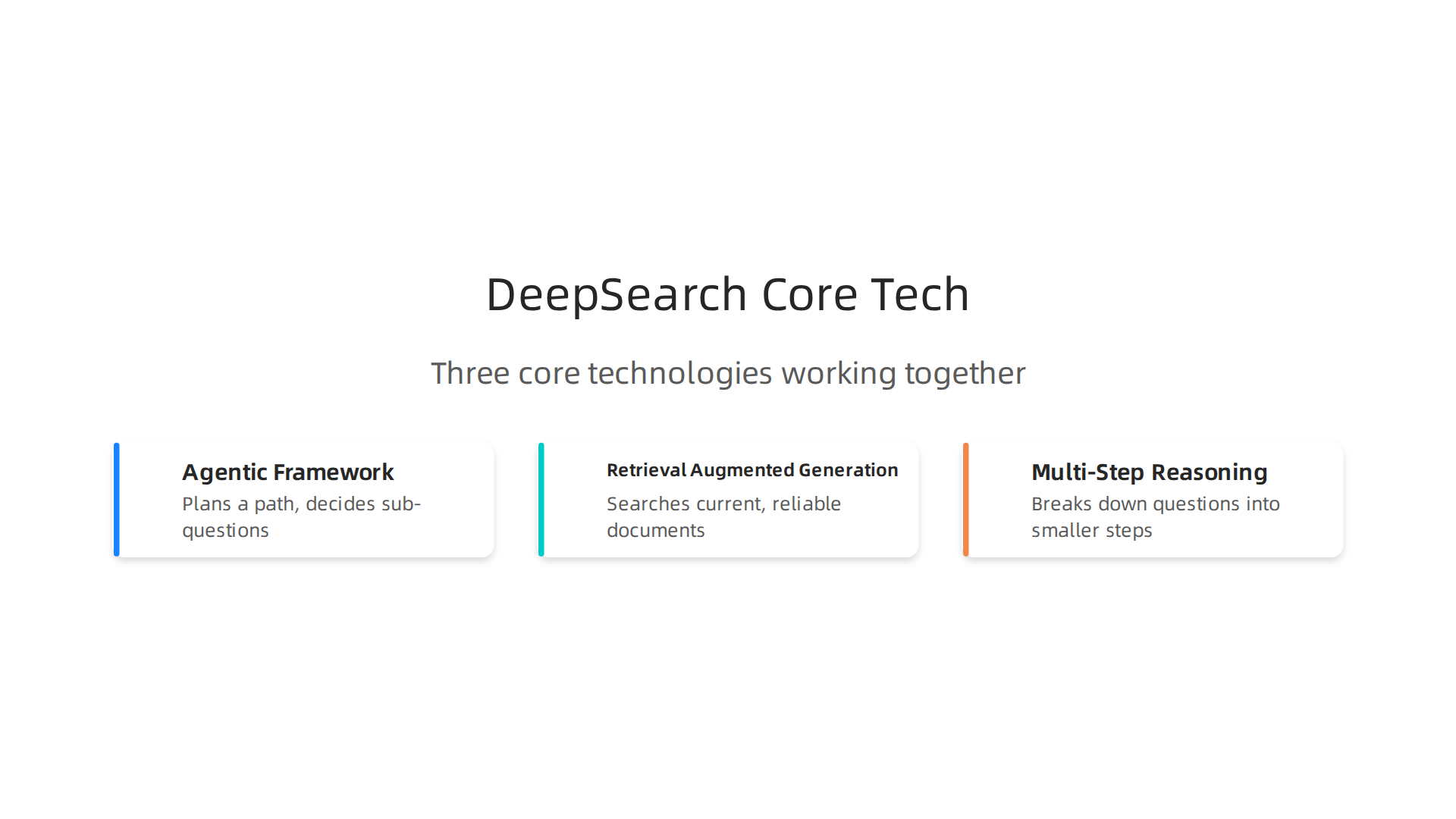
First, the agentic framework acts like a smart project manager. It plans a path, decides what sub questions to ask, and chooses the best data sources. This orchestration is a core feature of modern types of ai, as explained in this guide on core features of Agentic RAG. It does not just react. It thinks ahead.
Second, retrieval augmented generation keeps the system honest. Before it writes a single word, it searches for current, reliable documents. This grounding in real data helps reduce AI hallucinations in enterprise systems. This closes the gap in the old ai vs generative ai debate. You get the smooth language of generative AI paired with the accuracy of a live fact check.
Third, multi step reasoning lets it take on really hard questions. It breaks them down into smaller, simpler steps and solves each one in order. This architecture bridges the gap between LLMs and organizational knowledge, making it perfect for ai mastering a new topic or practicing for an interview ai simulation.
These technologies turn DeepSearch AI into a tool that goes beyond simple answers. If you want to see how these AI capabilities apply to real world business research, check out this guide on how to discover startup project opportunities using AI and data analytics.
The world of AI moves fast. Keeping up with breakthroughs in agentic systems and RAG can feel like a full time job. That is exactly why a trusted source of daily insights is so valuable. Get clear daily AI updates from The Deep View Newsletter to stay ahead of the curve.
Key Players and Platforms in the DeepSearch AI Landscape
All that technology we just talked about is worthless without the right tools to use it. So who is actually building the best DeepSearch AI platforms right now? The market splits into two main groups: scrappy startups and big tech giants. And each group brings something different to the table.
The Startup Pioneers
A handful of startups really defined this category. Perplexity AI made search feel like a natural conversation. You ask a question, and it gives you a clear answer with real sources attached.
Glean focused on enterprise search, helping large companies find information buried across their internal documents. Hebbia targets knowledge workers in finance and law with deep document analysis. And You.com combined a classic search engine with AI chat features.
These companies proved that DeepSearch AI could go beyond basic search. They showed the world that AI could handle complex, multi-step questions and return trustworthy answers. Investors noticed too. In 2026 alone, AI startups continue to pull in massive funding. In fact, they now attract 33% of all venture capital dollars globally. The race among these pioneers is heating up fast.
The Big Tech Response
The big players could not ignore this market for long. Google launched Gemini Deep Research, which uses agentic workflows to create detailed, cited reports on almost any topic. OpenAI introduced a deep research feature inside ChatGPT that browses the web and compiles findings for you. And Microsoft Copilot now includes deep research capabilities tied directly into the Microsoft 365 ecosystem.
These tools aim to do the same things the startups do. But they have a huge advantage. They already have millions of users. This tension between nimble startups and massive platforms is at the heart of the ai vs generative ai debate.

Do you pick a focused specialist tool or a general-purpose giant?
How the Market Breaks Down
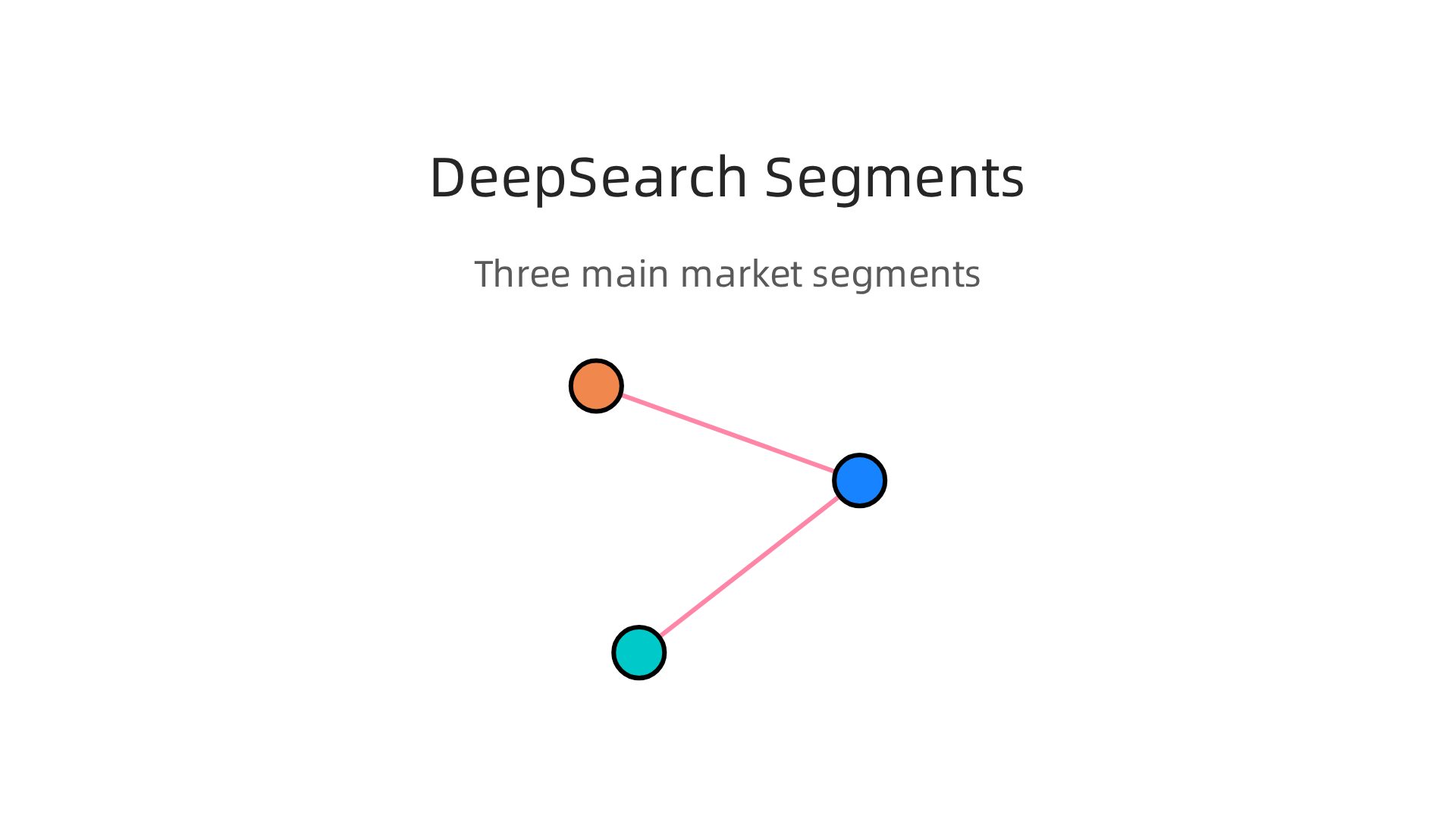
Here is the thing. Not all DeepSearch AI tools are the same. The market really splits into three clear segments.
| Segment | What It Does | Best For |
|---|---|---|
| General-purpose research | Answers any question with cited sources | Everyday learning and exploration |
| Enterprise knowledge management | Searches internal company data | Large teams and corporate use |
| Vertical-specific tools | Focused on one industry like law or finance | Deep professional research |
This segmentation helps you pick the right tool for your specific need. If you are practicing for an interview ai simulation, you want a general tool that covers many topics. But if you are doing deep due diligence on a startup investment, you might want a vertical tool built for financial analysis. Understanding these different types of ai platforms helps you make smarter choices.
Why This Matters for You
The DeepSearch AI landscape is changing every month. New startups launch. Big tech adds features. Winners and losers emerge quickly. To make the best decisions for your work or investments, you need to stay informed. Get clear daily AI updates from The Deep View Newsletter to know which players are winning and why.
DeepSearch AI vs. Traditional Search vs. LLM Chatbots: A Comparative Analysis
Let’s be honest. You have three ways to find information today. But they are not all the same. And picking the wrong one can waste your time or even give you bad answers.
Traditional search is like a library card catalog. You type a query into Google or Bing. You get a list of links. Then you click, read, and stitch the answer together yourself. Work, right? It is still useful for simple facts. But it forces you to do all the thinking. And if you are researching a complex topic like deepsearch ai funding trends, you will open dozens of tabs and still feel unsure.
LLM chatbots are like a confident friend who sometimes fibs. Tools like ChatGPT or Claude write full paragraphs for you. That feels amazing at first. But they hallucinate. They make up facts that sound true but are not. And their training data stops at a certain date. So ask about a startup funding round from last week, and they give you a blank stare. This is why ai vs generative ai matters: pure generative AI lacks real-time grounding.
DeepSearch AI is the hybrid you have been waiting for. It combines the best of both worlds. It searches the live web like a traditional engine. Then it reads, synthesizes, and writes a clear answer with explicit citations. You get the freshness of real-time data plus the readability of a chatbot. And because it uses agentic RAG architecture, it can plan multiple searches and double-check facts before answering. Systems built with this approach can retrieve more information when needed, think step by step, and refine responses for better accuracy. That is a big step toward reliable research.
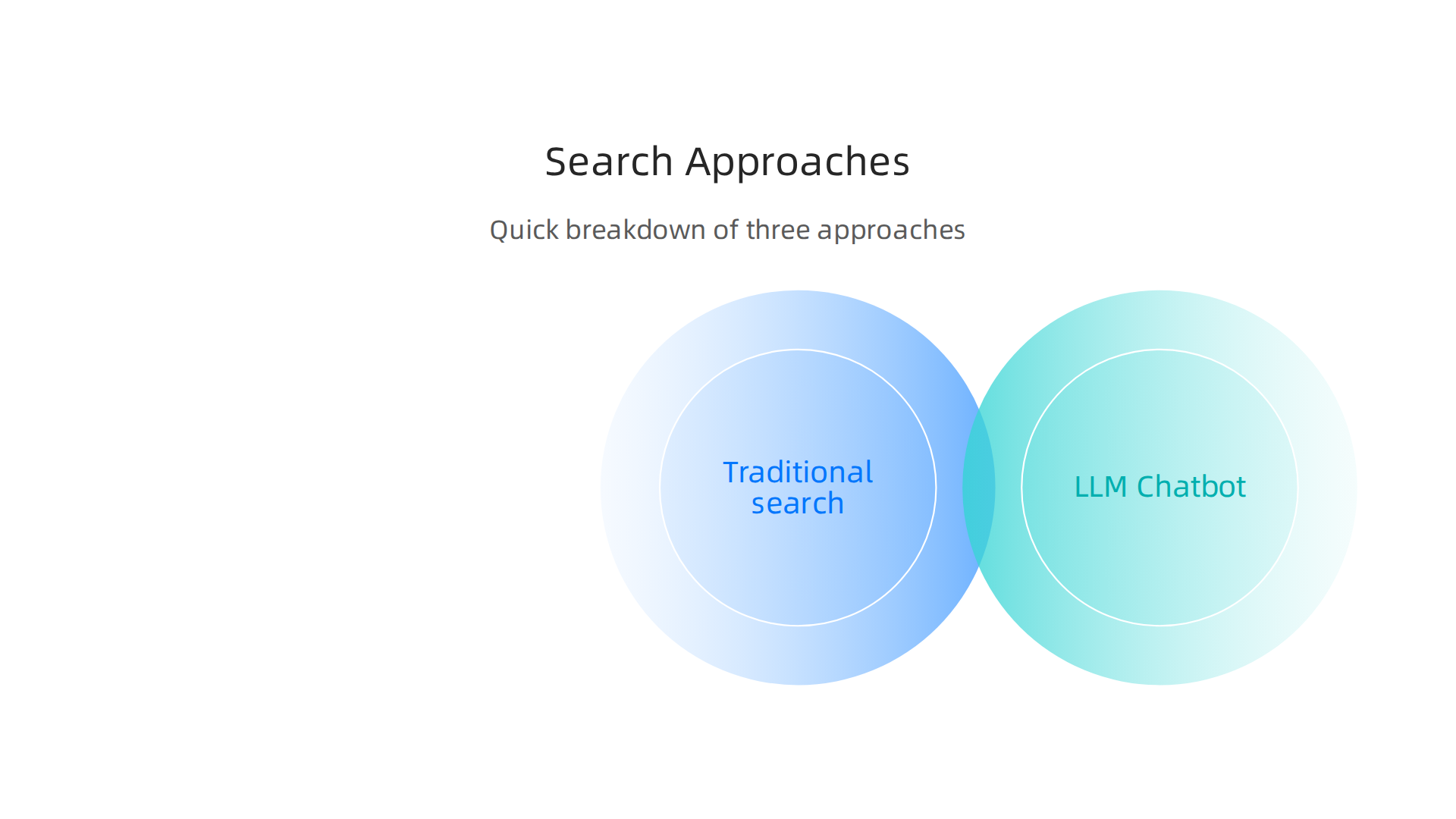
Here is a quick breakdown of the three approaches:
| Approach | Real-time data | Synthesized answer | Explicit citations | Hallucination risk |
|---|---|---|---|---|
| Traditional search | Yes | No | No (you decide) | Low for links, high for your interpretation |
| LLM chatbot | No (mostly) | Yes | Rarely | High |
| DeepSearch AI | Yes | Yes | Yes | Low (with verification) |
The technology behind deepsearch ai is often called agentic RAG. It acts like a research assistant that reads every source before writing. This makes it ideal for due diligence, academic research, or preparing for an interview ai simulation where accuracy matters.
To learn more about how AI moves beyond simple keyword matching, check out our guide on how AI understands meaning beyond keywords.
The market is moving fast. New tools appear every month. To stay informed about which approach is winning and why, get clear daily AI updates from The Deep View Newsletter.
Real-World Applications and Use Cases of DeepSearch AI
So where does DeepSearch AI actually make a difference? It is not just a nice idea. It is already changing how people work in three big industries: healthcare, finance, and legal.
Let us walk through each one.
Healthcare: Faster, Smarter Literature Reviews
Imagine you are a doctor treating a patient with a rare condition. You need the latest research. But traditional search gives you hundreds of papers to sift through. An LLM chatbot might make up a study that does not exist. DeepSearch AI steps in to solve both problems. It searches live medical databases, reads the full text, and hands you a clear summary with citations you can trust. This helps clinicians make evidence-based decisions faster. In fact, AI adoption in organizations jumped from 78% in 2024 to 88% in 2025, and healthcare is one of the top sectors driving that growth. Tools built on agentic RAG can even double-check facts across sources before answering.
Finance: Smarter Due Diligence
If you work in finance, you know the pain of due diligence. You have to pull data from SEC filings, earnings calls, news articles, and even social media. Then you try to connect the dots. DeepSearch AI automates that grunt work. It searches multiple sources in real time, synthesizes the key points, and gives you a concise report with exact references. This is a huge time saver for venture capitalists and analysts. The global AI market is projected to hit nearly $2 trillion in spending by 2026, and much of that is flowing into financial services. Understanding the different types of AI helps you pick the right tool for your job.
Legal: Summarizing Case Law in Minutes
Legal research is famous for being slow and expensive. You have to read through years of case law to find relevant precedents. DeepSearch AI changes that. It can scan thousands of legal documents and summarize the ones that matter, with links to the original rulings. This cuts the time from hours to minutes. For startups, this means lower legal costs and faster decisions. If you are preparing for an interview AI simulation that tests your knowledge of recent legal tech trends, DeepSearch AI is a great study partner.
The common thread across all three use cases is the same. DeepSearch AI does not just find information. It understands it, checks it, and writes it in a way you can use. That is the power of combining real-time search with agentic reasoning.
Want to stay ahead of how AI is reshaping these industries? Get clear daily AI updates from The Deep View Newsletter.
The Investment Landscape: Funding Trends and Hot Startups in DeepSearch AI
These real-world applications are not just cool stories. They are driving a massive wave of venture capital investment. In 2025 alone, top AI startups raised nearly $150 billion, accounting for more than 40% of global venture capital. A huge chunk of that money is flowing into the deepsearch ai space specifically.
Why? Because investors see a clear return. Enterprise AI search platforms are becoming the knowledge backbone that lets companies and their AI agents work at scale. The numbers back it up. In 2025, organizations using AI in at least one business function jumped to 88%. And the shift from experimental ai vs generative ai is driving money toward real-time, multi-source reasoning tools.
Here are some of the biggest bets being placed right now:
- Perplexity AI raised a $500 million round, valuing the company at over $5 billion.
- Hebbia, a startup specializing in document analysis for finance and legal work, secured $130 million.
- Glean, an enterprise search platform, closed a $200 million round.
These nine-figure rounds show that VCs are betting big on enterprise adoption as the primary revenue driver. The logic is simple. Companies need to master their internal data. Tools like DeepSearch AI promise to unlock that value by searching across every document, chat, and system in real time. Understanding the different types of ai in this space helps founders choose which platform to build or buy.
For startup founders and investors alike, tracking these funding trends is essential. It tells you where the market is heading and which platforms are gaining traction. If you want to understand how the biggest investment companies are shaping this landscape, read our analysis on the biggest investment companies of 2026 and their impact on startups and investors.
Want to stay ahead of where AI funding is going next? Get clear daily AI updates from The Deep View Newsletter.
Challenges, Limitations, and Ethical Considerations
All that investment sounds exciting, right? But here is the reality check. DeepSearch AI still has serious flaws. If you want to ai mastering these tools, you need to know where they stumble.

The biggest problem is hallucination. DeepSearch AI can pull information from the web or internal documents and serve up a confident answer that is completely wrong. In high stakes fields like medicine or law, this can be dangerous. A recent study on ethical frameworks in clinical research highlights how critical accuracy is when AI is used for real decisions (see this review on ethical challenges in clinical AI). You cannot just trust the output.
Bias is another hidden trap. The training data for these models often reflects the same old prejudices we see in society. If your company uses DeepSearch AI for hiring or performance reviews, skewed answers can hurt people. That is why transparency in reasoning is not just a nice to have. It is a must.
Regulators are finally catching up. In 2026, the EU AI Act is now in full force, classifying AI systems by risk and demanding strict transparency checks (learn more about conformity assessments required by the AI Act). This means any company deploying DeepSearch AI in high risk areas must prove it is safe and fair. The EU’s transparency rules require disclosure when an AI is making decisions that affect people.
For startups and investors building or buying these tools, these challenges are not just technical. They are ethical and legal. If you want to dig deeper into how to verify AI outputs, we have a guide comparing Originality AI vs Genspark AI to help you pick a trustworthy tool.
The landscape is shifting fast. Stay informed on the daily developments in AI and regulation. Get clear daily AI updates from The Deep View Newsletter.
Summary
This article explains DeepSearch AI, a new class of research tools that combines agentic workflows, retrieval-augmented generation (RAG), and multi-step reasoning to deliver real-time, cited answers instead of isolated links or ungrounded text. It shows how DeepSearch differs from traditional search and pure LLM chatbots by planning searches, fetching fresh sources, and synthesizing verified responses, making it valuable for professionals who need fast, trustworthy intelligence. The piece covers the core technology, market players from startups to big tech, and practical use cases in healthcare, finance, and legal work. It also summarizes recent funding activity, explains market segmentation, and highlights limitations like hallucinations, bias, and new regulatory requirements. After reading, you’ll understand how DeepSearch works, which types of tools suit specific needs, and what to check to evaluate accuracy and compliance before adopting the technology.