Unlock Startup Growth with AI-Powered Sales and Marketing Tools

Why startups should care about AI-powered sales and marketing tools now
In 2026, it’s clear that artificial intelligence (AI) is no longer just a futuristic idea. It’s a key tool that can help businesses grow, especially new startups. Many tools now act like a personal AI assistant for daily tasks. For startups, using AI-powered sales and marketing tools can make a huge difference right from the start.

These smart tools help early sales and marketing teams get things done much faster. This means startups can see results and value from their efforts in less time. For example, AI can quickly analyze data to find the best customers, which makes getting your first sales easier. This is super helpful when you’re looking for ai startup ideas and need to prove your market fast.
Many common problems that startups face can be solved with AI.
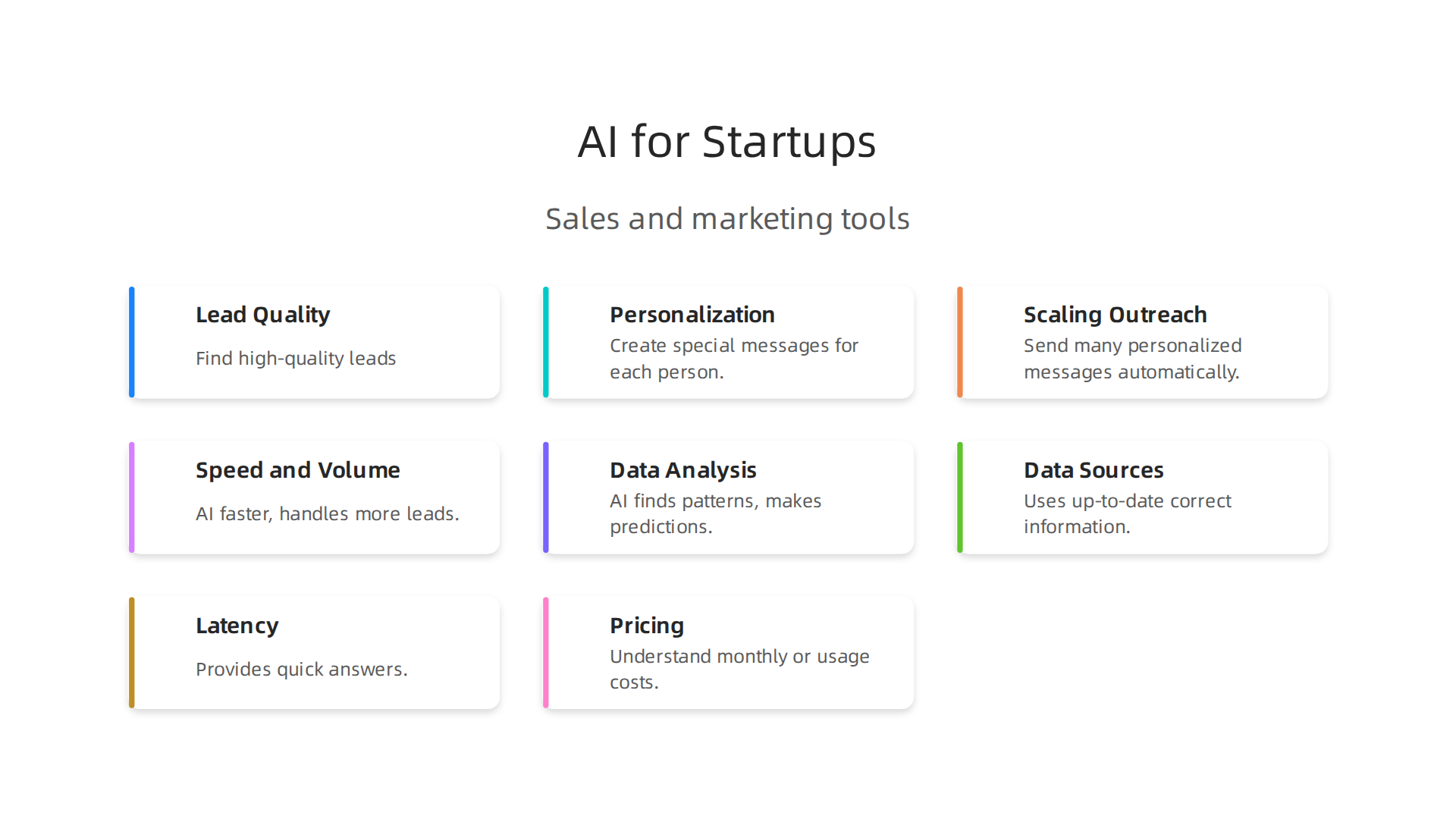
- Lead Quality: Finding the right people to sell to can be hard. AI tools can look through lots of information to find high-quality leads that are more likely to buy. This saves time and effort.
- Personalization: Sending the same message to everyone rarely works. AI can help create special messages for each person, making them feel seen and understood. This includes using AI for ai content creation to make personalized emails and ads.
- Scaling Outreach: As a startup grows, you need to reach more and more people without hiring a huge team right away. Tools like smartlead ai let you send many personalized messages automatically, helping you scale your efforts easily.
Actually, the numbers show just how important AI is. Around 87% of marketers are now using AI in their daily work in 2026, which is a big jump from before, showing how fast this trend is moving, according to Digital Applied. For sales, 83% of sales teams using AI saw more money coming in, compared to 66% of teams not using AI, as reported by Salesforce.
This proves that AI is a powerful ai gateway to better business results.
Staying up-to-date with these fast changes is very important for any startup. Get clear daily AI updates from The AI Newsletter Worth Reading.
With so many AI tools available in 2026, it helps to know how they fit into different groups. Knowing these categories makes it easier for startups to pick the right tools for their needs. Actually, there are over 14,200 active AI tools worldwide, showing how quickly this area is growing AI Tools Statistics 2026 | Usage, Growth & Market Data – Searchlab. Here are the main types of AI sales and marketing tools:
- Lead Generation Tools: These tools help find new potential customers. They look at huge amounts of data to find people or businesses that are most likely to be interested in what a startup sells. This saves a lot of time compared to finding leads by hand.
- Personalization Tools: Once you have leads, these tools help create special messages for each one. Instead of sending the same email to everyone, AI can change the words, offers, and even pictures to make the message feel unique to each person. This makes people more likely to respond.
- Sales Automation Tools: These are like a helpful robot for sales teams. They handle tasks that are repeated often, such as sending follow-up emails, scheduling meetings, or updating customer information. This frees up sales people to focus on talking to customers and closing deals. Many great AI sales tools in 2026 fall into this group.
- Predictive Scoring Tools: These smart tools use past information to guess which potential customers are most likely to buy. They give a "score" to each lead, telling sales teams who to focus on first. This helps sales teams use their time much more wisely.
Where does smartlead ai fit into all this? Smartlead ai is a key tool in the sales automation category, with a strong focus on personalization for outreach. It helps startups send many personalized messages automatically. Imagine needing to send tailored emails to hundreds of potential customers every week. Doing that by hand would take forever. Smartlead ai makes this possible by automating the sending of these unique messages, making sure each one feels special. This lets startups scale their efforts without needing a massive team.
These tools often use advanced insights, much like how a service like Deepsearch AI Delivers Smarter Answers With Real Citations And Multi Step Reasoning helps gather precise information. By using smart tools like smartlead ai, startups can make their sales and marketing much more effective and grow faster.
For startups looking to make a quick and strong impact, understanding how to use AI tools is key. Tools like smartlead ai really shine in certain areas, helping new businesses grow faster. The best ways for seed and Series A startups to use AI for fast results are in lead generation, lead scoring, personalization, and outreach automation. These areas can show big wins very quickly.
Why These Use-Cases Produce the Fastest Measurable Impact
- Lead Generation: For a startup, finding the right customers is job number one. AI tools help by looking through lots of information to find people or businesses most likely to want what you offer. This means less time wasted on bad leads and more focus on good ones. In 2026, 87% of marketers are already using generative AI in their work, showing how common and helpful these tools are for finding new paths to customers AI Marketing Statistics 2026: 200+ Adoption Insights.
- Predictive Scoring: After finding leads, how do you know which ones to talk to first? AI tools give each lead a "score" based on how likely they are to buy. This helps sales teams know who to focus on, making their work more effective. This is crucial for small teams with limited time.
- Personalization: Sending the same message to everyone rarely works. AI helps create special messages for each person or company. This makes people feel like you truly understand their needs, which boosts their interest. This is a big part of why
smartlead aiis so powerful for outreach. - Outreach Automation: Imagine sending hundreds of personalized emails every week. Doing that by hand is impossible for a small startup. Tools like
smartlead aiautomate this process, sending many tailored messages automatically. This lets startups reach a lot more potential customers without needing a huge team.
These smart tools boost sales teams’ revenue growth. Actually, 83% of sales teams using AI saw more money coming in, compared to 66% of those not using AI

Marketing Statistics: 100+ Insights for 2026. This shows how much of a difference AI can make.
Trade-offs Between Automation and Human-Driven Outreach
While AI offers amazing speed and scale, it’s important to know when to use it and when to rely on people.
-
Benefits of Automation:
- Speed and Volume: AI can do tasks much faster and handle more leads than a person. This is great for early stages when you need to reach a wide audience quickly.
- Efficiency: Automated tools take care of repetitive tasks, freeing up your team for more important work. For example, an
ai personal assistantcan schedule meetings or draft simple emails. - Data Analysis: AI can look at lots of data to find patterns and make predictions, helping you make smarter choices. This is key for discovering startup project opportunities using AI and data analytics.
-
When Human Touch is Best:
- Complex Sales: For very big or tricky deals, a human touch is often needed to build trust and answer complex questions.
- Deep Relationships: At the very early stage of a startup, building strong personal connections with initial customers can be super important. A
personal ai assistantcan’t replace a real conversation. - Strategic Conversations: When you need to understand a customer’s unique problems or offer a custom solution, a real person can adapt and think on their feet in ways AI can’t yet.
The best approach often mixes both. Use AI for the heavy lifting: finding leads, scoring them, and sending personalized first messages. Then, when a lead shows real interest, a human can step in to build that deeper connection and close the deal. This way, startups get the best of both worlds: speed and scale from AI, and thoughtful connection from people.
Get clear daily AI updates from The Deep View Newsletter. Subscribe now for The AI Newsletter Worth Reading.
After understanding the balance between AI’s speed and human connection, the next big step for a startup is picking the right AI tool. This means really looking closely at what tools like smartlead ai can do. You need to check a few important things about how they work, from where they get their information to how they fit into your team’s daily tasks. This careful check helps make sure you choose an AI that truly boosts your startup.
Evaluating Capabilities: What to Test in SmartLead AI and Competitors (Data, Models, and Workflows)
When you are thinking about bringing AI tools like smartlead ai into your startup, it’s like picking a team member. You want to know they are skilled and will work well with everyone else. Here are the key things to test:
Critical Technical Checks: Data Sources, Model Types, Latency, and Personalization Controls
First, let’s look at the basic building blocks of any good AI tool:
- Where Does the AI Get Its Information? Think of this as the AI’s food. For a tool like
smartlead ai, good "food" means it uses up-to-date and correct information about potential customers. This helps it find the best leads and make smart suggestions. If the data is old or wrong, the AI won’t be very helpful. - What Kind of "Brain" Does the AI Have? Many smart AI tools today use what we call Large Language Models, or LLMs. These are like advanced brains that help the AI understand and create human-like text. For example, some tools use different types of LLMs to create personalized messages. It’s smart to look at how these models are evaluated to make sure they are working well 8 LLM evaluation tools you should know in 2026 – TechHQ.
- How Fast Does It Work? This is called latency. For a startup, every second counts. You want an AI tool that can give you answers or send out messages quickly, without making you wait.
- How Much Can You Make It Your Own? Personalization is key for good outreach. An AI tool should let you control how it makes messages special for each person. This helps with
ai content creationthat really connects with customers. A personalizedpersonal ai assistantcan make a big difference in how your messages are received. Learning how to properly personalize AI output is a big part of successful AI strategy today, as shown in a survey on Personalization of Large Language Models.
Workflow Fit: Lead Routing, Integration into CRM, and Operations Handoffs
Next, you need to see how the AI tool fits into your team’s daily work.
- How Does It Handle New Leads? This is about "lead routing." Can the AI automatically send new, interested customers to the right sales person? This makes sure no good lead gets lost.
- Does It Work with Your Other Tools? Your startup probably uses a Customer Relationship Management (CRM) system to keep track of customers. An AI tool like
smartlead aishould easily connect with your CRM. This smooth connection means your team doesn’t have to jump between many different programs. Thinking about how AI connects to your other tech is like building anai gatewayto smarter operations. You can learn more about how AI helps find new chances for your business by looking into Discover Startup Project Opportunities Using AI And Data Analytics. - How Easy Is It to Pass Work to People? "Operations handoffs" means how simply the AI can finish its part of the job and pass it over to a human team member. This could be moving a hot lead from the AI’s automated messages to a sales person for a personal call. Making this smooth is vital for efficiency.
By carefully checking these points, you can choose an AI tool that truly helps your startup grow, making sure it’s not just smart, but also a perfect fit for your team.
Okay, so you’ve picked your AI tool, maybe something like smartlead ai, and made sure it fits your team. That’s a huge step! But how do you know if it’s actually helping your startup make more money or save time? This is where measuring what you get back, called Return on Investment (ROI), comes in.

In 2026, it’s not enough to just use AI; you need to prove it’s working. Many businesses are now focusing on showing real returns from their AI efforts, moving past just trying things out, as discussed in 2026 ROI Reckoning: How to Sell Enterprise AI That Moves the P&L.
Key Numbers to Watch: How AI Helps Your Business Grow
When you use AI for your Go-to-Market (GTM) plan, you want to look at a few main numbers:
- Turning Leads into Chances: This is about how many people who show a little interest (leads) actually become solid chances for a sale (opportunities). Does your
smartlead aitool help more leads turn into these chances? For instance, if you usually turn 10 out of 100 leads into opportunities, and with AI, you turn 20, that’s a big win! AI-powered sales tools are making a real difference, with many teams seeing positive ROI quickly, according to AI for Sales: The Complete 2026 Guide to Automating Revenue. - Getting More Done with Less: We call this "outreach efficiency." Is your AI helping your team send more emails, make more calls, or connect with more people without working extra hours? If your
personal ai assistantcan write better emails faster, that’s efficientai content creation. This means your team can focus on talking to the most interested customers. - Lowering the Cost to Get a Customer: This is your Customer Acquisition Cost, or CAC. When your
smartlead aihelps you find better leads and close deals faster, it often means you spend less money to get each new customer. This is a very important number for any startup to keep low. Many companies are seeing great improvements in their GTM strategy by using AI, as highlighted in A Practical AI Playbook for 2026 Planning: Where to Lean In—and Where to Tread Cautiously.
How to Test if AI is Really Helping
To be sure that your AI tool is making a difference, you need to run some tests. This is like doing a science experiment for your business.
- A/B Tests: Imagine you have two groups of customers. One group gets messages made by your
smartlead aitool, and the other group gets messages made the old way, without AI. By comparing the results from both groups (like who buys more or replies more often), you can see if the AI is truly better. This is how you measure the "incremental value" or the extra good that AI brings. - Cohort Experiments: This is similar but often looks at groups over a longer time. You might have one group of sales people use the AI tool for three months, and another group not use it. Then you compare their numbers. This helps you understand the long-term impact on things like lead quality and how quickly deals close. Learning how AI helps find new chances for your business is crucial for startups. You can discover more about these ideas in Discover Startup Project Opportunities Using AI And Data Analytics.
By keeping a close eye on these metrics and running smart tests, you can clearly see how your AI tools are helping your startup’s growth and proving their worth.
Want to keep up with the latest in AI and how it’s changing the startup world? Get clear daily AI updates from The AI Newsletter Worth Reading.
Now that you know how to tell if your AI tools are truly helping, let’s talk about getting them set up right. Making sure your smartlead ai or any personal ai assistant works well means connecting it properly to your other business tools. It also means keeping your data clean and safe.
Connecting AI with Your CRM and Keeping Data Tidy
For your AI to be really smart, it needs good information. This usually comes from your Customer Relationship Management (CRM) system. Your CRM holds all the important details about your customers and sales leads. If your AI tool, like smartlead ai, can talk directly to your CRM, it can learn from all that past information. This helps it make better predictions and create more helpful ai content creation.
But here’s the thing: garbage in, garbage out. If the data in your CRM is messy or wrong, your AI won’t be as good. So, before you fully link up your AI, it’s super important to clean up your data. Make sure names are spelled right, old contacts are removed, and all the information is correct. This is called "data hygiene." Good data hygiene helps your AI be a real ai gateway to smarter business.
Privacy, Rules, and How Vendors Handle Your Data
When you use AI, especially tools that handle customer information, privacy is a huge deal. In 2026, there are many rules about how businesses should protect personal data.

For startups, understanding these rules and making sure your AI tools follow them is a must. You don’t want to get into trouble later.
Think about these things:
- Data Privacy: How does your chosen AI tool protect the information it uses? Is it kept secret and safe from bad actors?
- Rules and Laws: Are you following all the privacy laws, like GDPR or CCPA, that apply to your customers? Experts say that good data privacy practices are key for businesses using CRM and AI in 2026 to avoid risks, as explained in the Data Privacy in 2026: CRM, AI & Compliance Guide.
- Vendor Handling: How does the company that made your AI tool handle your data? Do they share it with others? Make sure you read their terms carefully. Using tools that help automate these privacy checks can be very helpful for compliance. You can learn more about important tools for managing data privacy in 2026 by checking out some of the Best Data Privacy Software for Enterprises in 2026.
Proper data management isn’t just about following rules; it’s about building trust with your customers. If they know you’re careful with their information, they’ll be more likely to stick with you.
Growing Your AI Use Smartly
Once your AI is integrated and you’re handling data correctly, you can start thinking about how to grow its use. This is where ai startup ideas often come from. Start small, learn what works best, and then slowly expand to other parts of your business. This careful growth helps you make the most of your AI without facing too many problems. Understanding how AI can reshape innovation is crucial for this growth. You can read more about How Generative AI Assistants Are Reshaping Startup Innovation and Funding in 2026.
Once your AI is set up, your data is clean, and you are protecting privacy, the next big step is to use it to help your business grow. This means making clear plans, or "playbooks," for how AI will help your sales and marketing teams. In 2026, many companies are finding that old ways of reaching customers don’t work as well. Instead, a new way of doing things that uses AI is needed to really boost sales. In fact, many leaders say that having a modern, AI-powered system for going to market is key to driving revenue today, as highlighted in The 2026 Go-to-Market Execution Blueprint for GTM.
Go-to-market tactics with AI: playbooks for SDRs, content, and account-based outreach
Think of a playbook as a step-by-step guide. For your sales development representatives (SDRs) who reach out to new customers, AI can be a huge help. A personal ai assistant can make their work much easier.
Here’s how AI can help with smart go-to-market plans:
- Better Outreach with AI: Your SDRs can use AI tools, like
smartlead ai, to create messages that feel very personal. Instead of sending the same email to everyone, AI can help tailor each message to what a specific customer cares about. This is super important because people are more likely to respond when a message feels like it’s just for them. AI can also help your teams to discover startup project opportunities using AI and data analytics. - Smart Sequencing: AI can help decide the best order and timing for your messages. Should you send an email, then a LinkedIn message, then make a call? AI can learn from past successes to suggest the best path. This makes sure your sales team is always doing the right thing at the right time. Research shows that 40+ proven AI workflows are being used by top GTM leaders for everything from content to sales, according to The 2026 State of AI for GTM Workflows.
- Creating Helpful Content: When you send messages, you often need to share helpful information or articles. This is where
ai content creationcomes in. AI can quickly make different types of content that fit different customers. This means your sales team always has the right words and information to share. A goodpersonal ai assistantcan even suggest what content to send based on what a customer has looked at before. - Account-Based Outreach: For bigger deals, you might focus on a few key companies. This is called account-based outreach. AI can act as an
ai gateway, helping your team understand everything about those important companies. It can find out who the right people to talk to are and what their main problems might be. This lets your team create very specific plans for each company, instead of a general approach. - Growing with Your Business: How you use AI will change as your company grows. At the beginning, AI might help with simple tasks. As you get bigger, it can take on more complex jobs, like predicting which customers are most likely to buy. Using AI in sales can lead to big wins, with many teams seeing positive results quickly, as detailed in AI for Sales: The Complete 2026 Guide to Automating Revenue.
The key is that AI works best when it helps your human teams, not when it tries to replace them. It frees up your people to do the things only humans can do well, like building strong relationships.
To keep up with the latest ways AI can help your business, make sure you’re always learning. Stay informed on how artificial intelligence is changing the game for startups and big companies alike. Get clear daily AI updates from The AI Newsletter Worth Reading.
To really make AI work for your business, it’s not enough to just know what it can do. You also need to pick the right tools. This is super important for startups, as choosing wisely can save time and money. Think of it like buying a new car; you want to make sure it fits your needs now and in the future.
Vendor comparison checklist and procurement tips for startups
When looking for AI tools, especially for new companies, it’s easy to get lost. There are so many options out there in 2026! To help you pick the best ones, like a great personal ai assistant or an ai gateway for your data, here’s a simple checklist and some tips for getting good deals.
Your Checklist for Picking AI Tools
Before you say yes to any AI tool, ask these questions:
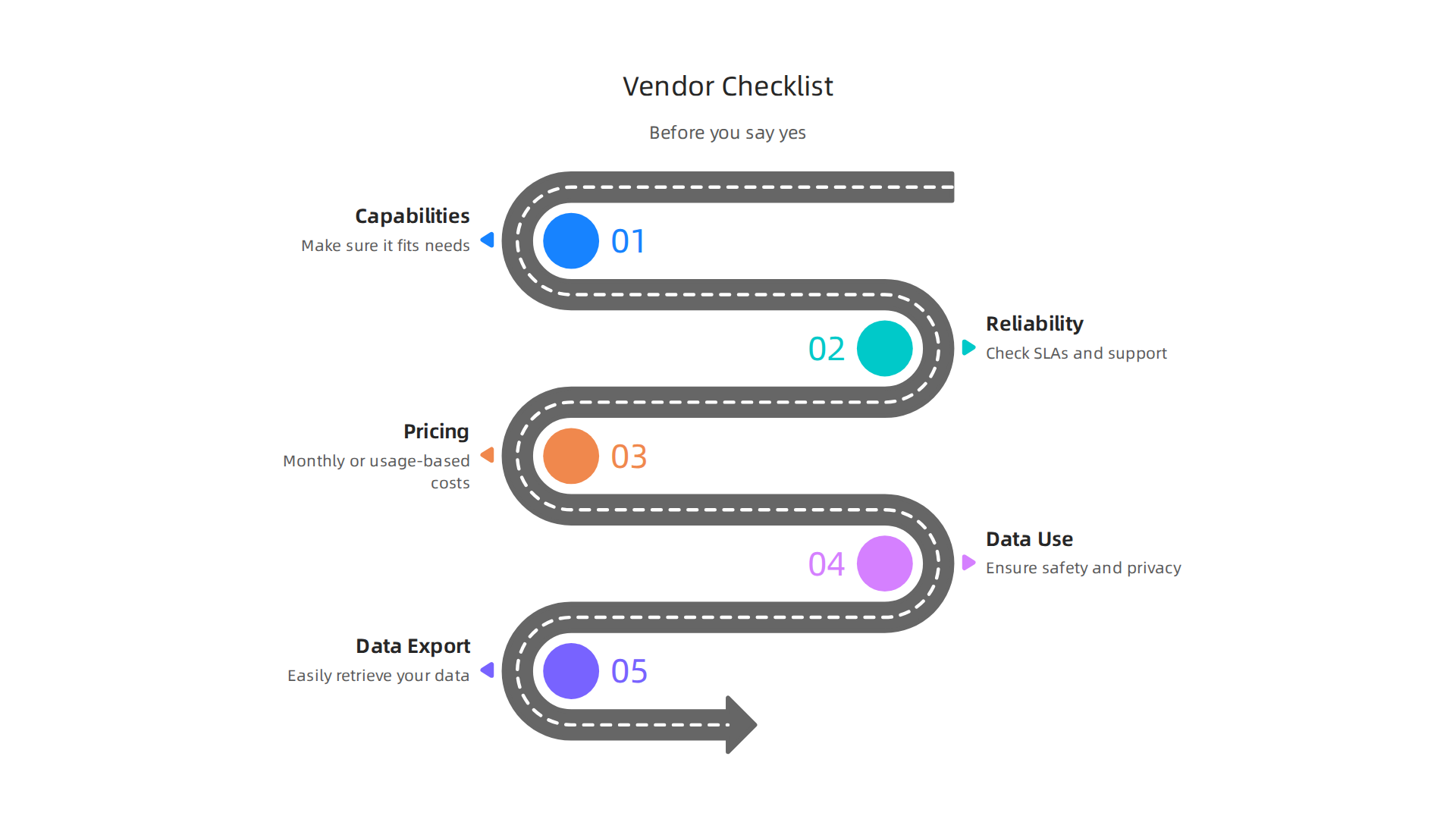
- What can it do? Make sure the AI tool does exactly what you need. For example, if you need help sending emails, does it offer features like
smartlead aifor smart outreach? If you need content, does it have goodai content creation? Don’t pay for features you won’t use. Many tools are out there, and some are better for startups than others, as shown in the 5 Best AI Tools for Startups in 2026. - How reliable is it? (SLAs) SLA stands for Service Level Agreement. It’s a promise from the company about how well their tool will work and how much help they will give you. Make sure you know what happens if the tool stops working or you need support.
- How does pricing work? Startups often have tight budgets. Understand the pricing model. Is it a monthly fee, or do you pay based on how much you use it? Does it change as your business grows? This helps you plan your money better.
- How will it use your data? You want to make sure your company’s information is safe and private. Ask about their rules for data access and security. This is a crucial step when choosing any new AI tool, as highlighted in Essential Questions to Ask Your AI Vendor Before Deploying.
- Can you take your data out? What if you decide to switch to a different AI tool later? Can you easily get all your data back? This is called "exit" or "export" provisions. Knowing this makes sure you’re not stuck with a tool you don’t like. For a fuller look at this, check out an Ultimate checklist for buying AI tools.
Tips for Smart Buying
For ai startup ideas and growth, getting the right tools at the right price is key:
- Know Your Needs First: Before you even look at tools, write down exactly what problems you want AI to solve for your business. This helps you focus.
- Ask for Startup Deals: Many AI companies offer special prices or trials for new businesses. Don’t be afraid to ask! They want to help new companies succeed.
- Start Small, Then Grow: You don’t have to buy the biggest, most expensive tool right away. Pick a tool that meets your immediate needs and can grow with you.
- Read Reviews and Talk to Others: See what other startups say about the tools they use. This can give you real-world insights. You might even find comparisons like Originality AI vs Genspark AI Which Tool Should Startups Trust In 2026 helpful.
- Think Long Term: While it’s good to start small, also think about where your company will be in a year or two. Will the tool still be useful?
By carefully checking these points and using smart buying tips, you can choose AI tools that truly help your startup grow strong. Choosing the right generative AI assistants can reshape your startup’s innovation and funding journey significantly, which is explored further in How Generative AI Assistants Are Reshaping Startup Innovation And Funding In 2026.
Summary
This article explains why seed and early-stage startups should adopt AI-powered sales and marketing tools now, showing where they deliver the fastest, measurable impact and how to get value quickly. It covers the main tool categories—lead generation, personalization, sales automation and predictive scoring—illustrates how tools like smartlead ai automate personalized outreach at scale, and explains the trade-offs between speed/efficiency and human-driven selling. You’ll learn how to evaluate tools (data sources, model types, latency, CRM fit), run A/B and cohort tests to prove ROI, track key metrics like lead→opportunity conversion and CAC, and follow a vendor checklist for pricing, SLAs and data export. The piece also covers integration, data hygiene, privacy/compliance considerations and practical go-to-market playbooks so founders can pick, deploy, and scale AI tools with confidence.