
Discover Startup Project Opportunities Using AI and Data Analytics

Introduction
Starting a startup project in 2026 means swimming in a constant flood of information. Funding announcements land by the hour. Competitors launch features overnight. Market trends shift faster than you can refresh your feed. For founders and investors, the noise is real and it can overwhelm even the sharpest teams.

The good news? Artificial intelligence has become the filter you need. According to the latest AI overview from Stanford HAI, generative AI reached 53% population adoption within three years, faster than the PC or the internet ever did. That speed means both opportunities and new complications for any startup project. How do you separate the signal from the static?
AI and data analytics now promise to cut through that clutter. They help you spot patterns in funding rounds, track investor sentiment, and validate your own assumptions before you burn through cash. Tools like stealth AI models can even scan early signals to find the next big opportunity before it hits the mainstream news. Behind the scenes, data annotation tech trains these systems to understand the language of startups, deal flow, and market timing.
In this article, we will look at how leading players use AI to identify opportunities, make smarter decisions, and stay ahead of the curve. We will explore real examples and show you how to apply these tools to your own startup project without getting lost in the hype.
For a quick comparison of two AI writing tools that startups trust, check out our breakdown of Originality AI vs Genspark AI. And if you want to stay on top of all this without the noise, get free updates from the daily AI insights that thousands of founders and investors read every morning.
The Data Revolution Reshaping Startup Innovation
Here is the thing. Ten years ago, if you wanted to know which startups were worth watching, you relied on word of mouth, a handful of press releases, and maybe a spreadsheet or two. Today, the data available on any given startup project is staggering. Financial metrics, web traffic numbers, social media signals, patent filings, hiring trends, and even satellite imagery all paint a picture of who is moving fast and who is falling behind.
The problem is that no human team can track all that information manually. The global AI market is projected to grow from $375.93 billion in 2026 to over $2.48 trillion by 2034, according to a recent report by Fortune Business Insights. That growth is fueled by tools that do exactly what humans cannot, ingest massive, messy datasets and find the hidden connections.
How AI Turns Noise into Opportunity
Modern data analytics platforms use machine learning to pull in information from hundreds of sources at once. They look at how a company’s stealth AI patent filings line up with its hiring patterns. They compare social media buzz against actual revenue signals. They track investor sentiment across thousands of news articles in real time.
Behind these systems lies data annotation tech that trains the models to recognize startup specific language. Terms like "seed round," "series A," "burn rate," and "go to market" get tagged and categorized. The result is a system that can spot a pattern early, like a sudden spike in engineering job postings at a hardware startup months before a product launch hits the news.
Early Adopters Pull Ahead
The teams that lean into this approach are already seeing results. PwC’s 2026 AI Business Predictions report notes that focused strategies and responsible innovation are driving real business value for early adopters. For example, venture capital firms now use AI to screen thousands of startups before human partners even look at a pitch deck.

They achieve higher accuracy in forecasting which startup project will succeed by correlating data that was previously siloed.
This is not science fiction. It is happening right now across hundreds of firms. If you want to see how specific AI writing tools stack up for your own startup team, check out our breakdown of Originality AI vs Genspark AI to see which one fits your workflow.
Stay Ahead Without the Overwhelm
The data revolution is here. AI gives you the power to see the signals hidden in the noise. But you still need a steady stream of reliable news and insights to feed into your decisions.
If you want to stay on top of the latest funding rounds, investor moves, and market trends without sifting through a thousand tabs, browse our funding news for concise, timely updates. Then use the tools and data strategies we have covered here to turn that information into real advantage for your own startup project.
The Rise of Alternative Data in Venture Capital
So what does all this data look like in practice? One of the biggest shifts in venture capital right now is the rise of "alternative data." This type of information goes far beyond traditional financial reports.
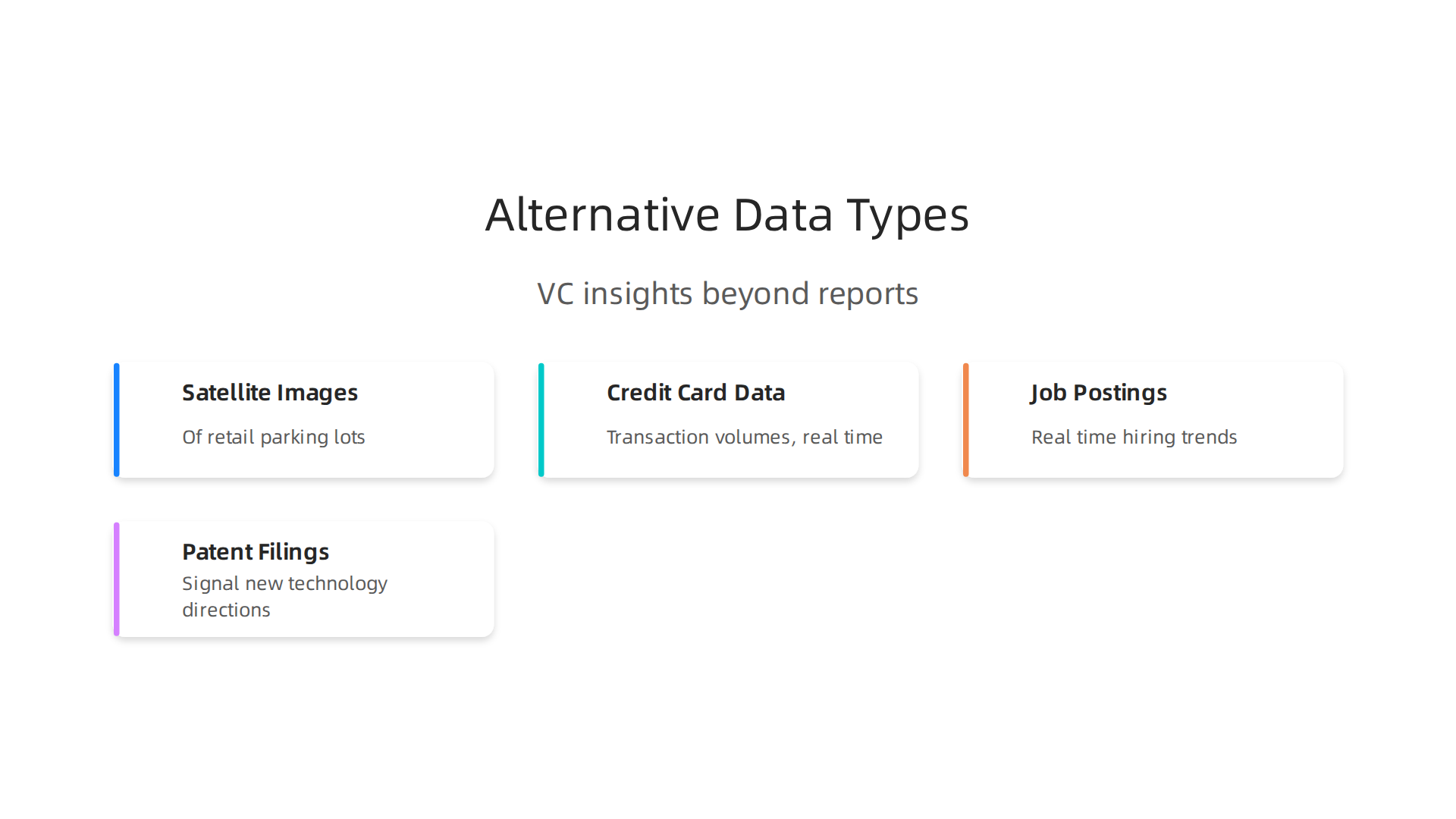
It includes satellite images of retail parking lots, credit card transaction volumes, real time job postings, and patent filings.
For a VC firm evaluating a startup project, these signals are pure gold. They can spot a stealth AI startup filing key patents or see a company doubling its engineering team before a funding round is even announced. This is why top firms are investing millions in proprietary data lakes. According to Neudata insights, investment managers spent roughly $2.8 billion on alternative data in 2025 alone. The edge gained from this kind of data analytics is simply too big to ignore.
But there is a catch. Using this data raises serious regulatory and ethical questions. Where do you draw the line on privacy? Firms that use these tools responsibly will stand out. If you want to compare the specific software tools used to analyze this data, check out our review of Originality AI vs Genspark AI. And to see which startups are winning the funding race right now, Browse Funding News.
How AI-Powered Analytics Reveal Untapped Market Opportunities
So how do you actually find a market gap before everyone else sees it? You don’t have to guess anymore.

AI powered analytics can now scan millions of data points to spot patterns that human eyes would miss. This is a game changer for any startup project that wants to move fast.
Think about all the noise out there. Customer reviews on Amazon, app store comments, social media complaints, competitor job postings, and patent filings. A single human can’t read through all of that. But an AI system can process it in minutes. According to research from AIMultiple, investors use these signals to monitor demographic trends and predict the profitability of a business venture before it even launches. That is a huge advantage.
Natural language processing, or NLP, is the key here. It reads text and understands the emotion behind it. When a thousand customers complain about the same problem in an app review, NLP flags that as a rising need. This is how stealth AI startups often get discovered. They might not be talking publicly yet, but their patent filings or job ads show up in the data. JP Morgan highlighted in their 2026 outlook that the next phase of AI is driving new opportunities in alternative investments. That includes using data analytics to find these hidden signals.
For a founder, this means you can validate a product idea with real evidence. Instead of asking friends what they think, you look at what the data says. Are people searching for a solution? Are competitors ignoring a specific problem? If the answers line up, you have a much stronger case to build your startup project around that idea. Tools like Carta now integrate AI to help connect these data workflows, making it easier for early stage teams to act on insights.
If you are launching a new product and relying on AI generated content, you need to make sure it stays original. Check out our detailed comparison of Originality AI vs Genspark AI to see which tool helps keep your work authentic.
The truth is, the startups that win are the ones that spot the opportunity first. AI analytics gives you that early look. To stay ahead of the curve, you need fresh intelligence every day. Subscribe Free to The Deep View Newsletter for clear daily AI updates that help you find the next big market opportunity.
Natural Language Processing for Sentiment Analysis
So NLP can find patterns in the data. But it can also read the emotion behind the words. That is where sentiment analysis comes in. Think about what happens on social media every day. People rant about products. They celebrate features. They beg for fixes. An NLP system can scan all of that and tell you if the mood around a topic is positive, negative, or neutral.
This is powerful for your startup project. You can run sentiment analysis on earnings calls from public companies, on news articles about your industry, and on Reddit threads where customers vent. If the sentiment shifts suddenly, that often signals a market change before the numbers show up in a spreadsheet. Hedge funds and VC firms already use this. They feed real time sentiment data into their models to make quick tactical moves.
The NLP market is exploding right now. Industry reports show it could grow from about $70 billion in 2026 to nearly $250 billion by 2031. That growth is happening because companies realize how much value sits inside unstructured text. One of the top use cases is analyzing sentiment in financial markets and customer feedback.
The trick for founders is to fine tune these models for your specific niche. General sentiment tools miss the slang and jargon that startups use. But a model trained on your domain can pick up on phrases that matter to your space. This is where data annotation tech becomes important. You label a set of comments from your industry so the model learns what a "real problem" sounds like versus just noise.
If you are ready to put this into practice, you need fresh intelligence every day. Get Free Updates from The Deep View Newsletter for simple daily AI insights that help you spot market shifts before your competitors.
Building Smarter Startup Projects with Predictive Modeling
You just learned how NLP reads the emotion behind the words around your startup project. That is powerful for understanding what is happening right now. But the real magic happens when you use that information to predict what comes next.
That is exactly what predictive modeling does for your startup project.
Think of it like a weather forecast for your business. Instead of guessing, you let the data do the talking. Predictive models look at early signals and calculate the odds. Will this startup project survive the first two years? What is its funding likelihood? How fast will it grow?
Recent research on large language models for business shows these AI systems are getting very accurate at finding the patterns that lead to success or failure. The best part? You can start using these techniques today.
What the Model Studies
A good predictive model looks at several key factors. Here is what matters most:
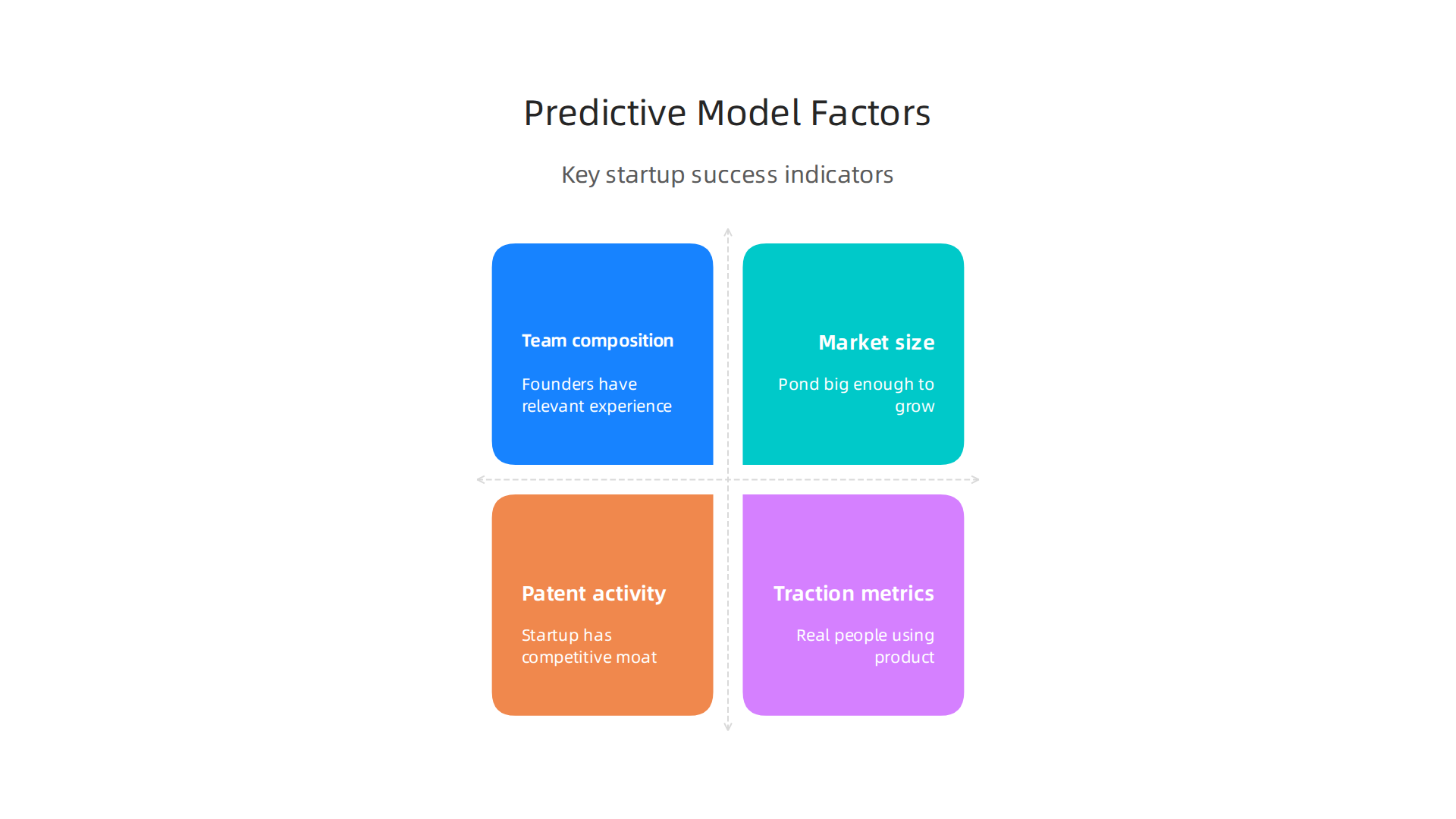
- Team composition. Have the founders done this before? Do they have relevant experience?
- Market size. Is the pond big enough to grow into?
- Patent activity. Does the startup project have a real competitive moat?
- Traction metrics. Are real people using the product?
This is where smart data analytics comes into play. You need to clean up your data so the model understands what matters. That is where data annotation tech helps you prepare your information. You teach the model what a strong founding team looks like or what real user growth feels like.
Keeping Your Model Fresh
Let me give you an ai overview of how this works in practice. Often, the best predictive models run in the background. You might call it stealth AI. It quietly monitors thousands of data points and alerts you when something changes.
But here is a word of caution. Models get old fast. A model built on 2021 data will fail you in 2026. Markets shift. Consumer behavior changes. You absolutely must update your model constantly. This avoids overfitting, which is when the model memorizes old data instead of really learning from it.
If you are choosing the tools to power your predictive engine, you need to make smart decisions. For example, understanding the differences between tools like Originality AI vs Genspark AI can help you build a more reliable tech stack for your startup project.
Your Next Move
Predictive modeling sounds complex, but you do not have to figure it all out alone. The smartest founders and investors use fresh intelligence every day to guide their next move.
Subscribe Free to The Deep View Newsletter for simple daily AI insights that help you spot the next big opportunity before everyone else catches on.
Or, if you want to see which sectors are heating up with new funding right now, Browse Funding News on Startup Funding News Today.
Streamlining Due Diligence: AI Tools for Investors
Predictive modeling gives you the forecast. But before you invest or make a move, you need to verify the details. That is where due diligence comes in. In 2026, investors have powerful AI tools that automate hours of manual work.
Traditionally, due diligence meant digging through piles of documents, checking references, and running financial models by hand. It took weeks and left room for human error. Now, AI due diligence tools can handle the heavy lifting.
According to a buyer’s guide from AlphaSense, the top due diligence platforms combine data from company documents, online presence, and third-party APIs into one clean dashboard. These tools automatically scan for red flags, verify financial statements, and validate market size.
What does that look like in practice? For background checks, AI tools scan public records, social media, and news feeds to vet founders and key team members. They flag any past legal issues, contradictory statements, or negative press in seconds. For financial analysis, they pull data from filings, invoices, and payment records to spot patterns or anomalies.
Market validation gets a boost too. A guide to the best AI market research tools for 2026 from Simular shows how AI can quickly size up a market using thousands of data points. Platforms like IBISWorld provide structured, human-verified industry data, so you can confirm your market assumptions without guesswork.
The best competitive intelligence tools for 2026, listed by Red Brick Labs, also help investors track rivals, analyze markets, and monitor trends in real time. When you combine all these capabilities, due diligence time can drop by up to 70% without sacrificing accuracy.

That gives you more time to focus on the people and the plan behind the startup project.
If you are deciding which AI tools to trust for your due diligence, comparing options like Originality AI vs Genspark AI can help you pick the right one for your startup project. The right toolset makes all the difference when you are moving fast.
Ready to stay ahead of the curve? Get Free Updates with The Deep View Newsletter for simple daily AI insights that sharpen your investment decisions.
Competitive Intelligence in Real-Time: Data Dashboards and Alerts
Picture this. You are tracking a promising startup project when suddenly a competitor launches a similar product. Before you can react, they have already captured market attention. In 2026, that delay costs you deals.
That is why real-time competitive intelligence matters. Instead of checking news sites every morning, you can use data dashboards that do the watching for you. These platforms pull in signals from hundreds of sources and show you exactly what matters.
Here is what a good dashboard tracks for your startup project:
- Competitor funding announcements as they happen
- New product launches and feature updates
- Hiring spikes in key roles like engineering or sales
- Patent filings that signal new technology directions
- Changes in pricing or marketing strategy
According to the best competitive intelligence tools for 2026 from Red Brick Labs, modern platforms give you a single view of all this data. No more jumping between Crunchbase, LinkedIn, and Google News.
The real power comes from AI alerts. You set the triggers, and the tool notifies you instantly. If a rival files a patent for stealth AI technology or announces a pivot into your market, you know within minutes. The guide from Parano.ai shows how continuous monitoring platforms can detect these critical events faster than any manual process.
Data analytics built into these dashboards also helps you benchmark your own startup project. You can compare your growth rate, team size, and funding against competitors. This gives you an honest picture of where you stand. The list of competitive intelligence companies from Improvado highlights how these tools help startups spot gaps and seize opportunities.
If you are deciding which intelligence platform fits your needs, comparing options like Originality AI vs Genspark AI can help you choose the right one for your workflow.
Here is the thing. Real-time intelligence does not just help you react. It helps you anticipate. When you see a competitor hiring for a new role or filing a patent in a related space, you can adjust your strategy before they make their move. That is the difference between leading the market and playing catch up.
Stay sharp without the noise. Subscribe Free to The Deep View Newsletter for daily AI insights that help you spot the next move first.
Overcoming Information Noise: Curated AI Feeds for Decision-Makers
Here is the problem with having too much information. Real time dashboards give you a flood of signals. But if you are tracking a startup project, that flood can quickly become overwhelming. Studies show that 73% of AI teams struggle with information overload, which actually kills innovation and slows down decision making. You end up reading dozens of alerts instead of acting on the few that matter.
That is where curated AI feeds come in. Instead of blasting you with every update, these systems use an ai overview of your preferences and past behavior to filter the noise. They learn which types of funding rounds, hiring spikes, or stealth ai moves actually matter to your startup project. Then they build a personalized digest that lands in your inbox or dashboard each morning.
The workflow is simple. You set your priorities, like "fintech" or "early stage data analytics startups." The curation engine scans thousands of sources, including funding news sites and investor announcements. It uses data annotation tech to tag and rank each signal by relevance. What you get is a short list of high impact events instead of a firehose of updates. One effective approach is to turn investor signals into a focused dashboard, as described in the 5 step workflow from Qubit Capital.
Trust matters here. Good curation tools let you peek behind the curtain. You can see why an item was flagged and adjust the filters if the ai overview misses something. This transparency makes you confident the algorithm is working for you, not against you.
For decision makers running a startup project, this means less time scanning and more time acting. You get the critical updates about competitors, funding, or market shifts without the noise. And when you need to compare which AI assistant fits your workflow best, a comparison like this one between different tools can guide your choice.
Stay focused on what matters for your growth. Get Free Updates with The Deep View Newsletter for clear daily AI insights that cut through the clutter.
Summary
This article explains how AI and modern data analytics are reshaping how founders and investors discover, evaluate, and act on startup opportunities in 2026. It covers the rise of alternative data sources (from job postings to patent filings), how NLP and sentiment analysis surface market needs, and how predictive models turn early signals into forecasts you can act on. The piece also describes AI-powered due diligence, real‑time competitive dashboards, and curated feeds that cut noise so teams can move faster with confidence. Throughout, the article emphasizes practical steps—cleaning and annotating data, updating models, and choosing appropriate tools—while flagging ethical and privacy concerns. Readers will learn how to apply these methods to validate ideas, monitor competitors, and make smarter investment or product decisions without getting overwhelmed.