
Mastering Data Ingestion for Startup Smart Decisions and Growth

It is 2026, and startups are growing faster than ever. To win, founders and investors need to make very smart choices. But here is the thing: many startups have a big problem. Their data is like puzzle pieces scattered all over the floor. It comes from many different places, in many different forms. This makes it really hard to see what’s truly happening in the market or with their customers.

It’s tough to find clear signals when your data is noisy and messy.
This is where data ingestion comes in. Think of data ingestion as the very first step in making sense of all that scattered information. It is the process of bringing data from all its different homes into one place where it can be cleaned and used. This includes getting data from many sources, whether it comes in big groups (called batch processing) or as a steady flow (called streaming) or in small, quick bursts (micro-batch processing)
. Without a good way to gather this data, companies can miss important clues about what to do next.
For any startup, good data ingestion is the basic building block for smart decisions. It helps founders and investors truly understand their business and market. It’s like building a strong foundation for a house. If the foundation is weak, the whole house struggles. If your data ingestion is weak, your startup intelligence will suffer, making it harder to attract important investments or lead the market.
This article will help you understand how to build that strong foundation. We will look at simple ways to collect data, what choices you need to make, and smart methods for setting up reliable data ingestion, even if you are a small startup. You will learn practical frameworks, common trade-offs, and engineering patterns that work for getting clean, useful, and crunchy data insights.
Want to stay ahead with the latest in AI and tech that affects startups and funding?
The AI Newsletter Worth Reading
When it comes to gathering all that important information, there isn’t just one way to do it. Different companies, especially startups, need different methods for data ingestion. The best choice depends on how fast you need to see new data, how much it will cost, and how hard it is to set up and keep running. Let’s look at the three main ways to bring data in: batch, micro-batch, and streaming.
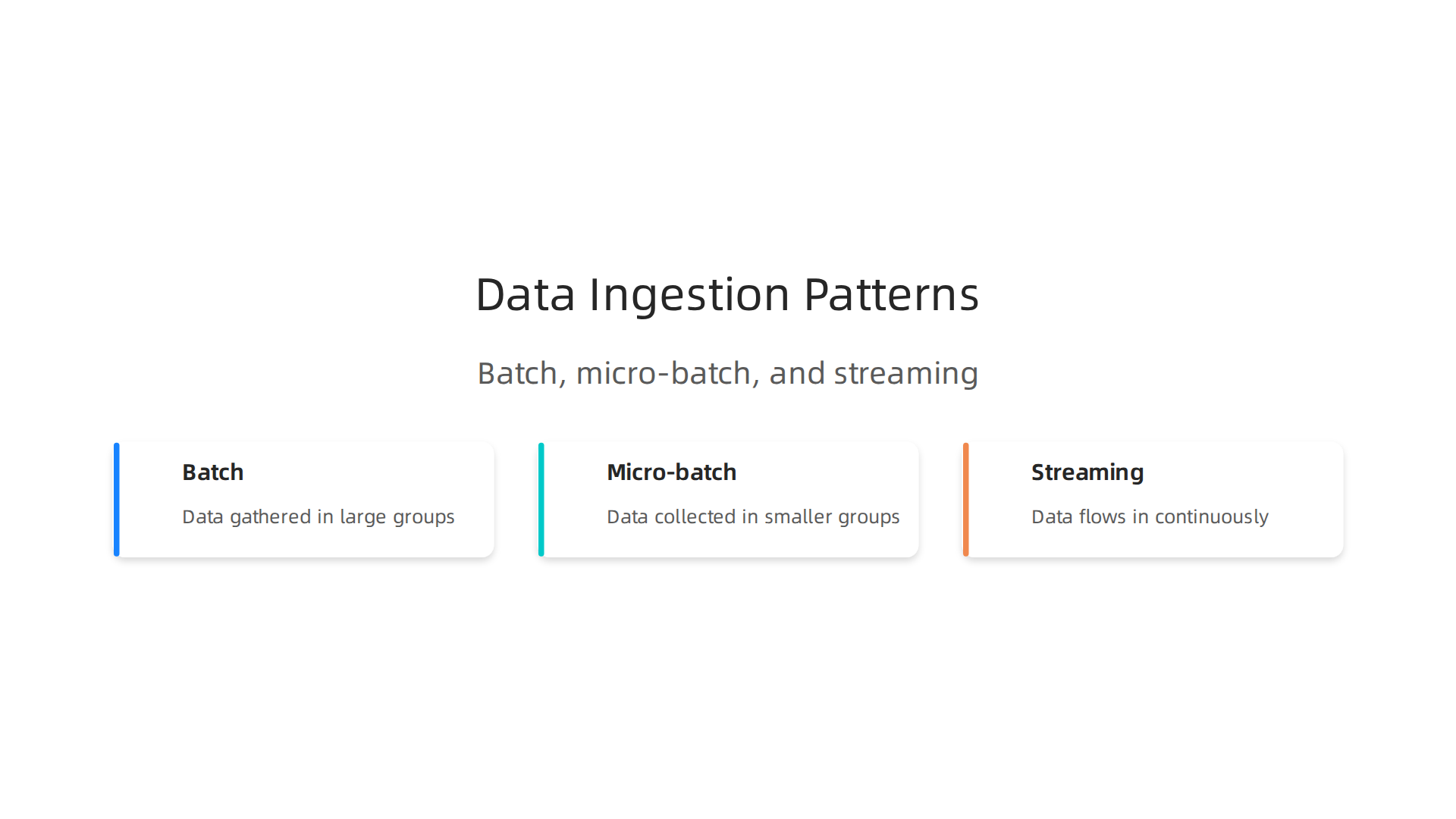
Core data ingestion patterns: batch, micro-batch, and streaming
These three patterns are like different speeds for moving data, from slow and steady to super fast. Each has its own sweet spot for what kind of information you are trying to gather and use.
Batch Processing
Imagine you collect all your mail for the whole week and then open it all at once on Sunday. That’s a bit like batch processing. With this method, data is gathered in large groups over a set time, like once a day or once a week. Then, all of it is moved and processed together.
- Where it fits: This is great for data that doesn’t need to be updated constantly. Think about monthly sales reports, yearly budget numbers, or old historical data. For many businesses, batch processing has been a core method for a long time, especially for general analytics that can handle data that isn’t instantly fresh. It’s often used when getting data from many different sources, or when you don’t need real-time updates to make good decisions, as noted in documents about AI-ready data architecture and AWS Cloud Data Ingestion Patterns and Practices.
- Cost and complexity: It’s usually the simplest and cheapest way to do data ingestion. You don’t need fancy tools that are always running.
- Trade-offs: The biggest downside is latency. This means new information isn’t available right away. You might only see data from yesterday or last week.
Micro-Batch Processing
Micro-batch processing is a middle ground between batch and streaming. Instead of waiting a whole day, data is collected in much smaller groups, usually every few minutes. Think of checking your mail a few times a day instead of just once a week.
- Where it fits: This method is good when you need data that is fairly fresh, but not every single second. For example, if you want to see how your website is doing every 15 minutes, or track inventory levels every hour. It offers a hybrid approach, combining the dependability of batch processing with close to real-time data access. Research shows that micro-batch systems can handle large amounts of data quickly, with short delays, making for some truly crunchy data.
- Cost and complexity: It’s more complex than simple batch processing, but less so than streaming. It needs tools that can handle data more often.
- Trade-offs: You get data much faster than with batch, but there’s still a small delay, like a few minutes. It’s not truly instant.
Streaming Processing
Streaming is like getting your messages as soon as someone sends them. Data flows in continuously, often just seconds after it’s created.
- Where it fits: This is for times when you need information right now, without any delay. Examples include stopping fraud as it happens, monitoring live sensor data from devices, or updating a stock ticker instantly. According to some sources, streaming data ingestion is crucial for getting real-time updates from sources like IoT devices or website logs.
- Cost and complexity: This is the most complex and often the most expensive data ingestion method. It needs powerful systems that are always on and ready to process data as it comes in.
- Trade-offs: You get the freshest data possible, but it costs more and is harder to set up and manage.
Choosing the right data ingestion pattern for your startup means looking closely at what you need. Do you need data to be super fresh, or is a daily update enough? How much can you spend, and how much technical skill do you have on your team? Understanding these choices helps you build your modern data pipeline for startup success and make smart decisions.
Want to stay ahead with the latest in AI and tech that affects startups and funding? The AI Newsletter Worth Reading
Once you choose how quickly your data moves, from slow batch to super-fast streaming, you also need to make sure that data stays good and doesn’t break. This means designing reliable data ingestion pipelines. It’s like making sure your water pipes don’t leak and the water stays clean.
Here are some important ideas for making your data pipelines reliable:
Idempotent Writes and Deduplication
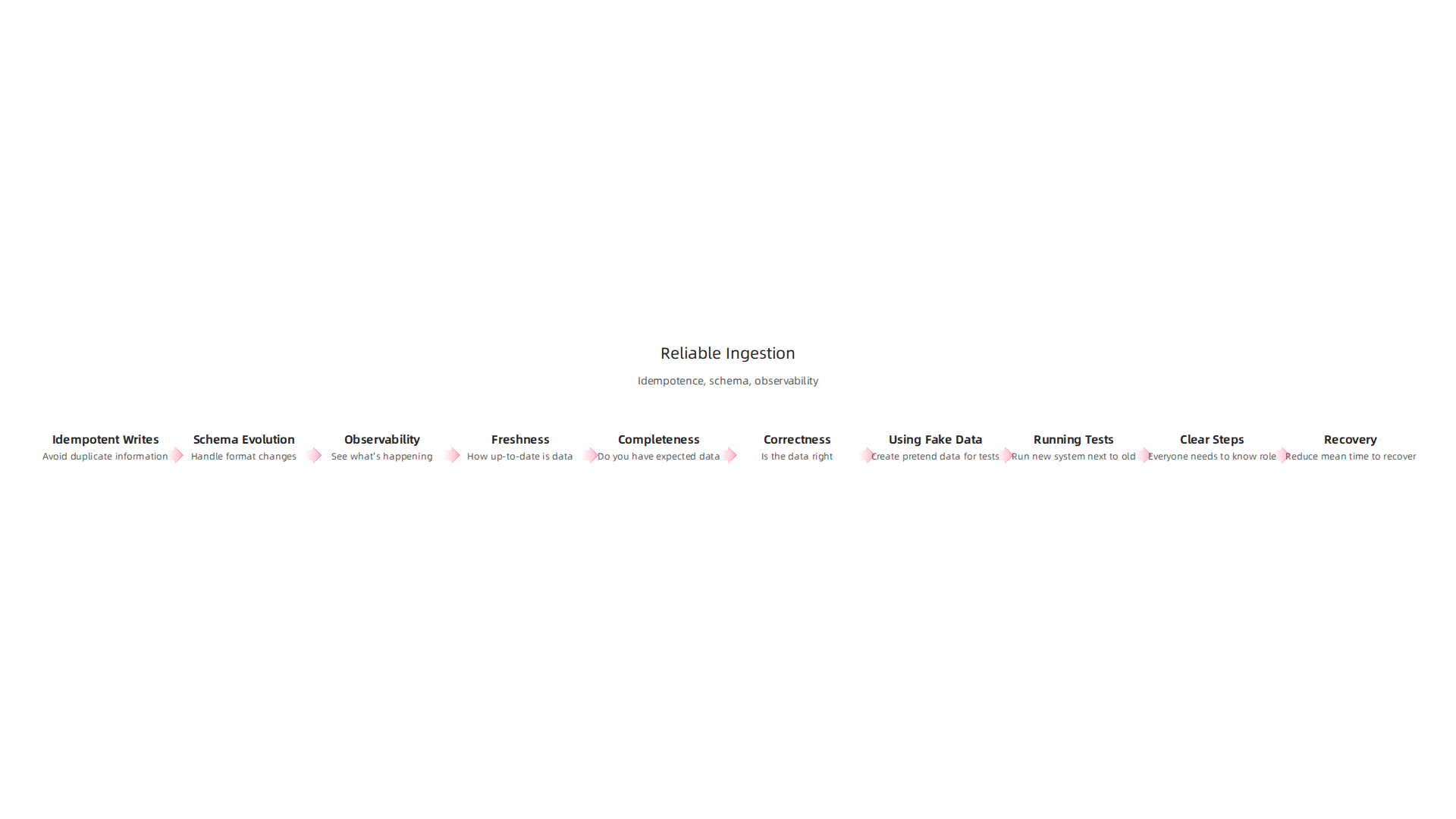
Imagine you click a button to buy something online. You only want to be charged once, even if you accidentally click the button twice. This idea is called "idempotence" in data. It means that if the same piece of data tries to enter your system more than once, it only gets counted or stored one time. This is super important to avoid having duplicate information, which can make your reports wrong. Good data ingestion systems automatically stop duplicates, making sure each piece of data is unique.
Schema Evolution
Data doesn’t always stay in the same "shape" or format. Think of a form you fill out. One year it might ask for your name and address. The next year, it might add a new box for your email. This change in format is called "schema evolution." Your data ingestion pipeline needs to be smart enough to handle these changes. It should know how to deal with old data that looks one way and new data that looks another, without losing any important information. This helps your data systems grow and change over time, as explained in studies on data ingestion patterns in big data systems.
Observability
Observability is about being able to see what’s happening inside your data pipeline. It’s like having a dashboard for your car that shows you how fast you’re going, how much gas you have, and if anything is wrong. For data, this means you can watch to see if data is flowing correctly, if there are any errors, or if the "shape" of your data has changed without you knowing. Being able to see these signals helps you find and fix problems quickly. This keeps your data clean and correct, which is key for making smart business choices. When you can track everything, it fuels your startup’s growth and helps you attract investors with good data dashboards.
Making your data ingestion pipelines reliable means building them with these ideas in mind. It ensures your startup always has good, trustworthy data to work with.
Get clear daily AI updates from The Deep View Newsletter. The AI Newsletter Worth Reading
Choosing tools and frameworks for your data ingestion is like picking the right vehicles for a delivery service.

You can either build your own trucks (open-source) or rent a fleet that someone else takes care of (managed services). Both ways have good points and bad points. Your startup needs to pick what works best for its goals.
Open-Source vs. Managed Services
Open-source tools are free to use. You download the software and set it up on your own computers or cloud space. Think of it as getting all the parts to build a cool robot. It can be cheap upfront, and you have full control over how it works. But you also need people on your team who know how to build, run, and fix that robot if something goes wrong. This might mean more work for your team and more things to keep an eye on. Studies show that making data ingestion work well in cloud systems needs careful design choices Enhancing Data Ingestion Efficiency in Cloud-Based Systems.
Managed services, on the other hand, are like subscribing to a service where someone else handles the robots for you. You pay a fee, and a company makes sure the data ingestion tools are always working, updated, and secure. This means less work for your team, so they can focus on using the data, not fixing the tools. It can be faster to get started, but the ongoing cost might be higher. These services often include ways to handle a lot of data, as seen in talks about Architecting Data Pipelines for Scalable and Resilient Data.
How to Choose What’s Right for You
To pick the best option, think about these key things:
- How fast do you need to get going? (Speed-to-market): If you need to start collecting data right away, managed services can be quicker because they’re already set up. Building your own open-source system takes more time.
- How much work can your team handle? (Operational burden): If your team is small or doesn’t have a lot of experts in data systems, a managed service can take a load off their shoulders. With open-source, your team does all the heavy lifting.
- What are your costs? Building and running open-source can seem cheaper at first. But don’t forget the cost of your team’s time for setting it up, fixing problems, and keeping it running. Managed services have clear monthly fees, which can sometimes be more expensive but also more predictable.
Practical Signals for Your Decision
Here are some real-world signs to help you choose:
- Your team’s skills: If your team has expert "data goonies" who love to build and fine-tune systems, open-source might be a great fit. If your team is newer to data engineering, managed services offer an easier start.
- How much data you expect: If you’re going to have huge amounts of "crunchy data" coming in all the time, like millions of messages per second, you’ll need a very strong system. Both open-source and managed solutions can handle big data, but the path to getting there will look different. For example, some architectures combine different tools for real-time data ingestion, as explored in studies on A Hybrid Architecture for Real-Time Data Ingestion and ….
- Rules for your data: If you have to follow strict rules about how you handle data (like privacy laws), you might need more control. Open-source can give you that control, but you’re also fully responsible for making sure you follow all the rules. Managed services often come with built-in ways to meet many common rules.
Choosing the right tools for your data ingestion is a big step. It affects how smoothly your business runs and how well you can use your data to grow. To learn more about selecting the right technological components, check out our guide on how to choose and implement enterprise tech solutions and hardware in 2026.
After choosing the right tools for your data ingestion, the next big step is to make sure your system can handle more data as your startup grows. This is called scaling. Think of it like building a road for your delivery service. You don’t just need trucks; you also need a road that can handle many trucks at once, without traffic jams, and enough space to store deliveries.
Planning for More Data: Partitioning and Storage
To handle a lot of data, we use smart tricks like "partitioning" and "storage strategies."
- Partitioning Keys: Imagine you have a giant stack of mail. Instead of one big pile, you sort it into smaller bins based on something like the zip code. That’s partitioning. For data, a "partition key" is the rule you use to divide your data into smaller, easier-to-manage parts. For example, you might sort data by the day it came in, or by which customer it belongs to. This makes it faster to find and process specific data later. Studies show that having good support for data stream partitioning is key for effective ingestion and storage systems Towards a Unified Ingestion-and-Storage Architecture for Stream ….
- Partition Sizing: This is about how much data goes into each bin. If your bins are too small, you’ll have too many of them, which can be hard to manage. If they’re too big, it defeats the purpose of splitting the data up. Finding the right size helps your system work smoothly.
- Retention Policies: This simply means deciding how long you need to keep your data. Do you need to keep everything forever, or can you delete older data after a week, a month, or a year? Setting clear rules helps you save storage space and manage costs.
If you are looking to build out your data systems, understanding how to design them is crucial. Learn more by checking out our guide on how to build your modern data pipeline for startup success.
Handling Backpressure and Slow Consumers
Sometimes, data comes into your system faster than it can be processed or used. This is like a hose with too much water pressure. If the water can’t flow out fast enough, the hose might burst. In data systems, we call this "backpressure."
To prevent data loss when backpressure happens:
- Buffering Data: Your system needs a place to hold onto data temporarily when things get busy. Think of it as a waiting room for data. This way, if a part of your system slows down, the incoming data can wait safely until it’s ready to be handled. Good systems have ways to buffer data and even replay it if there’s a problem Storage and Ingestion Systems in Support of Stream Processing: A Survey.
- Downstream Slow Consumers: This refers to the parts of your data system that use the data after it’s been collected. If these "consumers" are slow, they can cause backpressure. Your ingestion system needs to know how to deal with these slowdowns. It might send data in smaller chunks or pause the flow until the slow part catches up. Systems often include features like backpressure support to regulate data flow Big data stream processing. The goal is always to avoid losing any of your valuable data.
Staying up to date on these kinds of technical strategies and broader AI trends can give your startup a real edge.
The Deep View Newsletter offers clear, daily AI updates. You can get yours by signing up for The AI Newsletter Worth Reading.
After building a strong system for your own company’s data, the next important step for startups is to look outside. You need to bring in information from other places to get a full picture. This is called integrating "third-party signals."

Think of it like a smart detective who not only watches what’s happening inside their own office but also checks news from around town, listens to what people are saying, and looks at bigger trends.
Integrating Third-Party Signals: Funding Data, News Feeds, and Social Signals
Collecting outside information means gathering things like:
- Funding Data: Details about other companies getting money, which can show you where investors are putting their trust.
- News Feeds: Important news and articles that might affect your business or your market.
- Social Signals: What people are saying on social media about your industry, your products, or even your competitors.
Bringing in these different kinds of information reliably and legally is crucial for smart decisions. When you deal with data from outside sources, you must make sure you’re following all the rules about data privacy and how you can use the information. Being careful here helps avoid problems down the road. Some companies even use advanced methods to ensure their AI-driven data governance meets these compliance needs, as noted in recent studies AI-Driven Data Governance: Ensuring Compliance in Big Data ….
Making Data Ready for Use
Once you bring in this outside data, it often comes in many different forms. This is where "normalization" and "enrichment" come in.
- Normalization: This means making all the data look the same. If one news feed lists dates as "MM-DD-YYYY" and another uses "YYYY/MM/DD", you need to change them all to one format. This makes it easier for your systems to understand and use the data. This step is key for any good data ingestion process.
- Enrichment: This is like adding extra helpful notes to your data. You might combine funding news with social media buzz about the same company to get a richer story. Or, you could add market information to a news article to give it more context. The goal is to make these signals "analyst-ready" and "investor-ready," so people can quickly understand what’s important. To stay ahead, learn more about mastering AI and data business strategy for 2026 growth.
To make sure your data is truly useful for investors, it needs to be fresh, complete, and accurate. Freshness means the data is up-to-date. Completeness means you have all the pieces of information you expect. Accuracy means the data is correct. These three things are often measured using what are called Service Level Objectives, or SLOs, to keep data quality high Data SLOs: Freshness & Accuracy SLIs Guide. Many tools exist in 2026 to help with efficient data ingestion and processing, making it easier to manage all these sources The Best Data Ingestion Tools in 2026.
Staying informed about reliable news sources is also a big part of this. To avoid bad information, it’s smart to know how to identify trustworthy tech news for founders and investors. Having clear data dashboards can also help your startup grow and attract investors by showing off your insights.
Understanding how to gather, clean, and use external data is vital for any startup looking to make smart moves and attract investors in 2026.
Get clear daily AI updates from The Deep View Newsletter. You can get yours by signing up for The AI Newsletter Worth Reading.
When you deal with outside data, simply bringing it in isn’t enough. You also need to keep a close eye on its quality and how much it costs to manage. This is where Service Level Objectives (SLOs) and cost modeling become very important for your data ingestion pipelines.
Setting Service Level Objectives (SLOs) for Data Quality
SLOs are like clear promises you make about your data. They set specific goals for how good your data should be. For data ingestion, the most important SLOs focus on three key things:
- Freshness: How up-to-date is your data?
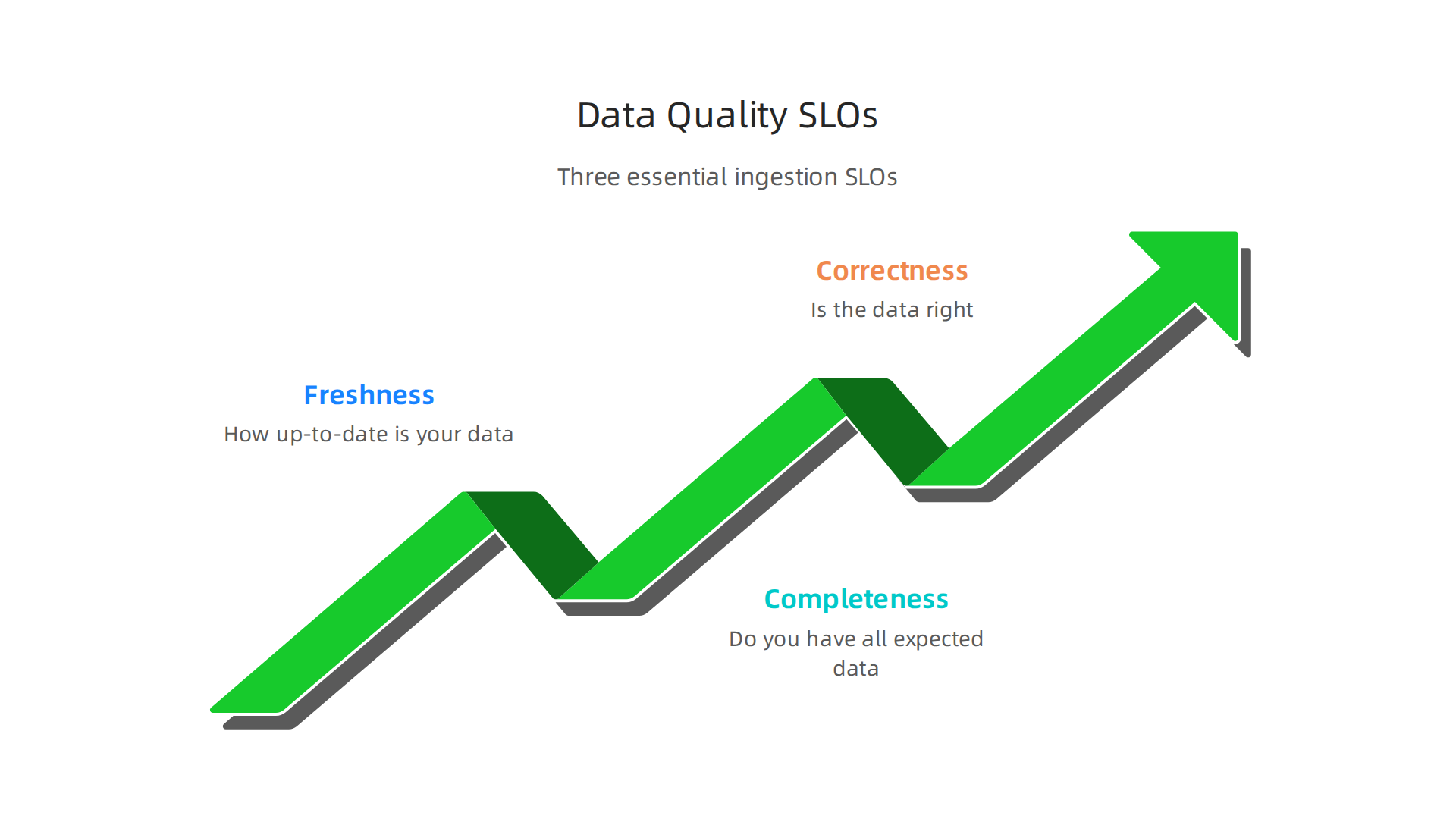
For example, an SLO for freshness might be "all sales data must be updated within 15 minutes of a sale." This means the data should not be old. Keeping data fresh helps ensure your decisions are based on the latest facts, which is crucial for quick business moves, as seen in systems designed for real-time deployments that use SLO-aware policies A Blueprint for Real-Time, Enterprise-Ready Deployments. You can even set specific freshness goals, like ensuring data age stays below a certain limit for a high percentage of the time How to Build Freshness SLOs.
- Completeness: Do you have all the data you expect? If a customer’s profile should have a name, email, and phone number, an SLO for completeness might say "99% of new customer profiles must have all three fields filled." This prevents missing pieces that could make your data less useful. This is about making sure that the expected number of data points actually show up when they should How to Measure Industrial Data Quality: SLOs for Latency, ….
- Correctness (or Accuracy): Is the data right? For instance, an SLO could be "less than 0.5% of critical fields can have wrong values." This makes sure your data is trustworthy. When you plan your data flow, it is smart to start with clear SLOs for freshness, completeness, and accuracy Best Practices for Syncing Snowflake & BigQuery to Product Analytics.
Setting these SLOs helps you know when your data ingestion process is working well and when it needs fixing. It also helps manage expectations for anyone using the data. To ensure your systems meet these goals, you might want to learn how to build your modern data pipeline for startup success.
Estimating and Optimizing Ingestion Costs
Running data ingestion pipelines costs money. You need to think about two main types of costs:
- Infrastructure Costs: This is the money you spend on the computer parts and tools that bring in and store your data. This includes servers, storage space, and the networks that move the data around. Many companies charge based on the amount of data processed. In 2026, processing data at the ingestion stage often costs between $25 and $75 per gigabyte (GB) for many companies Cybersecurity Concerns at Japan Airlines Highlight Wider …. Sometimes, these costs can be higher depending on how much processing happens at this first step Confidence cools, commitment holds: full results from the …. To save money, you might look for ways to store data more efficiently or use systems that only run when needed.
- Operational Costs: This is the money you spend on the people and processes needed to keep your data pipelines running smoothly. This includes paying data engineers to build and fix pipelines, monitoring systems to check data quality, and any special software licenses.
To optimize these costs, startups should first look at how much data they are truly bringing in. Are you collecting data you don’t actually use? Reducing unnecessary data ingestion can save a lot of money. Also, choosing efficient data ingestion tools can make a big difference. For instance, open-source tools like Apache Kafka are widely used for managing high-volume data streams, which can be cost-effective for heavy-duty needs Best 8 Data Ingestion Tools in 2026. Investing in good automation can reduce the need for constant human oversight, which also lowers operational costs. When choosing technology solutions, consider how to choose and implement enterprise tech solutions and hardware in 2026 to manage your budget wisely. By carefully tracking both your SLOs and your spending, you can make sure your data operations are both effective and affordable.
Keeping your data operations effective and affordable is a big win. But what happens when things go wrong? And how do you make sure your data pipelines are always working correctly? This is where an operational playbook comes in handy. It covers testing, how to react to problems, and how different teams work together.
Operational Playbook: Testing, Incident Response, and Handoffs Between Engineering and Research Teams
To make sure your data ingestion is top-notch, you need clear steps for testing, fixing issues, and making sure everyone on the team knows their part.
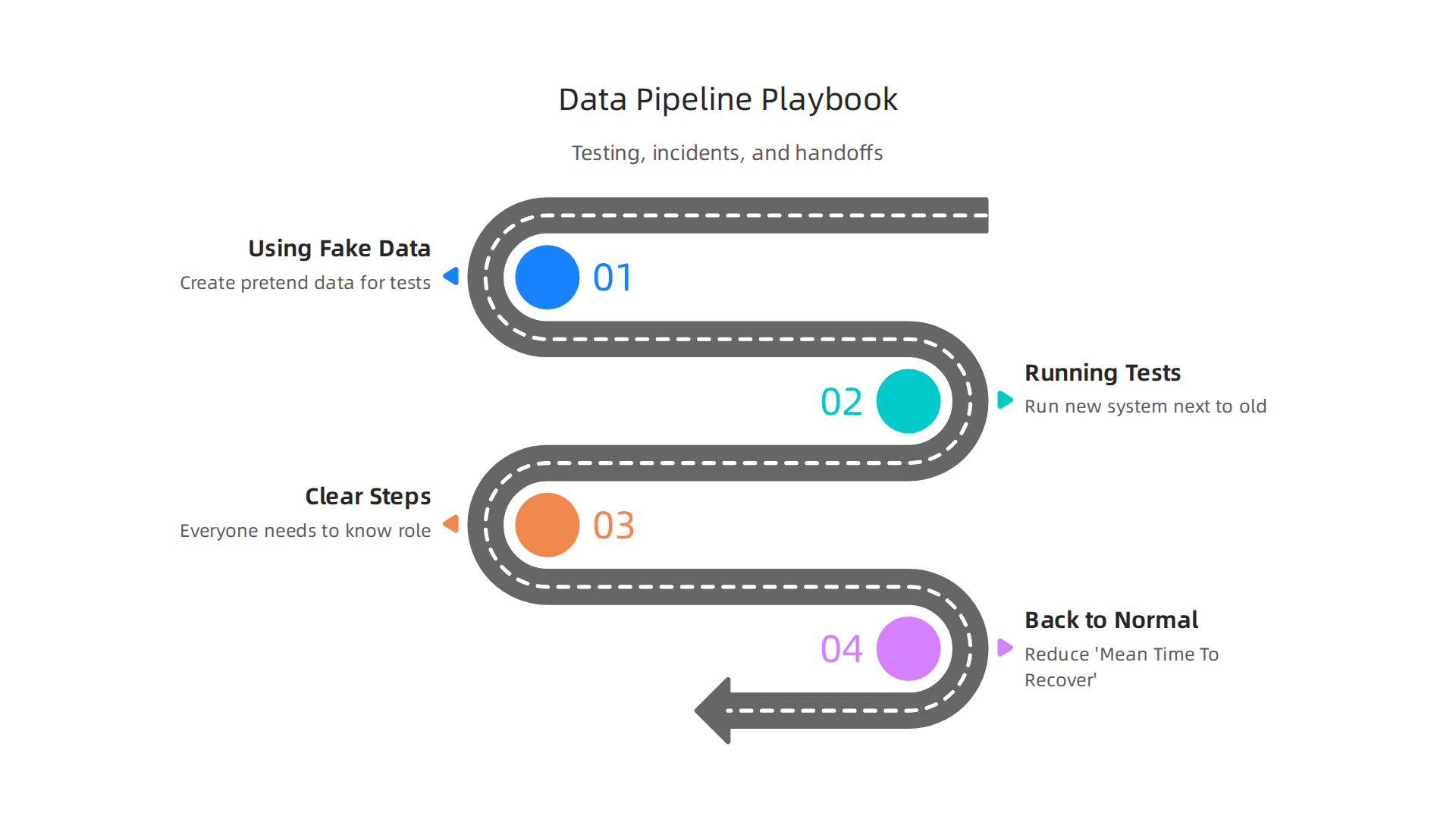
Smart Ways to Test Your Data Pipelines
Before new data rules or pipelines go live, you must test them. This helps find problems early. Two smart ways to test include:
- Using Fake Data (Synthetic Data): You can create "pretend" data that acts just like real data but doesn’t actually come from your customers. This lets you test your data ingestion system with lots of different situations without risking real information. For example, you can make fake data to see if your system can find strange patterns or problems as data streams in fast Anomaly detection using streaming analytics & AI. This helps you test the limits of your system.
- Running Tests in Secret (Shadow Runs): This means you run your new data system right next to your old one. Both systems get the same real data, but only the old system’s results are used. You then compare the results from the new system with the old one. If they match, you know the new system works well. If they don’t, you can fix the new system before anyone relies on it.
Good testing practices like these make sure your data pipelines are strong and ready for anything.
What to Do When Data Problems Happen (Incident Response)
Even with the best tests, problems can pop up. This is where a clear plan for what to do next is super important. This plan is called incident response.
- Clear Steps for Fixing Things: When a problem with data ingestion happens, everyone needs to know their role. The engineering team might fix the broken code, while the data operations team checks if data is flowing correctly. The analytics team might look at the data to see how bad the problem is. Having a playbook for these moments, like those used for cybersecurity alerts, means you can act fast GitHub – mmmalfares/SuperPlaybooks.
- Knowing Who Owns What: Each team needs to know what parts of the data pipeline they are responsible for. This stops confusion and helps fix issues faster. For example, the engineering team might own the tools that bring data in, while the research team owns how that data is used later.
- Getting Back to Normal Quickly: A key goal is to reduce the "Mean Time To Recover" (MTTR). This means how long it takes from the moment you spot a problem to when everything is working perfectly again. The faster you can recover, the less impact a problem has on your business AI Incident Metrics: MTTR / MTTD Framework Agentic 2026.
Working Together: Handoffs Between Teams
Making sure your data ingestion works well is a team effort. The engineering team builds and maintains the tools that bring in the data.

The research team (sometimes called "data goonies" because they love digging into data) often uses this data to find new insights and make decisions.
There must be smooth "handoffs" between these teams. This means:
- Sharing What’s Known: Engineering should tell research about any changes to data, new data types, or known issues.
- Getting Feedback: Research should tell engineering if the data is not good enough or if they need new types of data.
- Shared Goals: Both teams should work together to make sure the data helps the company grow. This shared understanding is important for any good data business strategy for 2026 growth.
By following a clear playbook for testing, handling problems, and working as a team, you can keep your data flowing smoothly and reliably.
Staying updated on all the latest developments in AI and data can be tough, but it’s key for success. If you want clear daily insights, consider signing up.
The AI Newsletter Worth Reading
Summary
This article explains why data ingestion is the foundational step for startups that want clear, actionable intelligence and investor-ready insights. It walks through the three core ingestion patterns—batch, micro-batch, and streaming—explaining when each fits, their cost and complexity trade-offs, and practical latency expectations. The guide then covers how to make pipelines reliable (idempotent writes, deduplication, schema evolution, and observability), how to scale storage with partitioning and retention rules, and how to handle backpressure and slow consumers. You’ll get a framework for choosing between open-source and managed tools based on team skill, speed-to-market, and cost, plus concrete guidance on SLOs for freshness, completeness, and correctness and ways to estimate ingestion costs. Finally, it lays out an operational playbook for testing (synthetic data and shadow runs), incident response, and smooth handoffs between engineering and research so your data stays trustworthy as you grow.